

























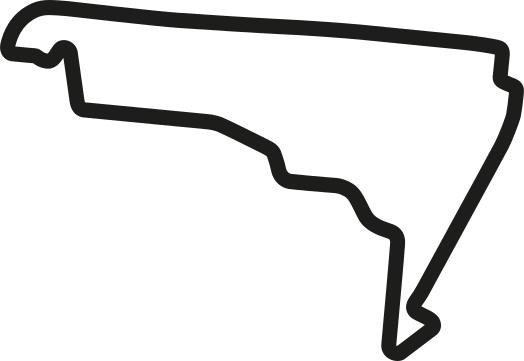







Set in Jaypee Sports City in Greater Noida, Uttar Pradesh, the Buddh International Circuit is India’s flagship purpose-built Grand Prix venue.
Designed by Hermann Tilke and inaugurated in October 2011, the circuit was created to bring Formula One to India for the first time. Unlike temporary street venues, Buddh is a modern, FIA Grade 1 facility with a flowing, high-speed character, meaningful elevation change, and one of the longest main straights in Grand Prix racing — a combination that quickly earned praise from drivers for its “classic circuit” feel.
While the Indian Grand Prix only ran three times (2011–2013), the venue has remained active with national racing, track days, and a return to top-level international competition via MotoGP in 2023. In recent years, plans and proposals have repeatedly surfaced around future upgrades, redevelopment and the possibility of bringing global motorsport back on a longer-term basis.
See also…
Buddh International Circuit
| First Grand Prix | 2011 Indian Grand Prix |
| Number of Laps | 60 |
| Circuit Length | 5.125 km |
| Race Distance | 307.500 km |
| Lap Record | 1:27.249 Sebastian Vettel (2011) |
Circuit
When was the Buddh International Circuit built?
The Buddh International Circuit opened on 18 October 2011, built by the Jaypee Group at an estimated cost of US$240 million. The venue sits within the wider Jaypee Greens Sports City development and takes its name from Gautam Buddh Nagar, the district in which it’s located.
Construction began after a tentative agreement to host a Formula One race was reached in 2007, though land procurement and financial pressures delayed progress. The circuit design was revealed in late 2009, and while the track was initially intended to debut in 2010, the first major event arrived a year later.
From the start, Buddh was engineered to be a modern, high-capacity arena (around 110,000) with contemporary safety standards, wide run-off areas, and a surface specification aimed at consistent grip and durability.
What makes the Buddh International Circuit unique?
Buddh’s layout blends long straights with technical, high-load sequences:
- 1.06 km main straight with a prime overtaking zone into the heavy braking at the end of the straight.
- Noticeable elevation change, including a significant rise through the early corners, that gives the lap a roller-coaster rhythm rarely seen at newer venues.
- A signature banked, multi-apex section (often highlighted as the circuit’s defining “commitment” sequence) that generates sustained tyre load and showcases car balance.
- An unusually long pit lane (over 600 metres), making pit strategy and time-loss a key part of race planning.
The end result is a circuit that many drivers rated highly for flow and difficulty — fast where it needs to be, but with enough technical corners to punish mistakes.
When was the first Indian Grand Prix?
The first Indian Grand Prix was held on 30 October 2011. The event was originally planned for December, but was moved due to scheduling changes elsewhere on the calendar.
Sebastian Vettel won the inaugural race from pole position and set the lap record that still stands for the F1-era layout. Vettel then repeated the feat in 2012 and 2013, with the 2013 edition also marking the race where he sealed a fourth consecutive Drivers’ Championship as Red Bull claimed another Constructors’ title.
Despite a strong on-track product, the Grand Prix was suspended for 2014 and later cancelled, with a long-running dispute over taxes and the event’s classification (sport vs entertainment) creating major financial and contractual complications for the organisers.
Buddh International Circuit lap record
The official Formula One race lap record for the Grand Prix circuit is 1:27.249, set by Sebastian Vettel in the Red Bull RB7 during the 2011 Indian Grand Prix.
Although Formula One has not returned since 2013, the circuit has continued to host domestic racing and international motorcycle competition — including the Indian Motorcycle Grand Prix in 2023 — with ongoing talk of redevelopment and future top-tier returns.