



















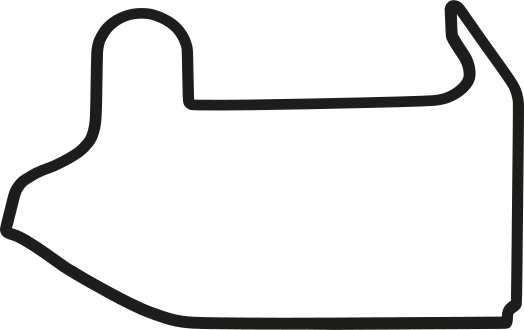




Located behind the famous Caesars Palace resort on the Las Vegas Strip, the Caesars Palace Circuit was one of Formula One’s most unusual venues.
Built entirely within the hotel’s vast parking lot, the temporary circuit hosted the Caesars Palace Grand Prix during the early 1980s. Unlike glamorous street races that weave through city landmarks, this track was a purpose-built layout assembled on flat asphalt, surrounded by concrete barriers, sand run-off areas and grandstands.
The circuit’s wide layout allowed overtaking opportunities and featured an extremely smooth surface. However, its repetitive design and lack of elevation changes drew criticism from drivers and fans alike. Despite this, the track played host to a dramatic moment in F1 history when Nelson Piquet secured his first World Championship at the inaugural event in 1981.
See also…
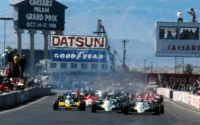
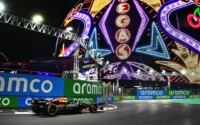
Caesars Palace Circuit
| First Grand Prix | 1981 Caesars Palace Grand Prix |
| Number of Laps | 75 |
| Circuit Length | 3.650 km |
| Race Distance | 273.750 km |
| Lap Record | 1:19.639 Michele Alboreto (1982) |
Circuit
When was the Caesars Palace Circuit built?
The Caesars Palace Circuit was constructed in 1981 in the parking lot behind the Caesars Palace hotel and casino in Las Vegas, Nevada. Developed as a temporary venue specifically for international motorsport events, the track was part of Formula One’s attempt to strengthen its presence in the United States during the early 1980s.
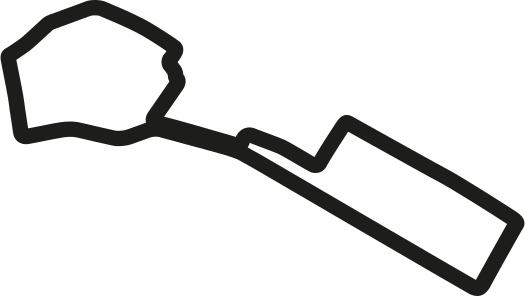
The circuit featured a 14-turn layout measuring 3.650 km (2.268 miles) and ran in a counter-clockwise direction — a rare characteristic in Formula One at the time. This orientation placed significant strain on drivers’ necks due to the high number of left-hand corners.
Despite being built on a parking lot, the track itself was wide and featured large sand-filled run-off areas, making it relatively safe by the standards of the era. Its extremely smooth asphalt surface also provided strong grip levels.
However, the venue struggled to capture the excitement and atmosphere associated with other street circuits. The flat layout, limited scenery and lack of elevation changes led many drivers to criticise the track, and it has since been described as one of the least popular circuits in Formula One history.
When was the first Caesars Palace Grand Prix?
The first Caesars Palace Grand Prix was held in 1981 as the final round of that year’s Formula One World Championship.
Originally, the race was intended to follow the United States Grand Prix at Watkins Glen as part of the 1980 season finale. However, when Watkins Glen dropped off the calendar, organisers pushed forward with the Las Vegas event for 1981.
The race would become famous for the dramatic conclusion of the championship battle between Nelson Piquet and Carlos Reutemann. Piquet finished fifth in exhausting desert heat to secure his first Formula One world title. After crossing the finish line, the Brazilian driver was so physically drained that he collapsed in his car and required medical attention.
Formula One returned in 1982 for a second edition of the race. That event was won by Michele Alboreto driving for Tyrrell, but poor attendance and financial losses meant Formula One never returned to the circuit.
Following Formula One’s departure, the venue hosted races for the CART IndyCar Series in 1983 and 1984. The track layout was significantly modified into a shorter, distorted oval configuration measuring 1.811 km (1.125 miles).
After the 1984 event, the circuit disappeared entirely as the site was redeveloped as part of the expanding Las Vegas Strip.
See also…
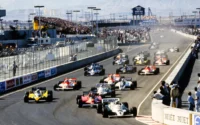
Caesars Palace Circuit lap record
The official Formula One lap record for the Caesars Palace Grand Prix circuit is 1:19.639, set by Michele Alboreto driving the Tyrrell 011 during the 1982 Caesars Palace Grand Prix.
Although the circuit existed for only a brief period, it remains a memorable — if controversial — chapter in Formula One’s history, symbolising the sport’s early attempts to establish a foothold in the American entertainment capital of Las Vegas.