
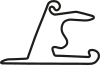

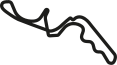


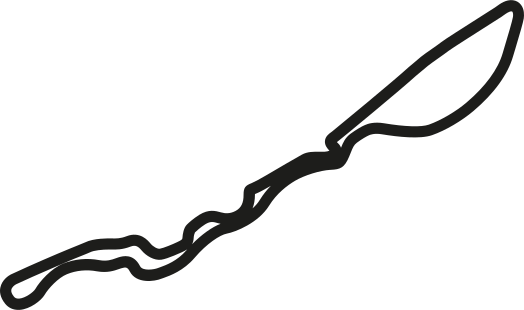



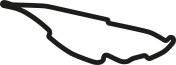








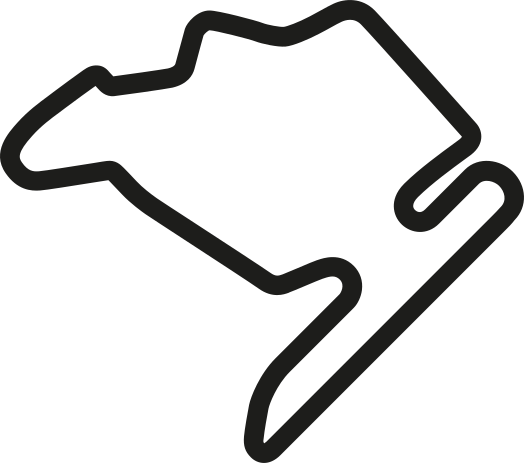










Located just north of Madrid in San Sebastián de los Reyes, the Circuito de Madrid Jarama is one of Spain’s most historically important permanent racing circuits. For over a decade, it served as the primary home of the Spanish Grand Prix, hosting Formula One during the late 1960s, 1970s and early 1980s.
Designed by one of the most influential circuit architects in motorsport history, Jarama became known for its tight, technical layout that placed a premium on precision rather than outright speed.
See also…
Circuito del Jarama
| First Grand Prix | 1968 Spanish Grand Prix |
| Number of Laps | 80 |
| Circuit Length | 3.314 km (2.059 mi) |
| Race Distance | 272.320 km (169.200 miles) |
| Lap Record | 1:15.467 Alan Jones (1980) |
Circuit
When was the Jarama Circuit built?
Construction of the circuit began in 1966, and it officially opened on 1 July 1967.
The track was designed by Dutch engineer John Hugenholtz, who also designed several famous circuits including Suzuka and Zandvoort. The venue was built on dry scrubland about 32 km north of Madrid and quickly became Spain’s main permanent motorsport facility.
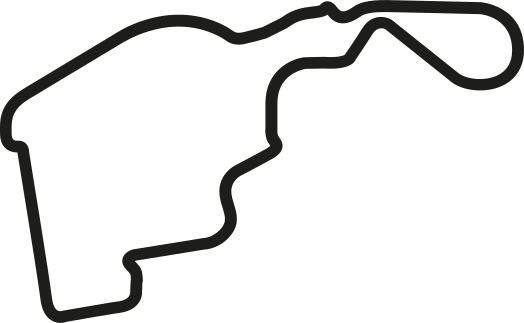
Jarama’s layout was compact and technical, with a short main straight and a series of tight corners. Unlike many circuits that favour engine power, Jarama rewarded handling, braking precision and driver consistency.
When was the first Spanish Grand Prix at Circuito del Jarama?
Jarama hosted the Spanish Grand Prix nine times between 1968 and 1981: 1968, 1970, 1972, 1974, 1976, 1977, 1978, 1979 and 1981.
The Spanish Grand Prix alternated between Jarama and Montjuïc Park during the 1970s until the Barcelona street circuit was abandoned after the 1975 accident.
The famous 1981 Spanish Grand Prix
The most memorable Formula One race at Jarama was the 1981 Spanish Grand Prix, won by Gilles Villeneuve.
Villeneuve spent the entire race defending his position from a group of faster cars that formed a tightly packed train behind him. The drivers chasing him included: Jacques Laffite, John Watson, Carlos Reutemann and Elio de Angelis.
Despite their cars’ superior cornering performance, the narrow layout made overtaking almost impossible. Villeneuve held them off for the entire race, winning by just over one second.
This would become the final Formula One victory of Villeneuve’s career.
Why did Formula One leave Jarama?
Formula One’s last race at Jarama took place in 1981.
By the early 1980s, the circuit had become too narrow for modern Formula One cars, making overtaking extremely difficult and raising safety concerns. As Formula One continued to grow, larger and more modern facilities were required.
The Spanish Grand Prix eventually found a permanent home at Circuit de Barcelona-Catalunya, beginning in 1991.
What is the circuit used for today?
Although it no longer hosts Formula One, Jarama remains an active motorsport venue.
Major events include, FIA European Truck Racing Championship, National Spanish racing series, historic motorsport events and touring car and endurance racing.
The circuit was also extended in 1991 and underwent further modernisation in 2015.
In 2022, the circuit officially changed its name to Circuito de Madrid Jarama – RACE, reflecting its ownership by the Royal Automobile Club of Spain (RACE).
Looking ahead, the circuit is set to host the Formula E Madrid ePrix beginning in 2026.
Circuito del Jarama lap record
The fastest Formula One race lap on the original Grand Prix layout is:
1:16.440 – Gilles Villeneuve (Ferrari 312T4), 1979 Spanish Grand Prix
This remains the official Formula One lap record for the circuit’s classic configuration.
In the Grand Prix Circuit of 1980–1990, the F1 race lap record of 1:15.467 belongs to Australian Alan Jones, driving a Williams FW07B in 1980.