

























Set against the waterfront streets of downtown Long Beach, California, the Long Beach Street Circuit is one of the most famous street races in North American motorsport. Best known today as a cornerstone of the IndyCar Series, the event has also enjoyed a significant place in Formula One history, having hosted the United States Grand Prix West from 1976 to 1983. With its palm-lined boulevards, concrete walls, and tight street-circuit confines, Long Beach has long been compared to a distinctly American version of Monaco.
The circuit itself is a temporary street course built around the Long Beach Convention Centre and the city’s waterfront. While modern in presentation, it retains the unforgiving character typical of classic street circuits, with little room for error and a premium placed on precision under braking. The track’s most recognisable feature is its final hairpin, which leads onto the long Shoreline Drive straight and creates one of the best overtaking opportunities on the lap.
Long Beach has built its reputation on more than scenery alone. Since its first race in 1975, the event has become one of the most prestigious fixtures in American open-wheel racing. It is the second-oldest continuously running event in IndyCar after the Indianapolis 500, and the longest-running major street race in North America. Across Formula 5000, Formula One, CART, Champ Car, and IndyCar, Long Beach has consistently delivered high-profile moments and memorable races.
See also…
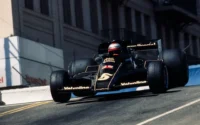
Long Beach Street Circuit
| First Grand Prix | 1975 Long Beach Grand Prix |
| Number of Laps | 90 |
| Circuit Length | 3.167 km |
| Race Distance | 285.05 km |
| Lap Record | 1:28.330 Niki Lauda (1983) |
Circuit
When was the Long Beach circuit built?
The Long Beach street circuit was first created for racing in 1975, when promoter Chris Pook brought the idea of a Monaco-style street race to Southern California. Inspired by the glamour and prestige of the Monaco Grand Prix, Pook believed a similar event could work in the Los Angeles area, and Long Beach was selected as the ideal setting.
At the time, the area around the waterfront was far more industrial and less developed than it is today. Even so, the first event attracted strong interest, with 30,000 fans attending the inaugural race, which was run as part of the Formula 5000 series. The success of that first edition helped establish Long Beach as a serious international motorsport venue.
Unlike permanent racing facilities, the Long Beach circuit is a temporary road course laid out on public streets around the convention centre and waterfront district. The current layout measures 1.968 miles (3.167 kilometres) and features 11 turns. Over the years, the configuration has been revised several times, but every version has retained the essential character of a true street circuit: tight walls, heavy braking zones, and a premium on traction and confidence.
The course is particularly famous for its closing section. A sharp hairpin turn feeds cars onto the long Shoreline Drive straight, one of the defining images of the event. The circuit also runs past fountains, hotels, and the waterfront, with palm trees lining key sections of the track and giving the race its instantly recognisable California identity.
Long Beach has undergone several layout changes since 1975. Early versions featured different turn-one complexes and even had the start and finish lines on different sides of the course. Further changes came in the 1980s and 1990s, while the most recent major update arrived around 2000, creating the longer straight leading toward Pine Avenue that remains part of the current design.
Though temporary by nature, the Long Beach circuit has become one of the most established venues in world motorsport. Its combination of waterfront scenery, street-circuit challenge, and rich history has made it one of the standout events on the calendar for generations.
When was the first United States Grand Prix West?
The first Long Beach Grand Prix took place in 1975 as a Formula 5000 race. Just one year later, the event took a major step forward by joining the Formula One World Championship as the United States Grand Prix West, a status it held from 1976 to 1983.
During its Formula One era, Long Beach quickly gained prominence. While it was demanding on cars and drivers alike, the race’s pleasant weather, striking setting, and location close to Los Angeles and Hollywood helped it stand out on the calendar. After Watkins Glen dropped off the Formula One schedule after 1980, Long Beach took on even greater importance as America’s premier F1 venue.
The track also produced one of Formula One’s most remarkable records. In 1983, John Watson won for McLaren from 22nd on the grid, still the lowest starting position for a Formula One race winner. His team-mate Niki Lauda finished second from 23rd, making that race one of the most extraordinary comeback drives in F1 history.
Despite its popularity, the event was financially difficult to sustain as a Formula One race. From 1984, Long Beach switched to CART IndyCar competition, a move that ultimately secured the event’s long-term future. The race later became part of Champ Car, and from 2009 onward, it joined the unified IndyCar Series.
Long Beach is now regarded as one of the crown jewels of American open-wheel racing. It has also become a major civic event, with weekend attendance regularly reaching or exceeding 200,000, and it has played a key role in the city’s regeneration and international profile.
Long Beach lap record
For the circuit’s Formula One era, the fastest official lap on the 1983 Grand Prix layout was 1:28.330, set by Niki Lauda in the 1983 United States Grand Prix West driving a McLaren MP4/1C.