



























Located near Sebring in central Florida, Sebring International Raceway is one of the most historic and distinctive road courses in American motorsport. Built on the site of the former Hendricks Army Airfield, the circuit is famous for its rough mix of concrete runway slabs and asphalt, giving it a punishing surface that has tested drivers and machinery for generations. Few tracks in the United States have a reputation quite like Sebring, and even fewer can match its endurance racing legacy.
Sebring is best known as the home of the legendary 12 Hours of Sebring, one of the world’s great sports car races. The circuit’s flat airfield setting, long straights, technical corners, and brutal bumps make it one of the toughest venues on any calendar. Drivers have long regarded it as a perfect preparation ground for Le Mans, not only because of its endurance format but because the track is so demanding on suspension, brakes, tyres, and concentration.
Although sports car racing defines its identity, Sebring also holds an important place in F1 history. In 1959, it hosted the United States Grand Prix, becoming the venue for the first Formula One World Championship race held in the United States outside the Indianapolis 500’s unusual championship-era inclusion.
See also…
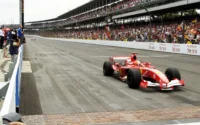
Sebring
| First Grand Prix | 1959 United States Grand Prix |
| Number of Laps | 42 |
| Circuit Length | 8.356 km (1959 F1 layout) |
| Race Distance | 350.952 km |
| Lap Record | 3:05.000 Maurice Trintignant (1959) |
Circuit
When was Sebring International Raceway built?
Sebring International Raceway first opened on 31 December 1950, making it one of the oldest continuously operating race tracks in the United States. The venue was developed on part of the former Hendricks Army Airfield, a World War II training base originally used for B-17 bomber crews.
After the war, Russian-American engineer Alec Ulmann saw the potential in the abandoned runways and service roads to create a major endurance racing venue in the United States. Inspired by the 24 Hours of Le Mans, he helped establish Sebring as an airfield circuit built around long concrete runways, access roads, and open expanses of flat Florida terrain.
The first race at the venue was held on New Year’s Eve in 1950, and the first 12 Hours of Sebring followed in 1952. That race quickly became internationally important and helped turn Sebring into one of the defining names in sports car racing.
One of Sebring’s most distinctive features is its surface. Much of the circuit still uses sections of the original wartime concrete, which creates the famous bumps and seams that have become part of the track’s identity. Over the years, the circuit has been modified many times, but it has always retained its airfield character.
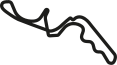
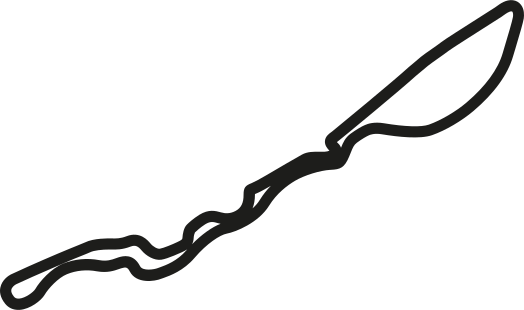
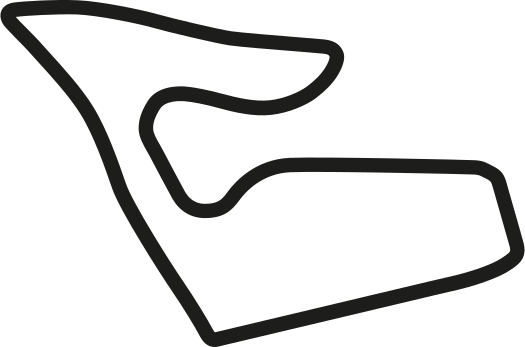
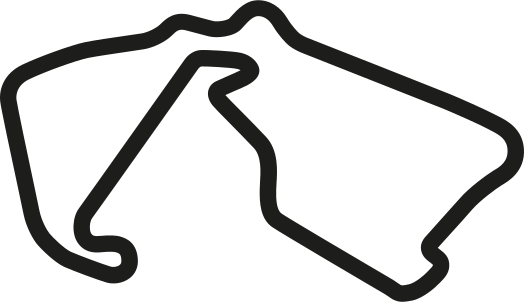
The Formula One layout used in 1959 measured 5.192 miles (8.356 kilometres) and featured 17 turns. Since then, the circuit has undergone several revisions, with the current Grand Prix road course measuring 3.740 miles (6.019 kilometres).
Sebring is also famous for Turn 17, a long, fast, bumpy right-hander leading onto the front straight. It is one of the most important corners on the modern layout and has become a signature challenge of the circuit.
When was the first United States Grand Prix at Sebring?
Sebring hosted the United States Grand Prix in 1959, marking the first time the race was held at the Florida circuit and one of the earliest attempts to establish Formula One more firmly in the American market.
The event was won by Bruce McLaren, although the official Formula One race lap record from that meeting was set by Maurice Trintignant at 3:05.000 in a Cooper T51. Despite the significance of the race, the event suffered from poor attendance and high costs, and Formula One moved on after just one year.
As a result, the United States Grand Prix relocated to Riverside International Raceway in 1960. Even though Sebring’s role in Formula One was brief, its place in world motorsport only grew stronger through endurance racing.
The circuit became synonymous with the 12 Hours of Sebring, which continued to attract top manufacturers, elite drivers, and major international championships. Over the decades, Sebring hosted races for the World Sportscar Championship, IMSA, FIA WEC, and many other categories, reinforcing its status as one of America’s great racing venues.
Sebring International Raceway lap record
For the 1959 Formula One layout, the official Formula One race lap record is 3:05.000, set by Maurice Trintignant in a Cooper T51 during the 1959 United States Grand Prix.