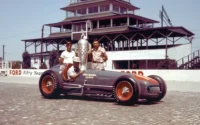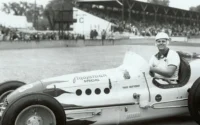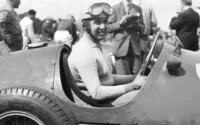


























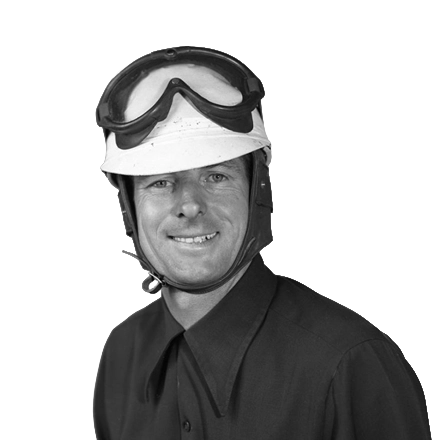
Born Samuel Dwight Hanks on 13 July 1914, Sam Hanks was a racer forged in the rough-and-tumble world of American short tracks long before he became an Indianapolis 500 winner. His family moved west when he was six, and Hanks grew up in Alhambra, California, where he attended High School and developed the grit and versatility that would define his long career.
| Nationality | American |
|---|---|
| Born | Samuel Dwight Hanks 13 July 1914 Columbus, Ohio, U.S. |
| Died | 27 June 1994 (aged 79) Pacific Palisades, California, U.S. |
Hanks made his name as a true barnstormer—a driver willing to race anything, anywhere. In 1937, he captured his first major title on the West Coast by winning the American Midget Association championship, immediately marking himself as a rising talent. He crisscrossed the country racing midgets, including appearances on the daunting board tracks of the era. In 1939, he reportedly won the first two board-track races ever held at Soldier Field in Chicago, a venue better known for football than fearless racing drivers. A year later, he added the 1940 VFW Motor City Speedway championship in Detroit, further cementing his reputation as one of the toughest competitors in the business.
World events briefly interrupted his racing ascent. During the Second World War, Hanks served in the Army Air Corps, stepping away from competition at the height of his early career. When peace returned, so did Hanks—and he wasted little time picking up where he left off.
The postwar years became the most successful stretch of his career. In 1946, he won the United Racing Association Blue Circuit Championship, followed by victory in the prestigious 1947 “Night Before the 500” midget car race. Two years later, he reached the pinnacle of midget racing by claiming the 1949 AAA National Midget Championship. His adaptability across disciplines was remarkable, and in 1953 he proved it again by winning the AAA National Championship in the famous Bardahl Special, the same year he recorded his first Championship Car victory at Springfield.
By the mid-1950s, Hanks was one of the most respected veterans in American open-wheel racing, yet the Indianapolis 500 remained stubbornly unconquered. He had debuted at the Speedway in 1940, beginning a long and often frustrating relationship with the Brickyard. One of the more unusual chapters came in 1941, when he was officially credited with a 33rd-place finish despite never taking the green flag—injured in a practice crash the day before the race, he was forced to withdraw. Still, the attempt counted.
After the 1956 Indianapolis 500, Hanks seriously considered retirement. It was car owner George Salih who persuaded him to return one more time. That decision set the stage for one of the most memorable perseverance stories in Indy history.
In 1957, making what was officially his 13th appearance in the race (and his 12th time actually starting), Hanks finally broke through. He won the Indianapolis 500, setting a record for the most attempts before achieving victory. In an era defined by grit and longevity, the moment was fitting: Hanks announced his retirement right there in Victory Circle. Decades later, Tony Kanaan would mirror the feat by winning his first Indy 500 on his 12th start in 2013.
Retirement, however, was not immediate. Hanks honored his commitments and finished out the 1957 season driving stock cars, having already claimed the 1956 Pacific Coast championship in USAC Stock Cars the year before.
Across his Championship Car career, Hanks competed in 43 races over 14 years, scoring four wins, 17 podium finishes, and a best season result of first overall in 1953. His first Championship Car win came at Springfield in 1953, and his last—appropriately—was the Indianapolis 500 itself.
World Championship Context
From 1950 through 1960, the Indianapolis 500 was part of the FIA World Drivers’ Championship, meaning Hanks’ Indy efforts also counted on the global Formula One stage. He competed in eight World Championship events, all at Indianapolis, earning one victory, four podiums, and 20 World Championship points—an impressive return for a driver whose primary focus remained American racing.
Life Beyond the Cockpit
Hanks even enjoyed a brief moment on television, playing himself in the episode “The Comedians” on the CBS sitcom Mr Adams and Eve, which aired on 8 November 1957.
From 1958 to 1963, he remained a fixture at the Speedway by serving as the Indianapolis 500 pace car driver, a ceremonial role befitting a respected champion.
He is believed to be the only driver to have competed in the Indianapolis 500 before World War II, served in the war effort, and then returned to race at Indy afterward—a distinction that underscores the span and resilience of his career. There has even been speculation, though never confirmed, that Hanks may have been a distant relative of Abraham Lincoln.
After three years of declining health, Sam Hanks passed away on 27 June 1994, at his home in Pacific Palisades, California, aged 79.
Sam Hanks Formula One World Championship career
| F1 Career | 1950 – 1957 |
|---|---|
| Teams | Kurtis Kraft, Salih |
| Entries | 8 |
| Championships | 0 |
| Wins | 1 |
| Podiums | 4 |
| Career points | 20 |
| Pole positions | 0 |
| Fastest laps | 0 |
| First entry | 1950 Indianapolis 500 |
| First win | 1957 Indianapolis 500 |
| Last win | 1957 Indianapolis 500 |
| Last entry | 1957 Indianapolis 500 |
Sam Hanks Wins
| Win No. | Grand Prix |
|---|---|
| 1 | 1957 Indianapolis 500 |
Sam Hanks Teammates
| 5 drivers | Involvement | First Year | Last Year |
|---|---|---|---|
| Joe James | 1 | 1952 | |
| Cliff Griffith | 1 | 1953 | |
| Art Cross | 1 | 1954 | |
| Bill Holland | 1 | 1954 | |
| Jim Rathmann | 1 | 1954 |
Sam Hanks Complete Formula One Results
| Year | Race | Driver No. | Team | Grid | Pos | Retired | Pts |
|---|---|---|---|---|---|---|---|
| 1950 | 1950 Indianapolis 500 | 23 | Kurtis Kraft | 25 | 30 | Oil Pressure | 0 |
| 1951 | 1951 Indianapolis 500 | 25 | Kurtis Kraft | 12 | 12 | Engine | 0 |
| 1952 | 1952 Indianapolis 500 | 18 | Kurtis Kraft | 5 | 3 | 4 | |
| 1953 | 1953 Indianapolis 500 | 3 | Kurtis Kraft | 9 | 3 | 2 | |
| 1954 | 1954 Indianapolis 500 | 45 | Kurtis Kraft | 27 | 11 | 0 | |
| 1954 Indianapolis 500 | 1 | Kurtis Kraft | 10 | 20 | Spun Off | 0 | |
| 1955 | 1955 Indianapolis 500 | 8 | Kurtis Kraft | 6 | 19 | Transmission | 0 |
| 1956 | 1956 Indianapolis 500 | 4 | Kurtis Kraft | 13 | 2 | 6 | |
| 1957 | 1957 Indianapolis 500 | 9 | Epperly | 13 | 1 | 8 |