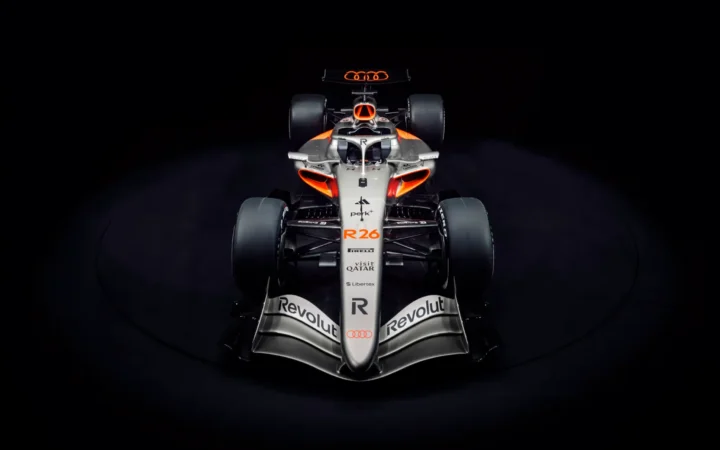






































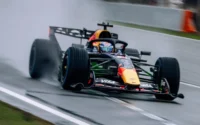
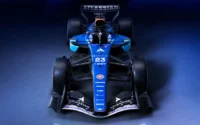
Now that we’ve seen the 2026 cars pound around the Circuit de Barcelona-Catalunya track (behind closed doors, we might add), we dive into the all-new Formula 1 cars arriving in 2026, focusing on the heart of the car: the power unit.
While the headline numbers may sound familiar, the way performance is generated, deployed and managed represents one of the most significant technical evolutions the sport has ever undertaken.
See also…

A new balance of power
At the core of the 2026 package remains a 1.6-litre turbocharged V6 internal combustion engine. However, a major component of the previous turbo-hybrid era has been removed. The MGU-H, which was directly connected to the turbocharger, has been eliminated entirely.
Its removal places greater emphasis on the MGU-K, which now becomes the sole motor-generators unit responsible for harvesting and delivering electrical energy. The result is a power unit that operates with an almost even split between combustion power and electrical output – close to a 50/50 balance.
Under the new regulations, the MGU-K can deliver up to 350kW of power, equivalent to approximately 470 bhp. That represents a significant step up from the previous limit of 120kW (around 160 bhp), fundamentally changing how performance is accessed over a lap.
Naturally, the increase in electrical output goes hand in hand with greater energy recovery and deployment. Drivers will now be able to harvest up to 9MJ of energy per lap. To put that into context, the original KERS systems introduced in 2009 deployed just 60kW from a total of 600kJ. The scale of progress since then is striking.
Simplifying the language: boost and overtake
Formula 1 technology and terminology have a reputation for being dense and intimidating, even for long-time followers. With the 2026 ruleset, the sport has made a conscious effort to simplify the description of complex systems, particularly regarding electrical energy usage.
As a result, fans and teams will hear deployment discussed using two clear terms: boost and overtake.
Boost is the baseline electrical energy consumption of the MGU-K over a lap. The driver controls how much boost is used, allowing them to tailor deployment for lap time, tyre management or specific moments of attack and defence during a race.
However, the boost is regulated to taper off as speed increases. Above 290kph, the level of electrical deployment is progressively reduced, reaching zero at 345kph.
Where overtake changes the equation
That’s where the second mode comes into play. Overtake is designed to provide a targeted performance advantage, but only under specific circumstances.
When a driver is running within one second of the car ahead, they gain access to full electrical deployment up to 337kph. From there, it tapers to zero at 355 km/h. In addition, the driver can deploy an additional 0.5 MJ of energy per lap in designated overtaking zones.
Crucially, this system introduces a genuine strategic trade-off. Using overtake mode may help complete a pass, but the additional energy expended must later be recovered. That recovery phase can leave a driver vulnerable elsewhere on the circuit.
This double-edged nature is deliberate. Unlike DRS, which offered a one-way advantage with no real downside, the 2026 overtaking concept forces teams and drivers to weigh track position against energy management. Tactical awareness will matter just as much as raw speed.
A fuel fit for the future
Alongside performance changes, sustainability is central to the new power unit regulations. As part of Formula 1’s commitment to achieving net-zero carbon emissions by 2030, the fuel itself has undergone a fundamental transformation.
From 2026, cars will run on fully sustainable fuels. These will be produced from sources such as non-food biomass, municipal waste and carbon capture technologies, and must meet strict, independently certified sustainability standards.
This shift presents a substantial technical challenge. Engine manufacturers, along with their fuel and lubricant partners, must extract maximum performance from entirely new fuel compositions. As ever in Formula 1, that challenge also represents opportunity, with competitive advantage available to those who develop the most effective solutions.
Seen in: