
























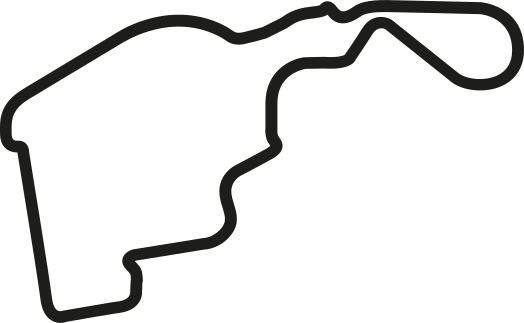
















Located in the Jacarepaguá district of Rio de Janeiro, the Autódromo Internacional do Rio de Janeiro, later known as the Autódromo Internacional Nelson Piquet, was one of Brazil’s most important motorsport venues during the late 20th century.
Often referred to simply as Jacarepaguá, the circuit hosted the Brazilian Grand Prix multiple times during the 1970s and 1980s. Built on reclaimed marshland near Barra da Tijuca, the track combined long straights with medium-speed corners and wide run-off areas, making it one of the faster circuits on the Formula One calendar during its era.
For decades, the venue served as a major hub of Brazilian motorsport, hosting everything from Formula One and CART to MotoGP and national championships before ultimately being demolished in 2012 to make way for facilities used during the 2016 Summer Olympics.
See also…
Autódromo Internacional do Rio de Janeiro Circuit
| First Grand Prix | 1978 Brazilian Grand Prix |
| Number of Laps | 61 |
| Circuit Length | 5.031 km |
| Race Distance | 305.879 km |
| Lap Record | 1:32.507 Riccardo Patrese (1989) |
Circuit
When was the Autódromo Internacional Nelson Piquet built?
Construction of the circuit began in 1971 in the Jacarepaguá neighbourhood of Rio de Janeiro, with the track officially opening on 27 January 1978.
The circuit was built on the site of the earlier Barra da Tijuca road course, which had hosted racing events during the 1960s. The new permanent facility provided a modern venue for international motorsport in Brazil and quickly became capable of accommodating crowds of up to 90,000 spectators.
The original Grand Prix circuit measured 5.031 km and featured 11 corners. The layout was relatively flat, but it included two long straights — a pit straight and an even longer back straight — which allowed Formula One cars of the turbo era to exceed 300 km/h (190 mph).
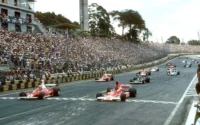
Large grandstands stretched along much of the back straight, offering spectators unusually wide views of the circuit, something rarely seen at Formula One venues at the time.
When was the first Brazilian Grand Prix at Jacarepaguá?
The first Brazilian Grand Prix at the circuit took place in 1978, just weeks after the track officially opened. The race was won by Carlos Reutemann driving a Ferrari.
Following brief returns to São Paulo’s Interlagos circuit in 1979 and 1980, Formula One moved back to Rio for the early 1980s. At the time, Interlagos was considered outdated, and the glamorous seaside setting of Rio better suited the sport’s evolving global image.
Throughout the 1980s, Jacarepaguá hosted the season-opening Brazilian Grand Prix, producing several notable races and controversies. One of the most famous incidents occurred in 1982, when Nelson Piquet and Keke Rosberg crossed the line first and second but were later disqualified for running underweight cars, handing victory to Alain Prost.
The circuit was eventually renamed in honour of three-time Formula One World Champion Nelson Piquet, one of Brazil’s greatest racing drivers.
What happened to the circuit after Formula One?
Formula One left the venue after the 1989 Brazilian Grand Prix, when the event moved permanently back to a renovated Interlagos circuit in São Paulo.
Despite losing Formula One, Jacarepaguá remained a major motorsport hub. The circuit hosted:
- CART IndyCar races between 1996 and 2000 on a modified oval known as the Emerson Fittipaldi Speedway
- MotoGP races from 1995 to 2004
- Numerous Brazilian championships, including Stock Car Brasil and Formula 3 Sudamericana
Several layout modifications were introduced during the 1990s and 2000s, including shortened circuits used for national racing events.
However, in 2008, the decision was made to demolish the circuit to make way for new sporting infrastructure for the 2016 Rio Olympic Games. The track continued operating in a shortened form until November 2012, when the remaining sections were finally demolished.
Interlagos lap record
The official Formula One race lap record at the original Jacarepaguá Grand Prix circuit is 1:32.507, set by Riccardo Patrese driving the Williams FW12C during the 1989 Brazilian Grand Prix.
Although the circuit no longer exists, Jacarepaguá remains an important part of Brazilian motorsport history, having hosted some of the country’s most memorable international racing events during its 34-year operation.