







































Located near Nivelles in Belgium, not far from Brussels, Nivelles-Baulers was a short-lived Formula One venue created during an era when organisers were searching for safer alternatives to the fearsome old Spa-Francorchamps. Built as a modern circuit with expansive run-off areas and a straightforward design, it was intended to represent a new generation of Grand Prix tracks. However, despite those good intentions, Nivelles never managed to capture the imagination of drivers, spectators, or the wider Formula One world in quite the same way as Belgium’s more famous venues.
Designed by John Hugenholtz and Roger Caignie, the circuit featured a flat and open layout with just seven corners, prioritising safety over spectacle. While that made it a sharp contrast to the high-speed danger of old Spa, it also gave the track a reputation for being somewhat bland, with little of the drama or natural character that often defines the most memorable circuits.
Nivelles-Baulers hosted the Belgian Grand Prix twice, in 1972 and 1974, during a period when the event was intended to alternate between different Belgian venues. Though its time in Formula One was brief, the circuit remains an interesting footnote in F1 history as an early example of a purpose-built “safe” track that struggled to win lasting support.
See also…
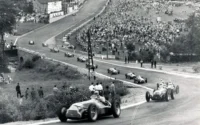
Nivelles-Baulers
| First Grand Prix | 1972 Belgian Grand Prix |
| Number of Laps | 85 |
| Circuit Length | 3.724 km |
| Race Distance | 316.540 km |
| Lap Record | 1:11.310 Denny Hulme (1974) |
Circuit
When was Nivelles-Baulers built?
Construction of Nivelles-Baulers began in 1971, and the circuit opened in 1972. It was created at a time when Formula One was becoming increasingly conscious of safety, with organisers looking for alternatives to older, more dangerous tracks. In Belgium, that meant searching for a venue that could either complement or temporarily replace the daunting original Spa-Francorchamps.
The result was a modern circuit near Nivelles, designed with broad tarmac run-off areas and a layout intended to reduce risk. Measuring 3.724 kilometres, the track featured just seven corners and a relatively simple, flat profile. Compared with the flowing forest roads and dramatic elevation changes of Spa, Nivelles was a very different kind of challenge.
Its design reflected a deliberate shift in philosophy. Rather than relying on natural landscape and high-speed bravery, Nivelles focused on order, space, and safety. In practice, though, many felt the track lacked character. Drivers often saw it as featureless, while spectators were left too far from the action to feel fully involved in the racing.
Although it was built with the future in mind, the circuit quickly ran into trouble. Financial problems emerged early, and the organiser went bankrupt in 1974. Even though enough backing was found to stage that year’s Formula One race, the venue never truly established strong foundations.
By 1976, when Nivelles was next due to host the Belgian Grand Prix, the track was no longer considered safe enough for Formula One because of the condition of the tarmac. By 1980, it had become too dangerous for car racing altogether, though motorcycle events continued for a short time. When the circuit licence expired on 30 June 1981, Nivelles-Baulers closed for good.
For many years, the abandoned track and pit buildings remained in place, and the old circuit was still visible. In the early 21st century, however, most of it was demolished, and the site became part of an industrial estate, though traces of the former layout can still be found.
When was the first Belgian Grand Prix at Nivelles?
Nivelles-Baulers first hosted the Belgian Grand Prix in 1972, during a period when the race was intended to alternate between Walloon and Flemish circuits. The venue returned to the Formula One calendar once more in 1974, meaning it hosted the championship race on just two occasions.
Both Grands Prix at Nivelles were won by Emerson Fittipaldi, giving the Brazilian a perfect record at the circuit. Although that gave the venue a small place in Formula One history, it was never able to become a popular long-term home for the Belgian Grand Prix.
Part of the issue was the circuit’s atmosphere. While it had been conceived as a safer alternative to Spa, it lacked the sense of speed, challenge, and identity that made some other tracks memorable. Spectators were also said to feel too removed from the circuit, which hurt the event’s appeal from a fan perspective.
Nivelles did host other categories during its short life, including Formula Two, Formula 5000, and Formula 750, but its role in top-level motorsport remained limited. Once its Formula One future faded, the track quickly declined.
Nivelles-Baulers lap record
The official Formula One lap record at Nivelles-Baulers is 1:11.310, set by Denny Hulme in a McLaren M23 during the 1974 Belgian Grand Prix.
That remains the fastest official race lap recorded by a Formula One car at the circuit and one of the key statistical markers from its brief time on the world championship calendar.