












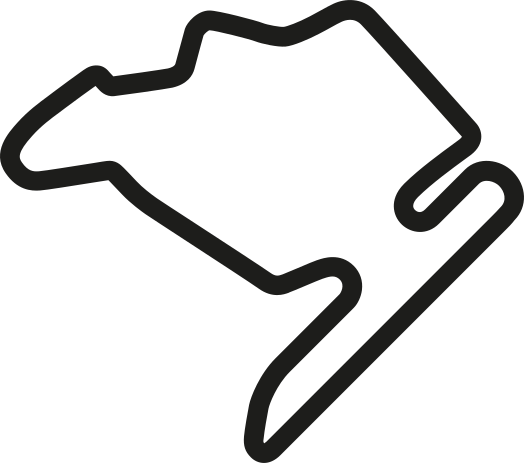










Located in Moreno Valley, California, Riverside International Raceway was one of America’s most important road racing venues during the second half of the twentieth century. Known simply as Riverside to generations of fans, the circuit became a fixture of West Coast motorsport and hosted everything from Formula One and Can-Am to NASCAR, IMSA, IndyCar, drag racing, and film production.
Opened in 1957, Riverside quickly earned a reputation as a fast and demanding circuit. Its long straights, sweeping corners, and heavy-braking zones created a layout that rewarded bravery and precision, while its multiple configurations allowed it to host an unusually wide variety of major racing categories. Although it staged only one Formula One World Championship race, Riverside remains an important part of F1 history as the venue for the 1960 United States Grand Prix.
Over time, Riverside evolved through several layout changes, the most significant coming in 1969 when Turn 9 was redesigned into the dogleg-and-banked sweeper that defined the track’s later years. By then, the circuit had become one of the best-known racing facilities in the United States. Its long tenure, broad event calendar, and place in American motorsport culture made it far more than just a racetrack.
See also…
Riverside
| First Grand Prix | 1960 United States Grand Prix |
| Number of Laps | 75 |
| Circuit Length | 5.230 km (1960 F1 layout) |
| Race Distance | 392.250 km |
| Lap Record | 2:04.500 Stirling Moss (1960) |
Circuit
When was Riverside International Raceway built?
Construction of Riverside International Raceway began in December 1956, and the circuit officially opened on 21 September 1957. Designed by William L. Duquette, the facility was built in Riverside County as a major new motorsport complex for Southern California after an earlier proposal in nearby San Bernardino County failed to materialise.
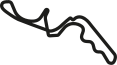
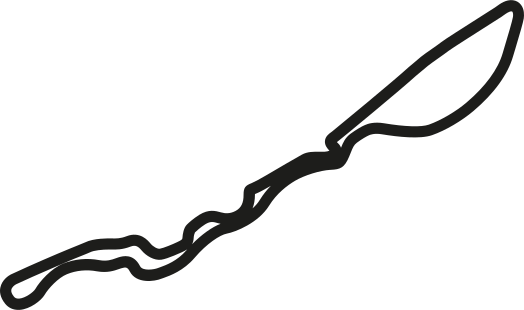
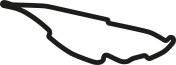
The original Grand Prix road course measured 3.25 miles (5.230 kilometres) and featured nine turns. From the start, Riverside was planned as more than a single-track venue. It included multiple road-course options, a drag strip, and, later, even short-oval configurations, making it one of the most versatile motorsport facilities in the United States.
In its early years, the track quickly established itself as a major venue for major sports car events and soon drew national attention. The annual Los Angeles Times Grand Prix became one of its signature races, helping Riverside gain prestige on the American sports car scene. The circuit’s fast nature and open layout also made it attractive to a wide range of series, from stock cars to prototypes and open-wheel machinery.
Riverside was modified several times during its life. One of the most important changes came in 1969, when the dangerous original final corner was replaced with a new left-hand kink leading into a wider, banked right-hand sweeper. This changed the main Grand Prix course length from 3.250 miles to 3.300 miles (5.311 kilometres) and created the layout most associated with Riverside’s later NASCAR, IMSA, and CART years.
The circuit remained in operation until 1989, when redevelopment plans finally brought its story to an end. After closure and demolition, most of the former site was transformed into the Moreno Valley Mall and the surrounding commercial district.
When was the first United States Grand Prix at Riverside?
Riverside hosted its only Formula One World Championship race on 20 November 1960, when it staged the United States Grand Prix. The event came at a time when Formula One was still searching for a stable American home, and Riverside briefly stepped into that role.
The race was won by Stirling Moss, giving the circuit an immediate place in Formula One history. Although the event was significant, it did not return the following year. Attendance and finances fell short of expectations, and the United States Grand Prix moved to Watkins Glen for 1961.
Even with just one Formula One appearance, Riverside remained a major racing venue. It became especially important in NASCAR, hosting regular Cup Series events for decades, and also played a major role in Can-Am, Trans-Am, IMSA, and later CART competition. In many ways, Riverside’s wider motorsport legacy in America became more substantial than its brief Formula One chapter.
The circuit was also deeply woven into popular culture. Because of its Southern California location and cinematic setting, it appeared in a long list of films and television productions, further cementing its place in American motorsport folklore.
Riverside International Raceway lap record
Because Riverside used multiple major layouts over the years, its lap records depend on configuration.
For the original Grand Prix road course used when Formula One visited in 1960, the official Formula One race lap was 2:04.500, set by Stirling Moss during the 1960 United States Grand Prix.