




















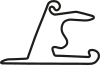

Located in Styria, Austria, the Zeltweg Air Base was one of Formula One’s most unusual early venues. Set on a military airfield rather than a purpose-built race track, the circuit used the runways and perimeter roads of the base to create a flat, fast, and extremely abrasive layout. Though its Formula One life lasted only a single World Championship race, Zeltweg still holds an important place in Austrian motorsport history as the precursor to the country’s later Grand Prix home at the Österreichring.
The venue was inspired by the success of Britain’s Silverstone, which had also been developed from an airfield. But while Silverstone evolved into one of Formula One’s classic circuits, Zeltweg quickly gained a reputation for being rough, basic, and hard on both cars and drivers. Its coarse surface and limited complexity made it a poor long-term fit for Formula One, even if it did host other major categories, including sports car racing.
Zeltweg staged the 1964 Austrian Grand Prix, the first Formula One World Championship race ever held in Austria. Although the event was historically significant, the shortcomings of the airfield circuit were clear enough that Formula One never returned there, instead moving to the purpose-built Österreichring nearby a few years later.
See also…
Zeltweg
| First Grand Prix | 1964 Austrian Grand Prix |
| Number of Laps | 105 |
| Circuit Length | 3.186 km |
| Race Distance | 334.530 km |
| Lap Record | 1:10.560 Dan Gurney (1964) |
Circuit
When was Zeltweg built?
The racing circuit at Zeltweg Air Base opened in 1957, using the existing infrastructure of the military airfield in Styria. The idea followed the example of Silverstone, where a former airfield had successfully been turned into a racing venue. In Austria, organisers hoped a similar approach could provide the country with a stage for major international motorsport.
The resulting circuit measured 3.186 kilometres and featured just four turns, making it one of the simplest layouts ever to host a Formula One World Championship race. Built entirely around the airfield’s flat expanse, the track relied on long straights and wide bends rather than changes in elevation or a technically varied sequence of corners.
Its biggest problem was the surface. The airfield tarmac proved highly abrasive, which made the circuit particularly hard on tyres, suspension, and driver comfort. This roughness would become one of the defining reasons why Zeltweg failed to establish itself as a lasting Grand Prix venue.
Even so, the circuit hosted a range of races during its short life, including Formula Two, sports car events, and eventually rounds of the World Sportscar Championship. But it was always clear that the long-term future of Austrian top-level racing would require something more sophisticated than an improvised airfield course.
When was the first Austrian Grand Prix at Zeltweg?
Zeltweg hosted the Austrian Grand Prix in 1964, marking the first time Austria staged a Formula One World Championship race. That event gave the country its place on the Formula One calendar, but it also exposed the limitations of the venue.
The race was won by Lorenzo Bandini for Ferrari, but the circuit itself was widely criticised. Its rough, abrasive surface made for an uncomfortable, mechanically punishing event, while the simple airfield layout lacked the character and quality expected of a permanent Grand Prix home.
As a result, Formula One never returned to Zeltweg after 1964. Instead, attention shifted to the construction of a purpose-built circuit nearby: the Österreichring, which opened later in the decade and went on to become Austria’s proper long-term Formula One venue.
Zeltweg did continue to host sports car racing for a few more years, including the 500 Kilometres of Zeltweg, which formed part of the World Sportscar Championship from 1966 to 1968. After that, the airfield circuit was abandoned for top-level racing.
Zeltweg lap record
The official Formula One lap record at the Zeltweg Airfield circuit is 1:10.560, set by Dan Gurney in a Brabham BT7 during the 1964 Austrian Grand Prix.