


























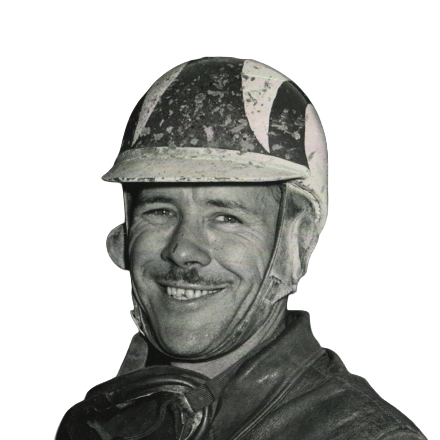
Carl Scarborough was one of American motorsport’s toughest and most fearless racers — a driver who built his reputation the hard way on dirt tracks across the Midwest before making his mark at the Indianapolis 500.
Driver Bio
| Nationality | American |
| Birthplace | Benton, Illinois, USA |
| Born | 3 July 1914 |
| Died | 30 May 1953 |
| First Grand Prix | 1951 Indianapolis 500 |
| Last Grand Prix | 1953 Indianapolis 500 |
| Years Active | 1951, 1953 |
| Current/Last Team | Privateer: Kurtis Kraft |
A national champion in both big car and midget racing, Scarborough became known for his speed, resilience and relentless driving style during one of racing’s most dangerous eras. Tragically, he lost his life to heat exhaustion during the brutally hot 1953 Indianapolis 500, a race remembered for pushing drivers and machines beyond their limits. His death ultimately led to important safety changes at Indianapolis, including new ventilation inspections for race cars.
Born in Benton on July 3, 1914, Scarborough earned his stripes long before the bright lights of Indianapolis. He competed throughout Michigan, Indiana and Ohio in the rough-and-ready world of “outlaw” racing, where drivers raced hard, travelled constantly and risked everything for prize money and pride. Early in his career, Scarborough was forced to step away from racing for two years after suffering injuries in a serious road accident while riding as a passenger. Rather than ending his ambitions, the setback only strengthened his determination to return.
That comeback paid off in spectacular fashion. In 1946, Scarborough captured the national midget car championship and also secured the national big car title in the same season — an extraordinary achievement that made him the first driver ever crowned Central States Racing Association national champion in both divisions. It cemented his status as one of the standout drivers of post-war American racing.
Scarborough brought that momentum to the Indianapolis Motor Speedway. During qualifying for the 1951 Indianapolis 500, he recorded the second-fastest qualifying lap ever seen at the Speedway up to that point, instantly proving he belonged among the elite. He went on to finish 18th in the race. The period was notoriously dangerous, and the risks drivers faced were staggering — within four years, eleven of the 35 starters from the 1951 race had died, most in racing-related incidents.
Death
By 1953, Scarborough returned to Indianapolis for what would become his final race. Starting from the seventh row, he qualified at an average speed of 135.936 mph (218.768 km/h), a formidable pace for the era. But the 1953 Indianapolis 500 quickly turned into a survival test. Temperatures soared to 91 °F (33 °C), while the track itself reached an unbearable 130 °F (54 °C). Cockpits became ovens, and drivers battled not only competitors, but extreme heat, fumes and exhaustion.
During his first pit stop, Scarborough began suffering badly from the intense heat and fumes inside the car. A fuel spill during the stop briefly ignited a small fire along the side of the machine, adding even more chaos to the moment. Clearly in distress, Scarborough climbed over the pit wall and collapsed into a chair. Fellow driver Bob Scott, whose own car had already retired with mechanical trouble, stepped in to finish the race in Scarborough’s car and eventually brought it home in 12th place.
Scarborough was rushed to the Speedway hospital, where doctors fought desperately to save him. He arrived with a body temperature of 104 °F (40 °C). Despite emergency treatment, including open-heart massage, he was pronounced dead later that day from heat exhaustion. He was one of nine drivers treated for heat-related illness during the race. Another competitor, Pat Flaherty, even blacked out behind the wheel and crashed into the wall later in the event.
Scarborough became the second fatality connected to the 1953 Indianapolis 500 after driver Chet Miller had been killed during practice before race day. At the time of his death, Scarborough lived in Clarkston with his wife and three children, and had spent 18 years competing in motorsport in one form or another.
Legacy
Although his life was cut tragically short, Scarborough’s death helped bring meaningful change to the sport. In the aftermath of the 1953 race, Indianapolis officials introduced new regulations requiring race cars to be inspected for proper ventilation before competing — an early acknowledgement of the extreme physical conditions drivers endured. Decades later, his contribution to American racing was formally recognised when he was inducted into the Michigan Motor Sports Hall of Fame in 1985.
Grand Prix Stats
| Race Entries | 2 |
| Race Starts | 2 |
| Did Not Start | 0 |
| Best Race Start | 15th |
| Best Race Finish | 12th |
| Retirements | 1 |
| First-Lap Retirements | 0 |
| Not Classified | 0 |
| Disqualified | 0 |
| Did Not Qualify | 0 |
Qualifying
| Qualifying Sessions | 2 |
| Reached Q3 | 0 |
| Q2 Eliminations | 0 |
| Q1 Eliminations | 0 |
| Did Not Qualify | 0 |
Stats by Season
| Year | Constructor | Entries | Starts | Wins | Podiums | Poles | Fastest Laps | Front Rows | DNF | Best Start | Best Result | Pts Finishes | Points | Championship |
|---|---|---|---|---|---|---|---|---|---|---|---|---|---|---|
| 1951 | Privateer: Kurtis Kraft | 1 | 1 | 0 | 0 | 0 | 0 | 0 | 1 | 15th | 18th | 0 | 0 | NC |
| 1953 | Privateer: Kurtis Kraft | 1 | 1 | 0 | 0 | 0 | 0 | 0 | 0 | 19th | 12th | 0 | 0 | NC |
Stats by Constructor
| Constructor | Years | Entries | Starts | Wins | Podiums | Poles | Fastest Laps | Front Rows | DNF | Best Start | Best Result | Pts Finishes | Points |
|---|---|---|---|---|---|---|---|---|---|---|---|---|---|
| Privateer: Kurtis Kraft | 1951, 1953 | 2 | 2 | 0 | 0 | 0 | 0 | 0 | 1 | 15th | 12th | 0 | 0 |