






















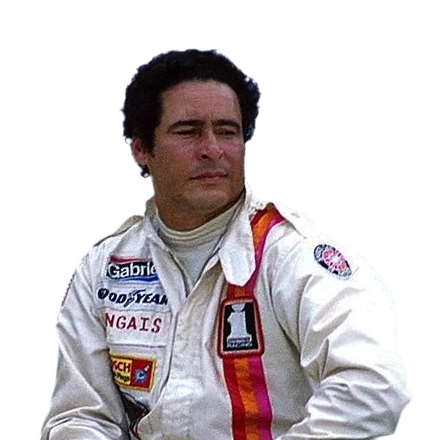
Ezekiel “Danny” Ongais was one of the most fearless and enigmatic figures in American motorsport. A rare all-rounder, he competed at a high level across motorcycles, drag racing, sports cars, Indy cars, and even Formula One. Known as “On-the-Gas” and “The Flyin’ Hawaiian,” Ongais remains the only Hawaiian-born driver to race in the Indianapolis 500—and the only driver ever to win both the NHRA U.S. Nationals and the 24 Hours of Daytona.
Driver Bio
| Nationality | American |
| Birthplace | Kahului, Hawaii, USA |
| Born | 21 May 1942 |
| Died | 26 February 2022 |
| First Grand Prix | 1977 United States Grand Prix |
| Last Grand Prix | 1978 Dutch Grand Prix |
| Years Active | 1977–1978 |
| Current/Last Team | Shadow |
Early life and two-wheel beginnings
Ongais was widely believed to have been born in Kahului, Hawaii, though his exact birth year has long been debated, with some evidence suggesting he may have been older than officially recorded. Raised in a family of Puerto Rican heritage, he showed an early appetite for speed—by the age of 14, he was already testing himself on motorcycles.
After a stint in the U.S. Army as a paratrooper in Europe, he returned to Hawaii and quickly rose through the ranks of motorcycle racing. By 1960, he was crowned Hawaiian motorcycle champion and remained among the top riders in the expert class through 1962.
Drag racing dominance
In the early 1960s, Ongais switched to drag racing—and immediately excelled. He captured back-to-back American Hot Rod Association AA Gas Dragster titles in 1963 and 1964, followed by the National Hot Rod Association AA Dragster championship in 1965.
He continued to build his reputation with major victories, including defeating Don Prudhomme in the 1966 Top Fuel semifinals and winning both the NHRA Spring Nationals and the prestigious U.S. Nationals in 1969, driving a Ford Mustang for Mickey Thompson.
His achievements earned him recognition as one of the NHRA’s Top 50 Drivers (1951–2000).
Rise through circuit racing
The 1970s saw Ongais reinvent himself yet again—this time in circuit racing. With backing from Ted Field, he progressed through SCCA competition and Formula 5000 before stepping into Indy car racing in 1976 with Interscope Racing.
His first Indy car race at Ontario Motor Speedway ended in a crash, but the following year told a very different story.
Indy car success and Formula One ventures
In 1977, Ongais completed his first full Indy car season, scoring strong finishes and claiming his maiden victory at Michigan International Speedway. He also secured three pole positions and finished 12th in the standings.
That same year, he dipped into Formula One with Interscope, entering races in the U.S. and Canada. Driving a year-old Penske, he impressed with a seventh-place finish in Canada—his best F1 result.
Peak performance: 1978
Ongais’ standout season came in 1978. He won five Indy car races—at Ontario, Texas World Speedway, Mosport, Milwaukee, and Michigan—and claimed eight pole positions. His dominance, particularly across different track types, highlighted his remarkable versatility.
At the 1978 Indianapolis 500, he looked set for victory, leading 71 laps before engine failure forced him out while running second.
Despite winning more races than any other driver that season, inconsistent results elsewhere left him only eighth in the championship standings.
He also made a final push in Formula One that year, racing with Ensign and later attempting to qualify with a Shadow chassis, though without success.
Endurance racing glory
Alongside his single-seater career, Ongais thrived in sports car racing, particularly in IMSA competition. The highlight came in 1979, when he won the 24 Hours of Daytona, sharing a Porsche 935 with Ted Field and Hurley Haywood.
CART years and the big crash
Ongais transitioned into CART competition in 1979, showing flashes of brilliance despite increasingly outdated equipment. He finished fourth at that year’s Indianapolis 500 after recovering from a practice crash.
However, his career took a dramatic turn at the 1981 Indianapolis 500. While leading, a disastrous pit stop set off a chain of events that ended in a violent crash. Ongais struck the wall nearly head-on and suffered severe injuries, including fractures in both legs, a broken arm, and internal damage.
The crash sidelined him for nearly a year.
Comeback and later career
Ongais returned in 1982 and continued racing sporadically throughout the 1980s, even taking on a team ownership role with Interscope Racing. Though results were mixed, his determination never wavered.
His final remarkable chapter came in 1996. At 54, after nine years away from racing, he was called in to replace the late Scott Brayton at the Indianapolis 500. Starting last, Ongais delivered a stunning drive to finish seventh—an extraordinary comeback performance.
He made one final IndyCar start in 1997 and attempted to qualify again in 1998, though a crash prevented him from making the field.
Personality and reputation
Ongais was as famous for his silence as his speed. Intensely private and rarely giving interviews, he remained an enigma even to those who worked closely with him. Team owner Roger Penske once remarked that racing was his entire world, while colleagues admitted they knew almost nothing about his personal life.
After his death, Mario Andretti described him as “that quiet lion”—a fitting tribute to a man whose actions spoke far louder than words.
Final years and legacy
Ongais was inducted into the Motorsports Hall of Fame of America in 2000 and the Hawaii Sports Hall of Fame in 2001, recognising a career that spanned multiple disciplines and decades.
He died of congestive heart failure on February 26, 2022, in Anaheim Hills, California, aged 79. He was survived by his partner, children, and grandchildren.
Grand Prix Stats
| Race Entries | 6 |
| Race Starts | 4 |
| Did Not Start | 0 |
| Best Race Start | 21st |
| Best Race Finish | 7th |
| Retirements | 3 |
| First-Lap Retirements | 0 |
| Not Classified | 0 |
| Disqualified | 0 |
| Did Not Qualify | 2 (Did Not Pre-Qualify) |
Qualifying
| Qualifying Sessions | 4 |
| Reached Q3 | 0 |
| Q2 Eliminations | 0 |
| Q1 Eliminations | 0 |
| Did Not Qualify | 2 (Did Not Pre-Qualify) |
Stats by Season
| Year | Constructor | Entries | Starts | Wins | Podiums | Poles | Fastest Laps | Front Rows | DNF | Best Start | Best Result | Pts Finishes | Points | Championship |
|---|---|---|---|---|---|---|---|---|---|---|---|---|---|---|
| 1977 | Privateer: Penske | 2 | 2 | 0 | 0 | 0 | 0 | 0 | 1 | 22 | 7 | 0 | 0 | NC |
| 1978 | Ensign / Privateer: Shadow | 4 | 2 | 0 | 0 | 0 | 0 | 0 | 2 | 21 | – | 0 | 0 | NC |
Stats by Constructor
| Constructor | Years | Entries | Starts | Wins | Podiums | Poles | Fastest Laps | Front Rows | DNF | Best Start | Best Result | Pts Finishes | Points |
|---|---|---|---|---|---|---|---|---|---|---|---|---|---|
| Privateer: Penske | 1977 | 2 | 2 | 0 | 0 | 0 | 0 | 0 | 1 | 22 | 7 | 0 | 0 |
| Ensign | 1978 | 2 | 2 | 0 | 0 | 0 | 0 | 0 | 2 | 21 | – | 0 | 0 |
| Privateer: Shadow | 1978 | 2 | 0 | 0 | 0 | 0 | 0 | 0 | 0 | – | – | 0 | 0 |
Teammates & Qualifying Head-to-Head
| Teammate | Years | Races | Qualifying H2H |
|---|---|---|---|
| Lamberto Leoni | 1978 | 2 | – |