
























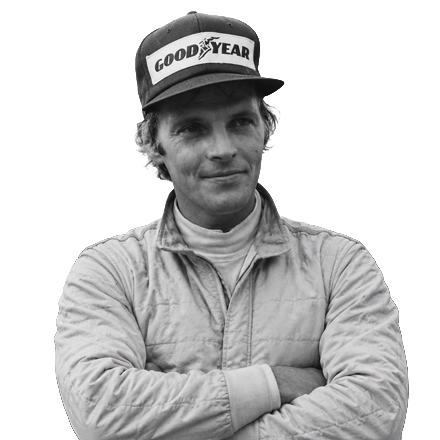
Johann Josef “Hans” Heyer (born 16 March 1943) is a retired German racing driver best known for his success in touring cars—and, somewhat unfairly, for starting a Formula One Grand Prix he had not qualified to enter.
Driver Bio
| Nationality | German |
| Birthplace | Monchengladbach, Germany |
| Born | 16 March 1943 |
| First Grand Prix | 1977 German Grand Prix |
| Last Grand Prix | 1977 German Grand Prix |
| Current/Last Team | ATS |
Heyer won the European Touring Car Championship, three Deutsche Rennsport Meisterschaft titles, the 12 Hours of Sebring and three consecutive editions of the Spa 24 Hours. Throughout his career, he was instantly recognisable by the Tyrolean hat that became his paddock trademark.
Early life
Heyer was born in Mönchengladbach, where his parents operated a bitumen and concrete-mixing business. His fascination with racing and mechanical engineering developed while he attended boarding school in Adenau, just a short distance from the Nürburgring.
He later trained as a mechanic with Daimler-Benz, completing his apprenticeship in 1962.
Racing career
Karting
At 16, Heyer was still too young to compete in Germany, so his racing career began across the border in the Netherlands in 1959. He quickly became successful in karting, winning the Dutch 100cc championship in 1962 and following it with the 125cc title in 1963.
Securing a German racing licence initially proved difficult, but Heyer eventually entered Formula K. He placed third in both 1966 and 1967 before dominating the discipline with German and European titles from 1968 through 1971, driving Taifun/BM machinery.
He also contested the Brignoles 24-hour kart race in France during 1969, 1970 and 1971. Heyer won twice and finished second in the remaining edition.
Touring-car breakthrough
Heyer’s career became closely linked with Zakspeed during the 1970s. Driving the team’s highly developed Group 2 Ford Escorts, he won the 1974 European Touring Car Championship and captured consecutive Deutsche Rennsport Meisterschaft titles in 1975 and 1976.
He made two appearances in European Formula Two during 1976. A sixth-place finish at Hockenheim suggested respectable potential, but he failed to qualify when the championship returned to the circuit and made no further attempts in the category.
The Grand Prix he was not meant to start
Heyer’s sole encounter with Formula One became one of the strangest episodes in World Championship history.
He entered the 1977 German Grand Prix at Hockenheim in ATS’s second Penske. With little single-seater experience and an uncompetitive car, he failed to qualify and was listed as the third reserve.
The situation shifted before the start. Frank Williams elected not to prepare first reserve Patrick Nève’s car, while second reserve Emilio de Villota suffered a last-minute engine failure. That effectively moved Heyer to the head of the reserve list, although he still had not received authorization to race.
Amid the confusion surrounding an accident on the starting grid, Heyer slipped out of the pit lane and joined the Grand Prix anyway. His unsanctioned adventure lasted nine laps before the gearbox failed.
Officials subsequently disqualified him once it became clear that he should never have been in the race. The result gave Heyer a unique statistical hat-trick: DNQ for failing to qualify, DNF for failing to finish and DSQ for being disqualified—all at the same event.
He was reportedly suspended for five Formula One races, effectively a lifetime punishment because he had no intention of entering another. Heyer never returned to Grand Prix racing.
Lancia and the 1980 DRM title
Touring and sports cars remained his real territory. In 1980, Heyer helped develop Lancia’s formidable Group 5 Montecarlo Turbo and drove it to another Deutsche Rennsport Meisterschaft crown.
That season also produced a frightening accident at the Norisring. A series of mechanical failures affected the front-left corner of the 480-horsepower car, which rolled repeatedly after Heyer lost control. He escaped without injury and promptly returned to the wreck—not out of mechanical curiosity, but to retrieve his famous hat. According to the story, the doctor conducting the subsequent examination appeared more shaken than the driver.
Endurance success
Heyer became particularly effective in long-distance racing during the 1980s. His greatest international sports-car victory came at the 1984 12 Hours of Sebring, where he shared a Porsche 935 with Stefan Johansson and Mauricio de Narváez.
He was equally formidable at Spa, winning the 24-hour race three years in succession during its European Touring Car Championship era.
In 1982, Heyer triumphed in a BMW 528i alongside Armin Hahne and Eddy Joosen. He and Hahne returned in 1983 with Thierry Tassin, this time winning in a BMW 635 CSi. The 1984 victory completed the hat-trick, with Heyer sharing a Tom Walkinshaw Racing Jaguar XJS with Walkinshaw and Win Percy.
He retired in 1989 after three decades in motorsport and an extraordinary total of 999 races.
Returns to competition
Heyer spent 1990 and 1991 working in the family concrete business, but retirement soon developed a few loopholes. He returned to test Mercedes-Benz racing trucks and entered the Nürburgring Truck Grand Prix in 1992.
The Nürburgring continued to draw him back. In 1994, he contested its 24-hour race in a BMW M3 with Heiner Weiss and Rainer Braun. He returned the following year as part of a BMW veterans’ “Dream Team” and later entered the circuit’s 500-kilometre race in 1997.
In 2004, Volkswagen motorsport director Kris Nissen discovered that Heyer’s next competitive appearance would be his 1,000th. Nissen invited him to celebrate the milestone by racing against a field of young drivers in the ADAC Volkswagen Polo Cup at the Norisring—appropriately enough, one of the venues most closely associated with Heyer’s colourful career.
Personal life
Heyer’s son, Kenneth, followed him into motorsport and became a GT racing driver, competing in series including the Blancpain GT Series Endurance Cup with Mercedes-AMG machinery.
Grand Prix Stats
| Race Entries | 1 |
| Race Starts | 1 |
| Did Not Start | 0 |
| Best Race Start | 25th |
| Best Race Finish | – |
| Retirements | 0 |
| First-Lap Retirements | 0 |
| Not Classified | 0 |
| Disqualified | 1 |
| Did Not Qualify | 0 |
Qualifying
| Qualifying Sessions | 0 |
| Reached Q3 | 0 |
| Q2 Eliminations | 0 |
| Q1 Eliminations | 0 |
| Did Not Qualify | 0 |
Stats by Season
| Year | Constructor | Entries | Starts | Wins | Podiums | Poles | Fastest Laps | Front Rows | DNF | Best Start | Best Result | Pts Finishes | Points | Championship |
|---|---|---|---|---|---|---|---|---|---|---|---|---|---|---|
| 1977 | ATS | 1 | 1 | – | – | – | – | – | – | 25 | – | – | – | NC |
Stats by Constructor
| Constructor | Years | Entries | Starts | Wins | Podiums | Poles | Fastest Laps | Front Rows | DNF | Best Start | Best Result | Pts Finishes | Points |
|---|---|---|---|---|---|---|---|---|---|---|---|---|---|
| ATS | 1977 | 1 | 1 | – | – | – | – | – | – | 25 | – | – | – |
Teammates & Qualifying Head-to-Head
| Teammate | Years | Races | Qualifying H2H |
|---|---|---|---|
| Jean-Pierre Jarier | 1977 | 1 | – |