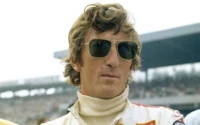





























Jo Schlesser was a French racing driver whose career spanned sports cars, Formula Two, Formula One, rallying, and even NASCAR, making him one of the most versatile drivers of his generation. Though his Formula One career was brief — just three World Championship Grand Prix — Schlesser’s name is inseparable from one of the sport’s most tragic moments, his death during the 1968 French Grand Prix.
| Nationality | French |
|---|---|
| Born | Joseph Théodule Marie Schlesse 18 May 1928 Liouville, Meuse, France |
| Died | 7 July 1968 (aged 40) Rouen-Les-Essarts, Seine-Maritime, France |
Beyond statistics, Schlesser’s legacy lived on through those closest to him. He was the uncle of Jean-Louis Schlesser, who would later compete in Formula One and achieve major success in endurance racing and rally raid. He was also a central figure in the early ambitions of Guy Ligier, whose future car company would permanently enshrine Schlesser’s initials.
Early career
Schlesser began his motorsport journey in 1952, entering rallying with a Panhard before moving into Monomill racing in 1954, a uniquely French formula popular at the time. His early progress was interrupted when he spent three years working in Mozambique, temporarily stepping away from competition.
Returning to Europe in 1957, Schlesser immediately demonstrated his ability by finishing second in the Rome–Liège–Rome Rally, driving a Mercedes. He then turned his attention to circuit racing, campaigning a Ferrari 250 GT, though early results were modest. His breakthrough came in 1960, when he finished second in class at the Nürburgring 1000 km and second overall at Rouen, confirming his strength as a sports car driver.
That same year, Schlesser tested himself in Formula Two, racing a Cooper and recording a sixth-place finish at Syracuse. His 1961 season was cut short following an accident at Le Mans, but he returned in 1962, this time competing in Formula Junior with a Brabham.
Formula Two and international competition
Schlesser’s reputation truly flourished with the arrival of the one-litre Formula Two regulations in 1964. In the years before a formal European Formula Two Championship existed, he became a highly regarded and consistent competitor across Europe, respected for his smooth driving style and technical understanding.
In 1966, Schlesser joined the works Matra Formula Two team, a significant step that placed him among the elite of the category. He remained with the same operation in 1967, by then running under the Ford France banner. For 1968, he partnered with close friend Guy Ligier, racing McLarens in Formula Two — a collaboration that reflected both professional trust and personal friendship.
Schlesser also demonstrated remarkable versatility by competing in American stock car racing, finishing 13th in the 1964 Daytona 500 as a teammate to Ned Jarrett — a rare achievement for a European driver of the era.
Formula Two at the Nürburgring
Schlesser twice entered the German Grand Prix at the Nürburgring with Formula Two machinery, as was permitted under the regulations of the time. In 1966, he drove a Matra MS5-BRM with a 1.0-litre engine, finishing 10th overall and third among the Formula Two entrants — an impressive performance on the daunting Nordschleife.
He returned in 1967 with a Matra MS5-Cosworth (1.6-litre), but his race ended prematurely after two laps due to clutch failure.
Formula One and death
Schlesser’s long-awaited opportunity in Formula One arrived in 1968, when he was offered a drive with Honda for the French Grand Prix at Rouen. Honda had developed an experimental air-cooled Formula One car, the RA302, which had been tested by team leader John Surtees. Surtees declared the car unsafe and unready, later describing it as a potential death trap.
Despite these warnings, Honda — with financial backing from Honda France — entered the car for the French Grand Prix. As a popular local driver, Schlesser was selected to drive it.
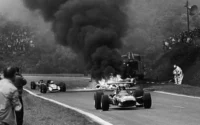
Tragically, after just two laps, the RA302 slid wide at the Six Frères corner, struck an embankment sideways, and burst into flames. The car’s magnesium body and full fuel load ignited instantly, leaving Schlesser with no chance of escape. He was killed at the scene.
In the aftermath, Honda withdrew from Formula One at the end of the 1968 season, after Surtees again refused to race the car at the Italian Grand Prix.
Death
Schlesser’s death deeply affected those closest to him — none more so than Guy Ligier. Shortly afterwards, Ligier founded Ligier Cars, fulfilling a shared ambition the two men had long discussed: to build a good car. In tribute, every Ligier model would carry the prefix “JS”, honouring Joseph Schlesser. That naming tradition continues today under Onroak Automotive, the current owner of the Ligier brand.
His influence extended beyond France. Years later, Dallara adopted a similar tribute when naming its 2012 IndyCar chassis after test driver Dan Wheldon, who had died during the final race of the previous generation.
Schlesser’s nephew, Jean-Louis Schlesser, went on to enjoy a highly successful career of his own — starting a Formula One Grand Prix, winning the World Sportscar Championship, and claiming victory in the Paris–Dakar Rally in 1999 and 2000.
Jo Schlesser Formula One World Championship career
| F1 Career | 1966–1968 |
|---|---|
| Teams | Matra, Honda |
| Entries | 3 |
| Championships | 0 |
| Wins | 0 |
| Podiums | 0 |
| Career points | 0 |
| Pole positions | 0 |
| Fastest laps | 0 |
| First entry | 1966 German Grand Prix |
| Last entry | 1968 French Grand Prix |
Jo Schlesser Complete Formula One Results
| Year | Entrant | Chassis | Engine | 1 | 2 | 3 | 4 | 5 | 6 | 7 | 8 | 9 | 10 | 11 | 12 | WDC | Pts |
|---|---|---|---|---|---|---|---|---|---|---|---|---|---|---|---|---|---|
| 1966 | Matra Sports | Matra MS5 F2 | Ford Cosworth SCA 1.0 L4 | MON | BEL | FRA | GBR | NED | GER 10 | ITA | USA | MEX | NC | 0 | |||
| 1967 | Écurie Ford-France | Matra MS5 F2 | Ford Cosworth FVA 1.6 L4 | RSA | MON | NED | BEL | FRA | GBR | GER Ret | CAN | ITA | USA | MEX | NC | 0 | |
| 1968 | Honda France | Honda RA302 | Honda RA302E 3.0 V8 | RSA | ESP | MON | BEL | NED | FRA Ret | GBR | GER | ITA | CAN | USA | MEX | NC | 0 |