































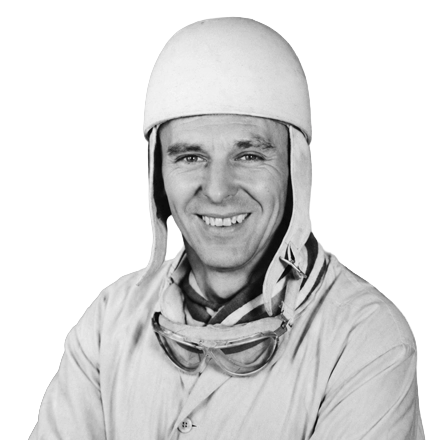
Johnny Mantz was an American racing driver who built a career across several very different series of motorsport, from AAA Championship Cars and the Indianapolis 500 to long-distance road racing and NASCAR stock cars.
Driver Bio
| Nationality | American |
| Birthplace | Hebron, Indiana, USA |
| Born | 18 September 1918 |
| Died | 25 October 1972 |
| First Grand Prix | 1953 Indianapolis 500 |
| Last Grand Prix | 1953 Indianapolis 500 |
| Years Active | 1953 |
| Current/Last Team | Kurtis Kraft |
Born on September 18, 1918, Mantz became one of those versatile post-war American racers who seemed willing to compete in almost anything with an engine. He won in Champ Cars, raced at Indianapolis, tackled the Carrera Panamericana in Mexico, became a stock car champion and earned a permanent place in NASCAR history by winning the very first Southern 500 at Darlington Raceway.
That Darlington victory, in particular, became one of the great examples of strategy beating outright speed.
Career
Mantz competed in the AAA Championship Car series between 1948 and 1952, making 17 starts. He wasted little time making an impression. During his rookie season in 1948, Mantz won at the Milwaukee Mile, immediately proving he could compete at the front in top-level American open-wheel racing. He also won the non-championship Indianapolis Sweepstakes at Williams Grove Speedway. It was a strong start to a career that would soon take him to the Indianapolis Motor Speedway itself.
Mantz made two starts in the Indianapolis 500, competing in 1948 and 1949. His first appearance came in 1948. Mantz qualified eighth, putting himself comfortably towards the front of the field. He completed 185 laps before being black-flagged and was ultimately classified 13th. A year later, he returned and produced a stronger result. For the 1949 Indianapolis 500, Mantz started ninth and completed the full 200 laps. He finished seventh, giving him his best result at the Speedway.
Mantz later returned to Indianapolis in 1953, although not as a starter in his own right. Instead, he took over as a relief driver for Walt Faulkner. Mantz’s two official starts produced a respectable record at one of the most demanding races in American motorsport. His seventh-place finish in 1949 stood as his best Indianapolis 500 result.
Mantz’s career wasn’t confined to American ovals. In 1950, he joined the Lincoln team for the inaugural Carrera Panamericana in Mexico. The event was an enormous multi-day road race covering huge distances across Mexico, and it quickly became known as one of the toughest competitions in the world.
Mantz shared driving duties with Bill Stroppe, and the pair showed serious pace. At various stages they were able to lead significant portions of the event. But as the finish approached, their challenge was undone by one of the most basic problems imaginable: tires.
They ran out of usable spares. With no fresh tires available, Mantz was forced to continue on the rims. He somehow managed to limp the car to the finish, eventually being classified ninth.
It was hardly the result their earlier pace had promised, but getting the car home at all under those circumstances was an achievement in itself.
Mantz also became heavily involved in stock car racing. He made 12 starts in NASCAR’s Grand National series across the 1950, 1951, 1955 and 1956 seasons. His NASCAR record wasn’t particularly extensive in terms of appearances, but one of those races turned him into a permanent part of the sport’s history. The breakthrough came in only his third NASCAR start.
In 1950, Mantz entered the inaugural Southern 500 at the newly constructed Darlington Raceway. This wasn’t just another event. The race represented several major firsts for NASCAR.
It was the first 500-mile race in the organisation’s history, Darlington became NASCAR’s first true superspeedway-style venue, and the Southern 500 was also the only paved NASCAR event held during the 1950 season.
The field was enormous. Seventy-five cars started the race. Mantz was nowhere near the fastest of them. In fact, he was the slowest qualifier with his Plymouth almost 10 mph slower than the pole-winning car of Curtis Turner. On raw qualifying speed, Mantz looked like anything but a race-winning contender. Then strategy took over.
Mantz and his team recognised that tire durability could become a major factor over 500 miles at the new Darlington circuit. Rather than simply trying to match the speed of his rivals, Mantz fitted truck tyres to his Plymouth. They weren’t particularly quick. What they were was durable.
While many of his competitors repeatedly returned to the pits for replacement tyres after suffering heavy wear and failures, Mantz was able to keep circulating for much longer stretches. It became a classic case of playing the long game.
Mantz had qualified during the ninth of 15 days of time trials and started 43rd in the massive 75-car field. From there, he steadily worked his way through the race while quicker cars lost time in the pits. By the finish, the supposedly slow car had become completely untouchable.
Mantz won the first Southern 500 by an astonishing nine laps. Fireball Roberts finished second, but by then Mantz had built an enormous advantage.
His average speed was 75.250 mph, and the race lasted more than six hours. It remained Mantz’s only NASCAR Grand National victory, but it was a spectacular one. He had taken NASCAR’s slowest qualifying car in one of its biggest races and won through preparation, durability and smart strategy rather than outright speed. That made the victory far more memorable than the raw statistics might suggest.
Mantz’s winning Plymouth also looked very different from the heavily branded stock cars that would later become familiar in NASCAR. Apart from its race number, the car carried just one sponsorship decal. That decal came from the Justice Brothers for a product they were distributing. The largely bare car became part of the image of one of NASCAR’s earliest major races.
Mantz’s association with the Southern 500 remained important long after his racing career had ended. By 2010, Darlington Raceway was presenting the Johnny Mantz Trophy to the winner of the Southern 500. It was a fitting tribute to the man who had won the first running of the event using one of the cleverest race strategies in early NASCAR history.
Mantz’s stock car achievements weren’t limited to NASCAR. In 1956, he became the first USAC Stock Car national champion. That made him the inaugural champion of the series and added another major title to a career that had already included success in Championship Cars and NASCAR.
His ability to succeed across different forms of racing was becoming one of the defining features of his career. Mantz also played a role in trying to expand NASCAR beyond its traditional southeastern American base. He became the first person to attempt to bring NASCAR-sanctioned racing to the West Coast of the United States. It was an ambitious idea at a time when NASCAR was still very strongly associated with the eastern and southern parts of the country.
Although the sport’s eventual West Coast expansion would take time, Mantz was among the early figures trying to make it happen.
Mantz’s final stock car race came in 1958 at Pomona, California. There was no quiet retirement drive. He won the race. For a driver whose career included victories in several different categories, ending his stock car racing career from the top step was a suitably strong finish.
Mantz remained a recognisable name in the automotive world after his frontline racing career began to wind down. During the early 1960s, he appeared in several magazine advertisements promoting Ford cars. His racing reputation made him a useful spokesperson at a time when manufacturers regularly connected performance, durability and competition success with their road cars. For Mantz, it was another link between his racing career and the wider American automobile industry.
Johnny Mantz’s career is difficult to define by a single racing category. He was a Championship Car winner. He competed twice in the Indianapolis 500 and finished seventh in 1949. He raced across Mexico in the Carrera Panamericana. He became the first USAC Stock Car national champion. And he wrote himself into NASCAR history by winning the inaugural Southern 500.
Death
Johnny Mantz died on October 25, 1972, as the result of a road accident near Ojai, California. He was 54 years old.
Grand Prix Stats
| Race Entries | 1 |
| Race Starts | 1 |
| Did Not Start | 0 |
| Best Race Start | – |
| Best Race Finish | 17th |
| Retirements | 0 |
| First-Lap Retirements | 0 |
| Not Classified | 0 |
| Disqualified | 0 |
| Did Not Qualify | 0 |
Qualifying
| Qualifying Sessions | – |
| Reached Q3 | – |
| Q2 Eliminations | – |
| Q1 Eliminations | – |
| Did Not Qualify | 0 |
Stats by Season
| Year | Constructor | Entries | Starts | Wins | Podiums | Poles | Fastest Laps | Front Rows | DNF | Best Start | Best Result | Pts Finishes | Points | Championship |
|---|---|---|---|---|---|---|---|---|---|---|---|---|---|---|
| 1953 | Kurtis Kraft | 1 | 1 | 0 | 0 | 0 | 0 | 0 | 0 | n/a | 17th | 0 | 0 | NC |
Stats by Constructor
| Constructor | Years | Entries | Starts | Wins | Podiums | Poles | Fastest Laps | Front Rows | DNF | Best Start | Best Result | Pts Finishes | Points |
|---|---|---|---|---|---|---|---|---|---|---|---|---|---|
| Kurtis Kraft | 1953 | 1 | 1 | 0 | 0 | 0 | 0 | 0 | 0 | n/a | 17th | 0 | 0 |