

























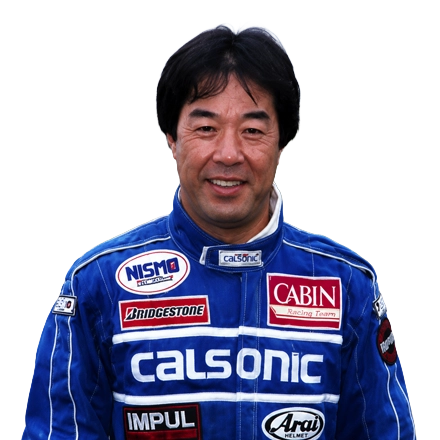
Kazuyoshi Hoshino is a Japanese former racing driver, team owner and businessman widely regarded as one of the most important figures in Japanese motorsport history. Known by the famous nickname “the fastest man in Japan”, Hoshino built a remarkable career across motorcycles, Formula racing, touring cars and endurance competition.
Driver Bio
| Nationality | Japanese |
| Birthplace | Shizuoka, Japan |
| Born | 1 July 1947 |
| First Grand Prix | 1976 Japanese Grand Prix |
| Last Grand Prix | 1977 Japanese Grand Prix |
| Current/Last Team | Privateer: Kojima |
Before becoming a star on four wheels, Hoshino first made his name on two. Competing for Kawasaki, he captured the Japanese national motocross championships in both the 90cc and 125cc categories in 1968. His speed and natural ability soon attracted attention, and in 1969 he made the switch from motorcycles to car racing after becoming a Nissan factory driver — beginning an association that would define much of his career.
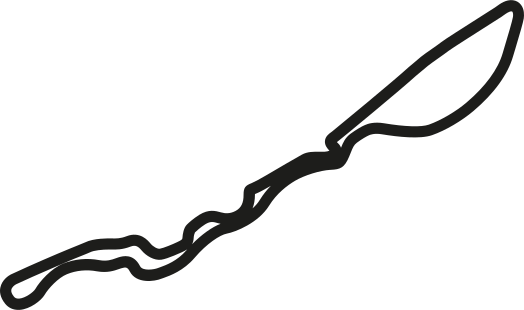
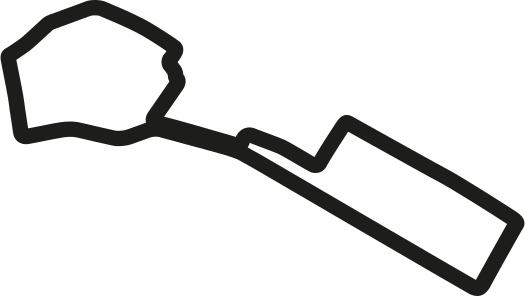
Hoshino became part of Formula One history in 1976 when he entered the Japanese Grand Prix at Fuji Speedway. Alongside fellow countrymen Noritake Takahara and Masahiro Hasemi, he became one of the first Japanese drivers to start a Formula One World Championship Grand Prix. Driving a Tyrrell-Ford for Heros Racing, Hoshino impressed in extremely difficult wet conditions, climbing as high as fourth place before retiring after running out of available tyres.
He returned for the 1977 Japanese Grand Prix, again competing with Heros Racing, this time driving a year-old Kojima-Ford. Hoshino finished the race in 11th place, bringing an end to his brief Formula One career with two Grand Prix starts and no championship points. Although his time in F1 was short, his performances helped establish Japanese drivers on the world stage.
Away from Formula One, Hoshino became one of Japan’s most successful and versatile racing talents. He won the Japanese Formula 2000 Championship in 1975 and 1977 before claiming the Japanese Formula Two Championship title in 1978. Moving into Japanese Formula 3000, he continued his dominance by winning championships in 1987, 1990 and 1993. His achievements in the category were extraordinary, with six top-level Japanese single-seater championships and 39 race victories — records that still highlight his incredible consistency.
Hoshino was equally successful in sports car racing. He became a dominant force in the Fuji Grand Champion Series, winning five championships in 1978, 1982, 1984, 1985 and 1987 while collecting 28 victories and 42 podium finishes.
On the international stage, Hoshino achieved his biggest world championship success at the 1985 Fuji 1000 km, a round of the World Sportscar Championship. Despite terrible weather conditions and many teams withdrawing because of heavy rain, Hoshino mastered the conditions to secure a memorable victory.
His long relationship with Nissan produced many more highlights. In 1990, he drove the legendary Nissan Skyline GT-R to victory in the Japanese Touring Car Championship, strengthening the car’s reputation as one of Japan’s greatest racing machines. That same year, he partnered Toshio Suzuki in a Nissan R90C to win the Suzuka 1000 km.
Hoshino and Suzuki continued their success by winning the All Japan Sports Prototype Championship in both 1991 and 1992. Later in his career, Hoshino achieved another major international result at the 1998 24 Hours of Le Mans, joining Aguri Suzuki and Masahiko Kageyama in a Nissan R390 GT1 to finish third overall.
After more than three decades behind the wheel, Hoshino retired from driving in 2002, but his impact on motorsport continued. He remained active as the head of his own racing organisation, Team Impul, and his Nissan-focused performance parts company, Impul. From 2003 onwards, his team became a powerhouse in Japanese single-seater racing, winning the Formula Nippon championship seven times in eight seasons.
The Hoshino racing legacy also continued through his son, Kazuki Hoshino, who became a professional racing driver before taking over as Impul’s team director in both Super GT and Super Formula in 2023.
Grand Prix Stats
| Race Entries | 2 |
| Race Starts | 2 |
| Did Not Start | 0 |
| Best Race Start | 11th |
| Best Race Finish | 11th |
| Retirements | 1 |
| First-Lap Retirements | 0 |
| Not Classified | 0 |
| Disqualified | 0 |
| Did Not Qualify | 0 |
Qualifying
| Qualifying Sessions | 2 |
| Reached Q3 | 0 |
| Q2 Eliminations | 0 |
| Q1 Eliminations | 0 |
| Did Not Qualify | 0 |