






















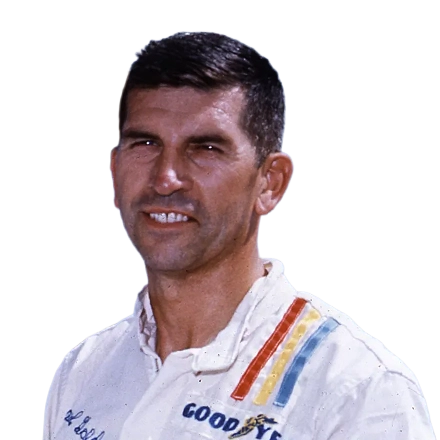
Paul Edward Goldsmith (2 October 1925 – 6 September 2024) was one of the most versatile American racers of his generation, succeeding on motorcycles, in NASCAR and USAC stock cars, and at the Indianapolis 500. Few drivers crossed disciplines with quite the same effectiveness.
Driver Bio
| Nationality | American |
| Birthplace | Parkersburg, West Virginia, USA |
| Born | 2 October 1925 |
| Died | 6 September 2024 (aged 98) Munster, Indiana, U.S. |
| First Grand Prix | 1958 Indianapolis 500 |
| Last Grand Prix | 1960 Indianapolis 500 |
| Years Active | 1958–1960 |
| Current/Last Team | Epperly |
Goldsmith was a two-time USAC Stock Car champion, winning the title in 1961 and 1962 with Pontiac machinery prepared by Ray Nichels. Earlier, he had been one of America’s leading motorcycle racers, winning the Daytona 200 for Harley-Davidson in 1953. Five years later, he returned to the same Daytona Beach road course in a Pontiac and won the final NASCAR Grand National race ever staged there.
By the time of his death, Goldsmith was the oldest surviving driver to have competed in the FIA World Drivers’ Championship and the oldest living Indianapolis 500 veteran. He and A. J. Foyt were also the final surviving competitors from the 1958 Indianapolis 500.
Early life
Born in Parkersburg, West Virginia, Goldsmith moved with his family to Detroit, Michigan, while still young. During the Second World War he served in the United States Merchant Marine.
After the war, he worked full-time at a Chrysler factory in Detroit and later co-owned a service station in Royal Oak, Michigan. Racing, however, was about to become the defining thread of his life.
Motorcycle career
Goldsmith’s racing career began almost by accident in 1946. He had gone to watch a motorcycle event at Partington Pastures in Sterling Heights, Michigan, when organisers found themselves short of competitors and invited him to take part.
He finished third.
That impromptu outing was enough to get him hooked, and before long Goldsmith was racing locally almost every weekend.
Harley-Davidson machinery became a constant throughout his motorcycle career. By 1947 he had secured backing from prominent Detroit Harley dealer Earl Robinson, working closely with Robinson’s mechanic Boots Carnegie while racing across the Midwest county-fair circuit.
Goldsmith earned AMA Expert status in 1948 and immediately showed he belonged at national level, finishing fifth in his first Daytona 200.
His results steadily improved. In 1950 he claimed his first national Class C podium at Strawberry Hill Raceway near Richmond, Virginia, before adding further third-place finishes at Bay Meadows in California and the Iowa State Fairgrounds. The following year brought another Strawberry Hill podium, a runner-up finish in Iowa and third at Williams Grove Speedway.
The breakthrough finally arrived in 1952.
Goldsmith finished third in a 25-mile national at the Illinois State Fairgrounds and then, one week later, took his first major victory at the Milwaukee Mile. The race had been extended because of a caution, but Goldsmith kept his nerve and beat Ernie Beckman to the flag.
By then Harley-Davidson had brought him into its factory effort. Goldsmith was offered the company’s new KR, although he initially preferred the older WR and helped develop the KR’s handling until it became competitive.
That work paid off spectacularly in 1953.
Daytona breakthrough
Goldsmith arrived at the 1953 Daytona 200 with Harley-Davidson’s new KR-TT road racer and spent the build-up obsessively refining and testing the bike.
While in Daytona, he regularly worked from Marshall Teague’s race shop, where he became acquainted with one of American motorsport’s great mechanical characters, Henry “Smokey” Yunick. Yunick was impressed by Goldsmith’s preparation, reactions and racing ability – a relationship that would later reshape Goldsmith’s entire career.
Starting from the second row at Daytona, Goldsmith grabbed the lead on the opening lap before settling into a measured rhythm behind John Hicks and Ed Kretz.
Consistency became his great weapon. Across the 48-lap race, his lap times barely varied.
On lap 21, Goldsmith passed Kretz for the lead at the North Turn and never looked back. He won at a record average speed of 94.45 mph, giving Harley-Davidson its first Daytona 200 victory since 1940.
It was the defining motorcycle victory of his career.
Goldsmith followed it with third place at the Ohio State Fairgrounds and later won a punishing 100-mile race on the cinders at Langhorne Speedway. His popularity matched his results, and he was voted the AMA’s Most Popular Rider of 1953.
The following season, Goldsmith looked capable of winning Daytona again. After Joe Leonard retired with mechanical trouble, Goldsmith inherited the lead – only to run into the surf while exiting the South Turn and crash out.
Despite that disappointment, his 1954 season was strong. He won at the Ohio State Fairgrounds, scored podiums at San Mateo, Portland Meadows and Sturgis, and finished second in the inaugural AMA national points standings behind Leonard, a rider Goldsmith had once helped mentor.
His final AMA victory came at Illiana Speedway in 1955, followed by one last national podium at Milwaukee.
By then, however, four wheels were increasingly taking over.
Move into stock cars
Goldsmith had actually begun racing cars as early as 1950 and won the first automobile event he entered, driving a modified Ford roadster in Detroit.
He also won a 250-mile stock-car race during the 1953 Michigan State Fair, although the victory only became official after the scoring records were rechecked.
His first major national stock-car appearance came in 1954 in an AAA event at Milwaukee, but the decisive transition came two years later through Smokey Yunick.
Yunick had long been impressed by Goldsmith, famously putting potential drivers through a series of unconventional reflex tests. Goldsmith excelled at them, including catching the spring-loaded snake from a novelty can – something Yunick later said he had never seen another driver manage.
More importantly, Goldsmith was just as impressive behind the wheel.
Yunick offered him a Chevrolet in the 1956 NASCAR Grand National championship.
Goldsmith’s NASCAR debut came at Lakewood Speedway, where an accident ended his race early. Results improved quickly, however, including a top-five finish in the Southern 500 at Darlington.
Then came Langhorne.
Goldsmith started from the outside of the front row and demolished the field, leading 182 of 300 laps and beating Lee Petty by an extraordinary seven laps. Across just nine NASCAR appearances in 1956, Goldsmith recorded a victory and three additional top-five finishes.
The switch to cars ultimately ended his motorcycle career. General Motors wanted him committed to stock cars, and although Goldsmith later admitted he hated giving up bikes, the opportunities available in automobile racing were simply too big to ignore.
His final motorcycle appearance came in the 1956 Daytona 200.
NASCAR success
Goldsmith continued racing for Yunick through 1957, initially with Chevrolet before the team switched to Ford.
The season brought both success and tragedy.
At Darlington’s Southern 500, Goldsmith was involved in a serious accident that badly injured him and Fonty Flock and killed Bobby Myers.
Despite the crash, Goldsmith finished the season with four victories and another six top-five finishes from 25 starts.
Then, in 1958, he produced one of the most unusual achievements in American racing history.
Driving a Pontiac, Goldsmith won the final NASCAR Grand National event held on the Daytona Beach road course, leading from start to finish.
Because he had already won the Daytona 200 there on a motorcycle, Goldsmith became the only driver to win major races on the course on both two wheels and four.
Soon afterwards, he stepped away from regular NASCAR competition. His attention had shifted to Indianapolis.
Ray Nichels and Pontiac
Goldsmith’s Daytona victory attracted the attention of Pontiac general manager Semon “Bunkie” Knudsen, who was working to transform the marque’s conservative image.
Knudsen had hired former Indianapolis mechanic Ray Nichels to help turn Pontiac into a genuine performance brand, and later arranged a meeting between Nichels and Goldsmith.
The partnership clicked almost immediately.
Goldsmith became Pontiac’s development driver and also replaced Pat O’Connor as Nichels’ Firestone test driver. He accumulated thousands of testing miles at Indianapolis and circuits across the American Southwest.
For much of 1958 and 1959, Goldsmith’s determination to establish himself in Championship Car racing – together with his growing commitments to Nichels – meant his stock-car schedule became comparatively light.
That changed in 1960.
USAC Stock Car success
Goldsmith returned to a full USAC Stock Car programme in 1960 and quickly became one of the championship’s dominant figures.
He took four pole positions and regularly ran near the front before finally winning the season finale at Dayton Speedway. Goldsmith grabbed the lead on the opening lap and controlled the race from there, finishing the year second in the championship behind Norm Nelson.
In 1961, everything came together.
Goldsmith opened the year by winning the Jimmy Bryan Memorial at Phoenix from pole position, beating Rodger Ward after taking the lead for good on lap 21.
Another victory followed at DuQuoin, again after a duel with Ward.
The Milwaukee Mile produced a considerably more chaotic afternoon. After retiring his own Pontiac, Goldsmith jumped into teammate Len Sutton’s car, only for that to fail too. He then took over Whitey Johnson’s older machine and somehow fought back to fifth.
The championship went down to the final race at Trenton.
Goldsmith came through to win both the race and the title, defeating reigning champion Norm Nelson.
His 1961 numbers were outstanding: seven poles, ten victories and 16 top-five finishes in 19 races.
A year later, he did it again.
Back-to-back champion
Goldsmith began 1962 by winning a two-heat event at Riverside. Dan Gurney had originally won the opening heat but was disqualified for running an underweight car, while Goldsmith beat him in the second.
At Mont-Tremblant in Canada, Goldsmith scored another road-course victory after trading heat wins with Rodger Ward. Their combined times were separated by only two seconds.
Across the season, Goldsmith claimed six poles, eight victories and 15 top-five finishes from 20 starts.
The result was a second consecutive USAC Stock Car championship.
His partnership with Nichels was now one of the strongest combinations in American stock-car racing.
Conflict with USAC
The 1963 season proved considerably messier.
Nichels Engineering moved from Pontiac to Plymouth support, and while Goldsmith still won three times, mechanical failures and missed races hurt his championship campaign.
There were still spectacular moments. In a Pontiac Tempest, Goldsmith won the non-championship NASCAR Challenge Cup at Daytona International Speedway, repeatedly lapping a Ferrari 250 GTO.
But the season ended in controversy.
Goldsmith and Nichels entered NASCAR’s Golden State 400 at Riverside even though USAC had told its licensed drivers not to participate.
Other leading USAC drivers – including A. J. Foyt, Parnelli Jones, Roger Penske, Rodger Ward and Dan Gurney – withdrew.
Goldsmith did not.
He later maintained that USAC had never directly informed him of the restriction and argued that, as an employee of Nichels and Plymouth, he had an obligation to race.
Even after missing the main qualifying session, Goldsmith set the fastest time of the meeting during a later session, breaking Gurney’s existing track record. Regulations still forced him to start from the middle of the field.
His race ended when Bob Bondurant hit him on lap 42.
The following day, USAC suspended Goldsmith for one year and stripped him of his 1963 championship points.
It was one of the more dramatic disputes of his career.
Return in 1965
Goldsmith’s suspension expired late in 1964, and he was formally reinstated the following March.
He immediately showed that the layoff had done little to blunt his speed.
At Indianapolis Raceway Park, Goldsmith beat Parnelli Jones to pole for the Yankee 300. He dropped to 15th after running off the road on the opening lap but recovered brilliantly to finish second behind Norm Nelson.
Two races later, he won on IRP’s oval without making a single pit stop.
Goldsmith added three more victories during the season and entered the finale still in championship contention, only to lose the title to Nelson.
Indianapolis and Championship Cars
Goldsmith’s ambition to race at Indianapolis had been one of the main reasons he stepped away from regular NASCAR competition.
Between 1958 and 1963, he made eight USAC Championship Car starts, six of them in the Indianapolis 500.
His best Indy results came in consecutive years.
Goldsmith finished fifth in 1959 and then climbed onto the podium with third place in the 1960 Indianapolis 500.
Those results gave a driver best known for motorcycles and stock cars another impressive entry on an already eclectic résumé.
World Drivers’ Championship
Because the Indianapolis 500 counted towards the FIA World Drivers’ Championship from 1950 to 1960, Goldsmith also became – technically – a Formula One World Championship competitor.
He participated in three championship-counting Indianapolis 500s during that period.
His third-place finish in 1960 earned four points, and across his World Championship appearances he accumulated six points in total.
It meant that Goldsmith’s extraordinary career included not only AMA, NASCAR, USAC and Indianapolis success, but an official Formula One World Championship podium as well.
Life beyond racing
Goldsmith was among the earlier American racing drivers to make extensive use of private aviation, frequently flying himself between races.
After retiring from competition, he continued flying – often in a Cessna 421 – and used aircraft to transport racing engines and components around the country.
Business became another major part of his life. Over the following decades, Goldsmith owned ranches and restaurants and remained active well beyond the age when most former racers had settled into retirement.
He also became owner and operator of Griffith-Merrillville Airport in Griffith, Indiana.
Goldsmith died in Munster, Indiana, on 6 September 2024, aged 98.
By then, he stood as one of the final direct links to a remarkable period of American racing history: a rider who conquered Daytona on a Harley-Davidson, a stock-car champion who beat the best in NASCAR and USAC, an Indianapolis podium finisher and an official World Drivers’ Championship points scorer.
Few racing careers covered more ground – literally or figuratively.
Grand Prix Stats
| Race Entries | 3 |
| Race Starts | 3 |
| Did Not Start | 0 |
| Best Race Start | 16th |
| Best Race Finish | 3rd |
| Retirements | 1 |
| First-Lap Retirements | 1 |
| Not Classified | 0 |
| Disqualified | 0 |
| Did Not Qualify | 0 |
Podiums
| Podiums | 1 |
| First Podium | 1960 Indianapolis 500 |
| Last Podium | 1960 Indianapolis 500 |
| 1st Place | 0 |
| 2nd Place | 0 |
| 3rd Place | 1 |
| Most Consecutive Podiums | 0 |
| Most Podiums in a Single Season | 1 (1960) |
| Seasons with Podiums | 1 |
Qualifying
| Qualifying Sessions | 3 |
| Reached Q3 | Not applicable |
| Q2 Eliminations | Not applicable |
| Q1 Eliminations | Not applicable |
| Did Not Qualify | 0 |
Points
| Points Scored | 6 |
| Points Finishes | 2 |
| Most Points in a Single Season | 4 (1960) |
| Seasons with Points | 2 |
Stats by Season
| Year | Constructor | Entries | Starts | Wins | Podiums | Poles | Fastest Laps | Front Rows | DNF | Best Start | Best Result | Pts Finishes | Points | Championship |
|---|---|---|---|---|---|---|---|---|---|---|---|---|---|---|
| 1958 | Kurtis Kraft | 1 | 1 | 0 | 0 | 0 | 0 | 0 | 1 | 16th | DNF | 0 | 0 | NC |
| 1959 | Epperly | 1 | 1 | 0 | 0 | 0 | 0 | 0 | 0 | 16th | 5th | 1 | 2 | 17th |
| 1960 | Epperly | 1 | 1 | 0 | 1 | 0 | 0 | 0 | 0 | 26th | 3rd | 1 | 4 | 15th |
Stats by Constructor
| Constructor | Years | Entries | Starts | Wins | Podiums | Poles | Fastest Laps | Front Rows | DNF | Best Start | Best Result | Pts Finishes | Points |
|---|---|---|---|---|---|---|---|---|---|---|---|---|---|
| Kurtis Kraft | 1958 | 1 | 1 | 0 | 0 | 0 | 0 | 0 | 1 | 16th | DNF | 0 | 0 |
| Epperly | 1959–1960 | 2 | 2 | 0 | 1 | 0 | 0 | 0 | 0 | 16th | 3rd | 2 | 6 |