























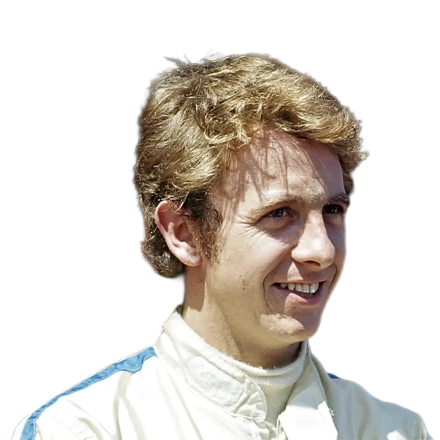
Piers Courage was a British racing driver who competed in the Formula One World Championship between 1967 and 1970. Over the course of his career, he entered 29 World Championship Grands Prix, racing for Lotus, Reg Parnell Racing, and Frank Williams Racing Cars. Courage made his Formula One debut at the 1967 South African Grand Prix, went on to achieve two podium finishes, and scored a total of 20 championship points.
Famous for both his natural speed and his easygoing personality, Courage became one of the most respected drivers of his generation and a key early figure in the rise of Frank Williams’s racing team.
| Nationality | British |
|---|---|
| Born | Piers Raymond Courage 27 May 1942 Colchester, Essex, England |
| Died | 21 June 1970 (aged 28) Circuit Park Zandvoort, North Holland, Netherlands |
Piers Courage was born into a prominent British family. From the 1920s until 2005, the Courage family held the title of Lords of the Manor of Edgcote. He was the eldest son of Richard Courage (1915–1994), who served as Lord of the Manor and was chairman of the Courage brewing dynasty, one of Britain’s best-known brewing families.
The family also had connections with the sporting world. Richard Courage’s aunt, Dorothy Courage (1877–1972) — later De Zoete — is mentioned in Burke’s Landed Gentry for her marriage in July 1903 to the distinguished cricketer Herman de Zoete.
Educated at Eton College, Courage developed an early fascination with motorsport. Rather than relying on factory support, he began racing in a car of his own — a Lotus 7 — demonstrating both independence and enthusiasm from the outset of his career.
Early racing career
In 1964, Courage began exploring the European single-seater scene, entering the Formula Three circuit with a Lotus 22. He raced alongside fellow driver Jonathan Williams, and his promising results quickly suggested that a full campaign could be worthwhile.
Encouraged by those early performances, Courage committed to a complete Formula Three season in 1965, driving a 1.0-litre Brabham entered by Charles Lucas. It was during this period that he formed an important partnership with Frank Williams, who at the time was Lucas’s other driver and occasionally worked as a mechanic. The friendship between the two men would later become one of the defining relationships of Courage’s career.
That season proved highly successful. Courage produced a string of strong results, including four notable victories, establishing himself as one of the most promising young drivers in the category. His performances caught the attention of Colin Chapman, founder of the Lotus team, who offered him a drive in a Lotus 41 for the 1966 Formula Three season.
Although the Lotus chassis was not as competitive as the dominant Brabham cars of the period, Courage still managed to challenge them on occasion with determined and skilful driving. His efforts earned him an opportunity to step up to Formula Two for the 1966 German Grand Prix, though his race ended prematurely after a crash.
Entry into Formula One
Courage’s potential was recognised by the BRM works team, which signed him for the 1967 Formula One season alongside Chris Irwin. Courage’s natural flair behind the wheel, however, came with an aggressive edge. His spectacular driving style occasionally tipped into over-exuberance, and a series of spins and accidents led to several retirements. After the 1967 Monaco Grand Prix, BRM decided to release him from the team.
Undeterred, Courage focused on another programme — a common arrangement for drivers during the 1960s — competing in Formula Two with John Coombs’s McLaren M4A. He enjoyed a productive season, finishing fourth in the unclassified drivers’ championship, and at the end of the year he purchased the car from Coombs.
During the winter Tasman Series, Courage continued to show his ability. His performances included a victory in the final race of the series, and the strong showing prompted Tim Parnell to offer him a seat in the works-supported Reg Parnell Racing BRM team for the 1968 Formula One season.
1968 season
In 1968, Courage combined his Formula One commitments with further racing in Formula Two, driving for Frank Williams’s team. His Formula One season included points-scoring finishes at the French and Italian Grands Prix, reinforcing his reputation as a fast and reliable competitor.
Meanwhile, Frank Williams had ambitions of entering Formula One with his own team. When Frank Williams Racing Cars decided to make that step in 1969, Courage was the obvious choice to lead the effort.
Breakthrough with Frank Williams 1969
Driving the distinctive dark-blue Brabham BT26, Courage delivered performances that exceeded expectations. Despite Williams’s team being relatively small compared with established manufacturers, Courage consistently challenged the leading entries.
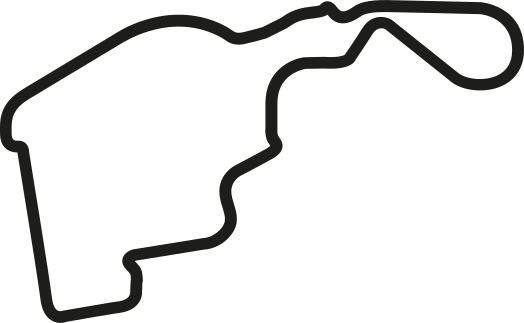
His standout results included second place at the Monaco Grand Prix and another second place at the United States Grand Prix at Watkins Glen — two podium finishes that established him firmly among the top drivers of the season.
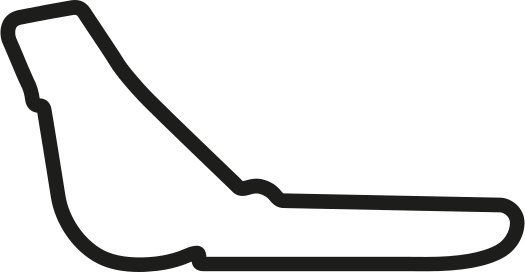
One of his most impressive drives came at the 1969 Italian Grand Prix at Monza, a circuit famous for its high speeds. In a car that was older and slightly down on power compared with the leading machinery, Courage managed to stay with the front group for most of the race. Only fuel starvation late in the event slowed his pace, and he eventually crossed the line in fifth place.
Another fifth-place finish at the British Grand Prix helped him secure 16 championship points, placing him eighth in the drivers’ championship by the end of the season.
Accident and death
For the 1970 Formula One season, Frank Williams entered into a technical arrangement with the Argentine-Italian manufacturer De Tomaso. The team switched to a newly designed De Tomaso chassis, but the car quickly proved problematic. It was overweight and unreliable, making consistent results difficult.
Courage’s best performance with the car came in the non-championship International Trophy, where he finished third, but the early part of the season was otherwise disappointing.
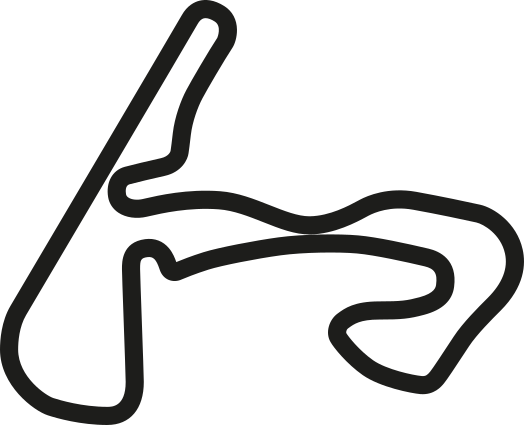
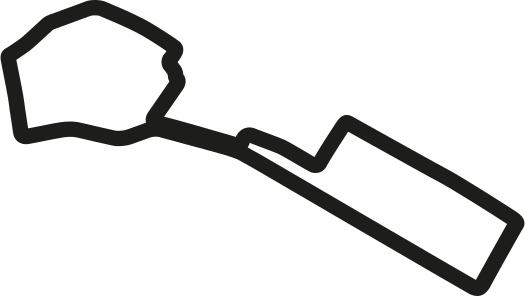
At the 1970 Dutch Grand Prix at Zandvoort, however, the weekend initially appeared more promising. Courage qualified ninth on the grid, placing him comfortably in the midfield. During the race, he was running among the main pack when tragedy struck.
As he approached the Tunnel Oost section of the circuit, the De Tomaso hit a bump at high speed. Either the front suspension or steering failed, causing the car to continue straight instead of following the curve of the corner. The car ran off the track, climbed an embankment among the Zandvoort dunes, and broke apart violently.
The impact tore the engine away from the monocoque, and the wreckage immediately burst into flames. To reduce weight, De Tomaso used magnesium components in its chassis and suspension. When magnesium burns, it produces an extremely intense fire, and the blaze was so fierce that nearby bushes and trees also caught fire.
During the crash itself, Courage suffered a fatal injury when one of the front wheels broke free and struck him in the head, tearing away his helmet. The wheel and helmet were seen rolling out of the dust cloud following the accident.
Courage was 28 years old.
Aftermath
The 1970 Formula One season would prove to be one of the most tragic in the sport’s history.
During qualifying for the 1970 Italian Grand Prix, Jochen Rindt experimented with higher gear ratios to reduce aerodynamic drag, allowing his car to reach an estimated 330 km/h (205 mph). On his fifth qualifying lap, he crashed heavily while approaching the Parabolica corner, suffering fatal injuries. Lotus withdrew its cars from the race, and Rindt later became the only driver to win the Formula One World Drivers’ Championship posthumously.
Tragically, the Zandvoort circuit would again witness a similar accident. Three years later, in 1973, driver Roger Williamson lost his life when his car crashed at the same Tunnel Oost bump that had triggered Courage’s accident, overturning and catching fire.
Piers Courage Formula One World Championship career
| F1 Career | 1967–1970 |
|---|---|
| Teams | Lotus, Parnell, Frank Williams |
| Entries | 29 (27 starts) |
| Championships | 0 |
| Wins | 0 |
| Podiums | 2 |
| Career points | 20 |
| Pole positions | 0 |
| Fastest laps | 0 |
| First entry | 1967 South African Grand Prix |
| Last entry | 1970 Dutch Grand Prix |
Piers Courage Teammates
| 2 drivers | Involvement | First Year | Last Year |
|---|---|---|---|
| Chris Irwin | 2 | 1967 | |
| Richard Attwood | 1 | 1969 |
Piers Courage Complete Formula One Results
| Year | Entrant | Chassis | Engine | 1 | 2 | 3 | 4 | 5 | 6 | 7 | 8 | 9 | 10 | 11 | 12 | 13 | WDC | Pts |
|---|---|---|---|---|---|---|---|---|---|---|---|---|---|---|---|---|---|---|
| 1966 | Team Lotus | Lotus 44 F2 | Ford Cosworth SCA 1.0 L4 | MON | BEL | FRA | GBR | NED | GER Ret | ITA | USA | MEX | NC | 0 | ||||
| 1967 | Reg Parnell Racing | Lotus 25 / 33 | BRM P60 2.1 V8 | RSA Ret | NC | 0 | ||||||||||||
| Reg Parnell Racing | BRM P261 | BRM P60 2.1 V8 | MON Ret | NED | BEL | FRA | GBR DNS | GER | CAN | ITA | USA | MEX | ||||||
| 1968 | Reg Parnell Racing | BRM P126 | BRM P101 3.0 V12 | RSA | ESP Ret | MON Ret | BEL Ret | NED Ret | FRA 6 | GBR 8 | GER 8 | ITA 4 | CAN Ret | USA Ret | MEX Ret | 19th | 4 | |
| 1969 | Frank Williams Racing Cars | Brabham BT26A | Ford Cosworth DFV 3.0 V8 | RSA | ESP Ret | MON 2 | NED Ret | FRA Ret | GBR 5 | GER Ret | ITA 5 | CAN Ret | USA 2 | MEX 10 | 8th | 16 | ||
| 1970 | Frank Williams Racing Cars | De Tomaso 505/38 | Ford Cosworth DFV 3.0 V8 | RSA Ret | ESP DNS | MON NC | BEL Ret | NED Ret | FRA | GBR | GER | AUT | ITA | CAN | USA | MEX | NC | 0 |