




























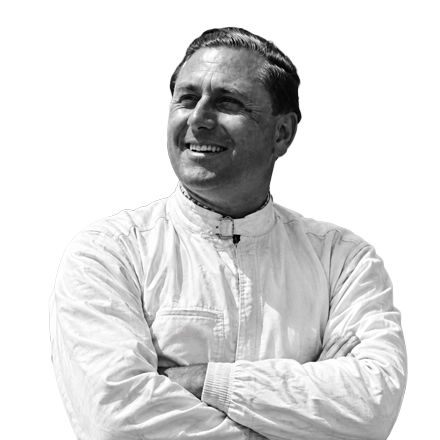
Willi Krakau was a German racing driver, engineer, and constructor whose career captured the inventive spirit of post-war motorsport. More than simply a competitor, Krakau was a hands-on specialist who designed, built, and raced his own machines during an era when determination and mechanical skill could still open the door to Grand Prix competition. Though his Formula One World Championship record amounts to a single attempted start, his wider contribution to German racing was far richer.
Driver Bio
| Nationality | German |
| Birthplace | Schonebeck-Felgeleben, Germany |
| Born | 4 December 1911 |
| Died | 26 April 1995 |
| First Grand Prix | 1952 German Grand Prix |
| Last Grand Prix | 1952 German Grand Prix |
| Years Active | 1952 |
| Current/Last Team | Privateer: AFM |
Krakau was born in Felgeleben, now part of Schönebeck, on 4 December 1911. Long before he became known in motor racing, he was a talented all-round sportsman. He competed in several disciplines and reached an elite level as a rower, earning selection for Germany’s rowing team at the 1936 Summer Olympics. That early achievement reflected the discipline, physical toughness, and competitive drive that would later define his racing life.
After the Second World War, as European motorsport slowly rebuilt itself, Krakau turned his attention fully to racing. During the late 1940s and early 1950s, he developed a strong reputation not only as a driver but also as a constructor of special racing cars. In a time of limited resources and scarce factory support, many competitors relied on ingenuity rather than large budgets, and Krakau was among the best examples of that tradition.
Several of his creations were based around components from the celebrated BMW 328, a machine whose robust engineering and straight-six engine made it a favourite foundation for post-war specials. Krakau modified and developed these cars to compete across a range of categories, including Formula Two. His efforts brought a measure of success and helped establish him as one of Germany’s respected independent racers of the period.
His only appearance in the Formula One World Championship was at the 1952 German Grand Prix. That season, the championship was run to Formula Two regulations, allowing many smaller constructors and private entrants to compete on the sport’s biggest stage. Krakau entered in a six-cylinder AFM racing car and successfully completed qualifying.
Although he ultimately did not take his place on the starting grid, merely reaching that point was a significant accomplishment. In the early 1950s, qualifying for a World Championship event demanded persistence, technical reliability, and courage—especially on Germany’s demanding circuits. For private entrants like Krakau, each appearance represented months of preparation and personal commitment.
Krakau belonged to a generation that bridged two worlds: pre-war amateur sport and post-war mechanical racing innovation. He was not backed by major manufacturers or lavish teams, yet he carved out a place in motorsport history through practical engineering skill and competitive spirit. Drivers and constructors of his kind were essential to rebuilding European racing in the difficult years after the war.
He died in Peine on 26 April 1995, aged 83.
Grand Prix Stats
| Race Entries | 1 |
| Race Starts | 0 |
| Did Not Start | 1 |
| Best Race Start | – |
| Best Race Finish | – |
| Retirements | 0 |
| First-Lap Retirements | 0 |
| Not Classified | 0 |
| Disqualified | 0 |
| Did Not Qualify | 0 |
Qualifying
| Qualifying Sessions | 0 |
| Reached Q3 | 0 |
| Q2 Eliminations | 0 |
| Q1 Eliminations | 0 |
| Did Not Qualify | 0 |
Stats by Season
| Year | Constructor | Entries | Starts | Wins | Podiums | Poles | Fastest Laps | Front Rows | DNF | Best Start | Best Result | Pts Finishes | Points | Championship |
|---|---|---|---|---|---|---|---|---|---|---|---|---|---|---|
| 1952 | Privateer: AFM | 1 | 0 | 0 | 0 | 0 | 0 | 0 | 0 | – | DNS | 0 | 0 | Never classified |