






























Andrea Moda Formula was a short-lived but unforgettable entrant in the 1992 Formula One World Championship. Owned by Italian shoe designer Andrea Sassetti, the team took its name from his fashion business—but while the branding was stylish, the racing operation was anything but.
Amid a chaotic season, Andrea Moda entered nine Grand Prix and qualified for just one. By both the numbers and reputation, the team has gone down in history as one of Formula One’s least successful—and most controversial—constructors.
Origins
The story begins in September 1991, when Sassetti purchased the struggling Coloni F1 team. Coloni’s record was already bleak: just 14 race starts from 82 attempts over four seasons. Even more telling, the team hadn’t qualified for a race in over two years—their last appearance being Roberto Moreno lining up 15th at the 1989 Portuguese Grand Prix. Their best-ever finish? An 8th place courtesy of Gabriele Tarquini at the 1988 Canadian Grand Prix.
Sassetti retained several former Coloni staff and struck a deal with Simtek to revive a chassis originally designed for BMW back in 1990. Rebranded as the Andrea Moda S921 and powered by Judd V10 engines, the car promised potential—but it wasn’t ready when the season began.
1992 Season
Andrea Moda’s debut at the 1992 South African Grand Prix ended before it began. The team arrived with a modified Coloni chassis for drivers Alex Caffi and Enrico Bertaggia, only to be excluded for failing to pay the mandatory $100,000 entry deposit. Sassetti argued this wasn’t a “new” team—but because he hadn’t purchased Coloni’s official entry, the FIA disagreed. Caffi managed a few reconnaissance laps, but the team never officially competed.
In Mexico, things didn’t improve: the cars were still under construction, and neither ran.
Frustrations quickly boiled over. After publicly criticising the team’s lack of preparation, both Caffi and Bertaggia were dismissed. They were replaced by the experienced Roberto Moreno and Perry McCarthy—the latter later becoming known as “The Stig” on Top Gear.
Moreno finally gave the S921 its first proper outing in Brazil, though he failed to pre-qualify. McCarthy, meanwhile, couldn’t even start—he initially lacked the required Super Licence. When he finally obtained it in Spain, his race weekend lasted only as long as it took the car to crawl down the pit lane before breaking down.
Behind the scenes, instability reigned. Bertaggia briefly attempted a comeback with $1 million in sponsorship, but the FIA blocked further driver changes. Sassetti, furious at the lost funding, increasingly sidelined McCarthy and focused almost entirely on Moreno.
Monaco
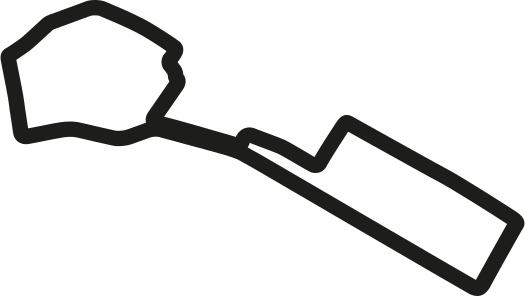
Against all odds, Andrea Moda reached its high point at the 1992 Monaco Grand Prix.
McCarthy’s weekend was disastrous—his pre-qualifying lap time was an astonishing 17 minutes. Moreno, however, delivered a minor miracle: he progressed through pre-qualifying and qualifying to secure 26th place on the grid. It remains the team’s only race start.
The fairy tale didn’t last long. After 11 laps, Moreno retired with engine failure—but for a brief moment, Andrea Moda had achieved the improbable.
Collapse
Any momentum from Monaco quickly evaporated. At the 1992 Canadian Grand Prix, the team arrived without engines after failing to pay Judd. A borrowed unit from Brabham allowed Moreno to run a few laps, but he failed to qualify, and McCarthy didn’t run at all.
By mid-season, staff were leaving, sponsors were withdrawing, and logistical issues mounted. The team even missed the 1992 French Grand Prix entirely when its truck became stranded during nationwide transport strikes—something every other team managed to navigate.
McCarthy’s treatment became increasingly farcical. At his home race, he was sent out on wet tyres on a dry circuit. In Hungary, he was released from the pit lane with just 45 seconds remaining in pre-qualifying—far too late to set a time. The FIA eventually issued a warning: run both cars properly, or face exclusion.
Final Straw and Expulsion
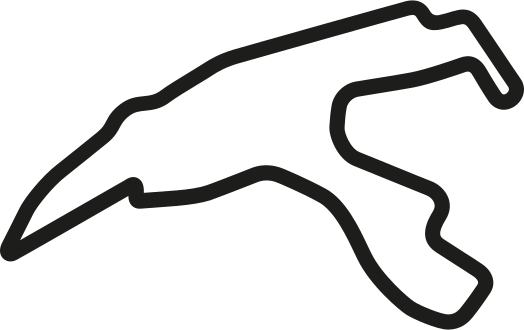
At the 1992 Belgian Grand Prix, Andrea Moda avoided pre-qualifying due to a reduced entry list. It made little difference. Both cars were comfortably the slowest—Moreno over 13% off pole, McCarthy more than 22% off, and neither qualified.
Then came the final blow. During the same weekend, Sassetti was arrested in the paddock over allegations of forged auto part invoices.
A week later, on September 8, the FIA World Motor Sport Council expelled Andrea Moda from the championship, citing its failure to operate in a manner befitting Formula One and its conduct that brought the sport into disrepute. The team was subsequently barred from even entering the paddock at the 1992 Italian Grand Prix.
Andrea Moda Formula One World Championship Records
| First entry | 1992 South African Grand Prix |
|---|---|
| Races entered | 9 (1 start) |
| Engines | Judd |
| Constructors’ Championships | 0 |
| Drivers’ Championships | 0 |
| Race victories | 0 |
| Pole positions | 0 |
| Fastest laps | 0 |
| Final entry | 1992 Belgian Grand Prix |
Andrea Moda Formula Constructors’ Championship Results
| Year | Chassis | Engine | Tyres | No. | Drivers | 1 | 2 | 3 | 4 | 5 | 6 | 7 | 8 | 9 | 10 | 11 | 12 | 13 | 14 | 15 | 16 | Points | WCC |
|---|---|---|---|---|---|---|---|---|---|---|---|---|---|---|---|---|---|---|---|---|---|---|---|
| 1992 | C4B S921 | Judd GV 3.5 V10 | G | RSA | MEX | BRA | ESP | SMR | MON | CAN | FRA | GBR | GER | HUN | BEL | ITA | POR | JPN | AUS | 0 | NC | ||
| 34 | Alex Caffi | EX | DNP | 0 | NC | ||||||||||||||||||
| Roberto Moreno | DNPQ | DNPQ | DNPQ | Ret | DNPQ | DNA | DNPQ | DNPQ | DNQ | DNQ | 0 | NC | |||||||||||
| 35 | Enrico Bertaggia | EX | DNP | 0 | NC | ||||||||||||||||||
| Perry McCarthy | DNP | DNPQ | DNPQ | DNPQ | DNP | DNA | DNPQ | EX | DNPQ | DNQ | 0 | NC |