































For Larrousse, 1992 was supposed to mark a fresh start—a lifeline thrown just as the team teetered on the brink. A judicial recovery process, triggered by mounting financial troubles, ultimately led to the team’s sale. The buyer was Venturi, which took a controlling 65% stake through the newly formed Venturi-Larrousse structure. On paper, it looked like salvation. And in many ways, it was.
The deal prevented the team’s collapse and ushered in a full organisational overhaul. Operations were split across two countries: a sporting division in Toulon would handle race preparation, while the UK base focused on design work and the development of future Venturi chassis. It was ambitious, structured—and, briefly, promising.
High Hopes, Modest Returns
Reality, however, had other plans. The Venturi-badged, Lamborghini-powered cars lined up at every race of the 1992 Formula One World Championship—a respectable achievement in itself. But the results were thin. Across the entire season, the team scored just a single point, courtesy of Bertrand Gachot. And even that tally could have been higher.
Too often, the team’s own drivers became their biggest obstacle. Collisions, spins, and unforced errors defined much of the campaign. Rookie Ukyo Katayama gained notoriety for his over-enthusiasm—at times blocking his own teammate during qualifying, and even managing to run into the back of him while being lapped. It was a season where potential repeatedly dissolved into frustration.
A Season of Near Misses
The year began at the 1992 South African Grand Prix. Gachot retired with suspension damage after an accident, while Katayama brought the car home in 12th.
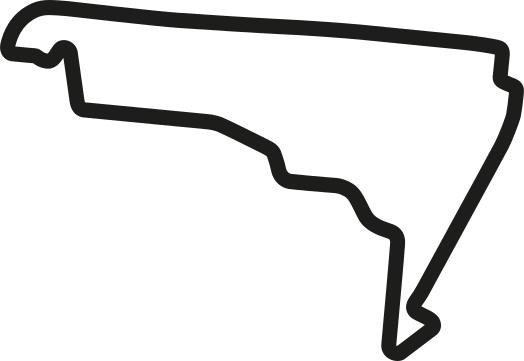
In Mexico, both cars finished, with Gachot leading Katayama by 11th and 12th, respectively. Brazil offered more of the same: Gachot again sidelined by suspension issues, Katayama improving to ninth.
Spain proved tougher—Katayama failed to qualify for the first time that season, and Gachot retired mid-race with engine failure. At the 1992 San Marino Grand Prix, things unravelled further, with both drivers spinning out within eight laps of each other.
Then came Monaco—the standout moment. At the 1992 Monaco Grand Prix, Gachot delivered a gritty drive to sixth place, earning the team’s only point of the season. He finished a lap down but, crucially, ahead of half the field. Katayama, in contrast, didn’t even make it through pre-qualifying.
It was the peak—and everything after it felt like a slow descent.
The next three races brought nothing but retirements and disqualifications. It wasn’t until the 1992 German Grand Prix that a Venturi Larrousse car saw the chequered flag again, with Gachot finishing 14th after Katayama crashed out early.
Hungary brought a double retirement. Belgium at least saw both cars classified—though they were the last two finishers, with Katayama spinning during the race. In Italy, both cars retired again, but Katayama was still classified ninth thanks to completing enough laps.
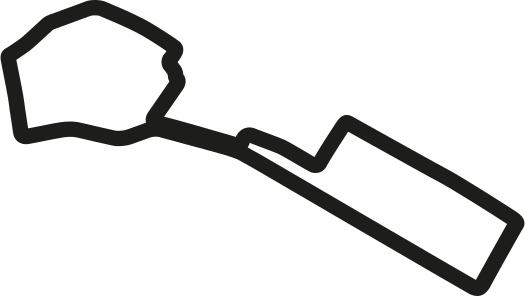
Portugal followed with another double retirement. In Japan, Katayama managed 11th, offering a brief glimpse of stability. The season closed in Australia with—fittingly—another double retirement.
Trouble Off the Track
If the on-track story was messy, events behind the scenes were even more dramatic.
As the season wore on, team boss Gérard Larrousse found himself dealing with escalating turmoil. Interpol arrested him in connection with crimes linked to a German sponsor. At the same time, Katayama departed for Tyrrell, taking significant sponsorship backing with him. Then came the final blow: Venturi itself pulled out.
Citing what it described as a “gangster-like atmosphere,” the French manufacturer abandoned the project entirely. Initially drawn to Formula One with long-term ambitions, Venturi quickly reconsidered once confronted with the sport’s financial realities.
Despite everything—the instability, the controversies, the constant setbacks—Larrousse endured. The team finished the season 11th in the Constructors’ Championship, their single point enough to keep them on the board. Gachot ended the year 19th in the Drivers’ standings.
And remarkably, Gérard Larrousse regrouped once again, returning for the 1993 season—this time without Venturi.
Venturi One World Championship Records
| First entry | 1992 Brazilian Grand Prix |
|---|---|
| Races entered | 16 (16 starts) |
| Engines | Lamborghini |
| Entrants | Larrousse |
| Constructors’ Championships | 0 |
| Drivers’ Championships | 0 |
| Points | 1 |
| Podiums | |
| Race victories | 0 |
| Pole positions | 0 |
| Fastest laps | 0 |
| Final entry | 1992 Australian Grand Prix |