














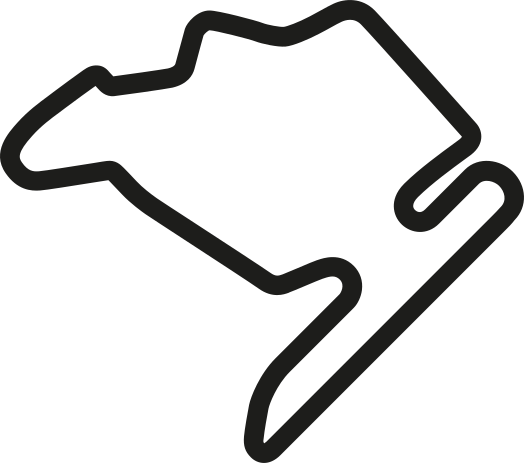







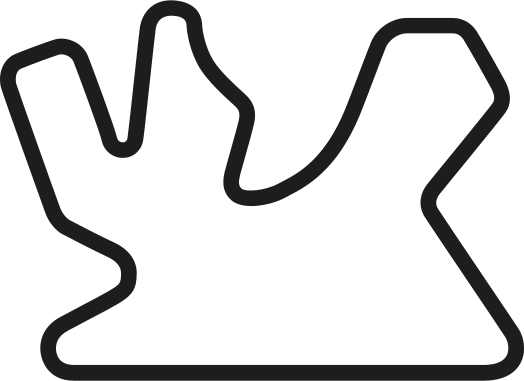




Located in Baden-Württemberg, near the town of Hockenheim, the Hockenheimring is one of Germany’s most famous racing circuits and, for decades, shared hosting duties for the German Grand Prix with the Nürburgring.
Originally a vast, ultra-fast track that blasted through the forest on enormous straights before returning to the stadium-like Motodrom section, Hockenheim developed a reputation as one of Formula One’s great speed venues. Although the circuit was dramatically shortened in 2002, it remains one of the most important tracks in German motorsport history.
See also…
Hockenheimring
| First Grand Prix | 1970 German Grand Prix |
| Number of Laps | 67 |
| Circuit Length | 4.574 km |
| Race Distance | 306.458 km |
| Lap Record | 1:13.780 Kimi Räikkönen (2004) |
Circuit
When was the Hockenheimring built?
The Hockenheimring first opened on 29 May 1932.
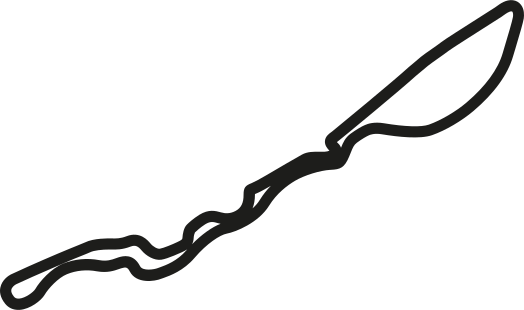
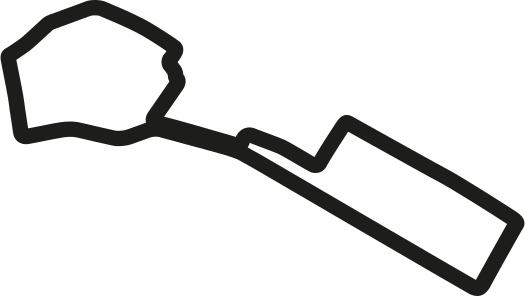
The original layout, known as the Hockenheimer-Dreieck, was around 12 km long and consisted of a triangular course linking long straights with a hairpin in the town of Hockenheim. In 1938, the circuit was shortened significantly and renamed the Kurpfalzring, introducing the famous Ostkurve for the first time.
After the Second World War, the circuit was repaired and eventually became known simply as the Hockenheimring. In 1965, the construction of the Autobahn A6 forced a major redesign, and a new stadium section — the Motodrom, designed by John Hugenholtz — was added. That created the classic version of Hockenheim that most fans came to know.
What made the old Hockenheimring special?
For many years, Hockenheim was one of Formula One’s most distinctive circuits.
The old layout was defined by very long forest straights, low-downforce, high-speed setups, a tight, technical Motodrom stadium section and famous braking zones and chicanes deep in the forest.
This created a major setup compromise. Teams had to choose between trimming their cars for speed on the straights or adding downforce for grip in the stadium section. During the turbo era of the 1980s, the circuit was especially brutal on engines and fuel consumption.
The contrast between the flat-out forest blasts and the enclosed Motodrom gave old Hockenheim a character unlike any other Grand Prix track.
When was the first German Grand Prix at the Hockenheimring?
Hockenheim hosted its first Formula One World Championship German Grand Prix in 1970.
The race was moved there after Formula One drivers boycotted the Nürburgring on safety grounds. From then on, Hockenheim became a regular Grand Prix venue and, after the mid-1970s, one of Formula One’s principal homes in Germany.
The circuit hosted the German Grand Prix intermittently until 2019, most often alternating with the Nürburgring.
Why was the circuit changed in 2002?
By the early 2000s, Formula One authorities felt the old circuit no longer suited modern requirements for safety, security and spectator viewing.
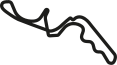
In response, the Hockenheimring was heavily redesigned for 2002 by Hermann Tilke. The long forest section was removed, replaced by a shorter infield connection and the long Parabolika straight leading into a major overtaking point at the hairpin.
The Motodrom was largely retained, but the new layout was much shorter at 4.574 km.
The redesign was controversial. Many fans, drivers and team bosses preferred the old high-speed version and felt the new circuit had lost much of Hockenheim’s unique identity.
What is the Hockenheimring used for today?
Although Formula One has not returned since 2019, the Hockenheimring remains a major international venue.
It continues to host DTM, International GT Open, NitrolympX drag racing and National and international motorsport events.
The circuit also remains one of Germany’s best-known racing venues, with its Motodrom section still giving spectators a strong amphitheatre-style view of the action.
Hockenheimring lap record
The official Formula One race lap record for the current Grand Prix layout is 1:13.780, set by Kimi Räikkönen driving the McLaren MP4-19B during the 2004 German Grand Prix.
From its origins as a giant triangle course to its years as one of Formula One’s fastest tracks, the Hockenheimring remains one of the great names in Grand Prix and F1 history.