





















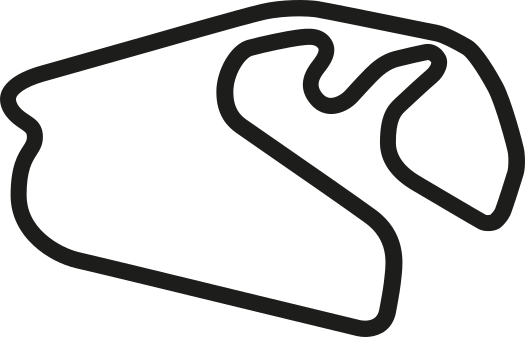







Nestled in Yeongam, South Jeolla Province, roughly 320 kilometres south of Seoul, the Korea International Circuit was built with the ambition of bringing Formula One to South Korea. The modern facility blends permanent race track infrastructure with elements designed to resemble a waterfront street circuit, creating a unique hybrid layout that mixes high-speed straights with a technical sequence of tight corners.
Designed by renowned circuit architect Hermann Tilke, the circuit features long acceleration zones followed by heavy braking points, offering several overtaking opportunities. The track’s flowing middle sector contrasts with a tight, wall-lined final section that was originally intended to run through a harbour-side development project, giving parts of the circuit a street circuit feel similar to venues like Marina Bay.
Despite hosting Formula One for only four seasons, the Korea International Circuit remains one of the longest tracks built during Formula One’s global expansion era. Its combination of wide run-off areas, long straights, and challenging braking zones provided drivers with a demanding test of both speed and precision.
See also…
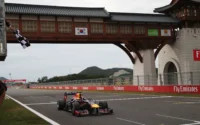
Korea International Circuit
| First Grand Prix | 2010 Korean Grand Prix |
| Number of Laps | 55 |
| Circuit Length | 5.615 km |
| Race Distance | 308.630 km |
| Lap Record | 1:39.605 Sebastian Vettel (2011) |
Circuit
When was the Korea International Circuit built?
Construction of the Korea International Circuit began in September 2009, as part of South Korea’s effort to expand its presence in global motorsport and host a Formula One Grand Prix. The project was backed by a joint venture between the Korean government and private investors, with the goal of creating a state-of-the-art racing facility capable of hosting major international events.
After just over a year of construction, the circuit officially opened in October 2010, only days before its first Formula One race. Located near the port city of Mokpo, the circuit sits in a rural coastal area surrounded by open land and farmland. The facility has a maximum spectator capacity of around 135,000 people, making it one of the largest motorsport venues in Asia at the time of its opening.
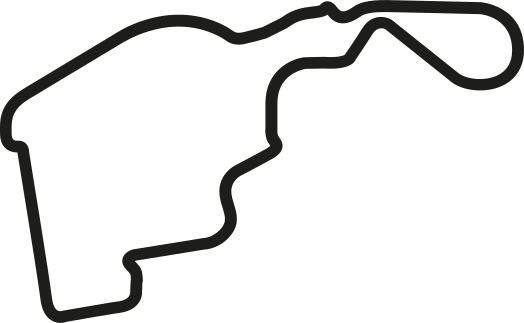
The Grand Prix layout measures 5.615 kilometres and features 18 corners, combining long straights with tight switchbacks and sweeping bends. One of the circuit’s defining features is its hybrid design: the opening sector resembles a traditional permanent racing circuit with wide run-off areas and high-speed corners, while the final sector was designed to mimic a temporary street circuit that would eventually run alongside a planned harbour development.
The lap begins with a flowing double left-hander before leading onto a 1.16-kilometre straight, one of the longest on the Formula One calendar during the circuit’s time in the championship. This straight leads into the slowest corner on the track, a tight right-hand hairpin that provides a prime overtaking opportunity.
The middle sector features a series of tight, technical corners that require strong braking and traction. Drivers then accelerate through a sequence of faster bends before approaching a downhill braking zone into Turn 10, a tricky right-hander that has caught out many drivers over the years.
The final part of the lap resembles a street circuit section, with narrow walls and a twisting series of corners that demand precision and rhythm. A blind right-hand bend at Turn 17 presents one final challenge before the track returns to the main straight.
When was the first Korean Grand Prix?
The Korean Grand Prix debuted in the 2010 Formula One World Championship as the seventeenth race of the season. The inaugural event was held under challenging conditions, with heavy rain causing multiple incidents and a delayed start.
The race ultimately produced a dramatic finish, with Fernando Alonso claiming victory for Ferrari after both Red Bull drivers retired while leading.
Despite early excitement about the event, the Korean Grand Prix struggled with financial difficulties and low attendance. The race remained on the Formula One calendar for four consecutive seasons between 2010 and 2013 before being dropped due to funding issues and logistical challenges.
Although the circuit no longer hosts Formula One, it continues to operate as a motorsport venue and remains home to various regional racing series, including the Superrace Championship, South Korea’s premier touring car competition.
Korea International Circuit lap record
The official Formula One lap record for the Korea International Circuit is 1:39.605, set by Sebastian Vettel during the 2011 Korean Grand Prix while driving for Red Bull Racing.
During the circuit’s short time on the Formula One calendar, Vettel was particularly successful at the venue, winning two races and setting the fastest race lap in 2011.