






















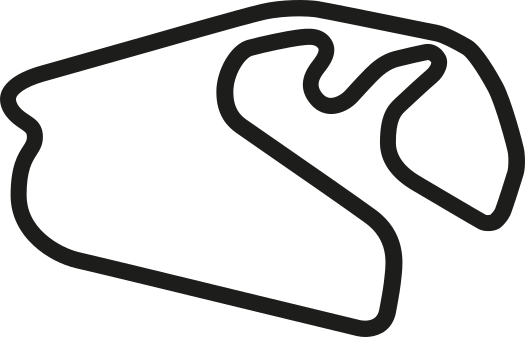







Set among the public roads and villages surrounding Pescara in the Abruzzo region of Italy, the Pescara Circuit was one of the longest, fastest, and most daunting tracks ever used in top-level motorsport. Built entirely from ordinary roads, the circuit stretched across the countryside in a vast triangular loop, linking coastal straights with hilly inland sections and creating a challenge that demanded absolute bravery from drivers.
At 25.801 kilometres, Pescara remains the longest circuit ever to host a Formula One World Championship Grand Prix. Its layout combined narrow roads, bumpy surfaces, fast open sections, and technical village corners, giving it a fearsome reputation similar to that of other legendary road circuits such as the old Spa-Francorchamps and the Nürburgring. It was admired as a magnificent drivers’ circuit, but equally feared for its danger and lack of forgiveness.
The circuit is most famous for hosting the 1957 Pescara Grand Prix, its only official Formula One World Championship race. Though its spell in Formula One was brief, Pescara had already built a significant place in European motorsport through the Coppa Acerbo, a major Italian road race first held in the 1920s.
See also…
Pescara
| First Grand Prix | 1957 Pescara Grand Prix |
| Number of Laps | 18 |
| Circuit Length | 25.801 km |
| Race Distance | 464.418 km |
| Lap Record | 9:44.600 Stirling Moss (1957) |
Circuit
When was the Pescara Circuit built?
The Pescara Circuit first opened for racing in 1924, when it began hosting the Coppa Acerbo, one of Italy’s major road races of the pre-war period. Built entirely on public roads near Pescara, the circuit used a combination of town streets, rural roads, and fast open sections that linked several villages in the surrounding countryside.
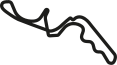
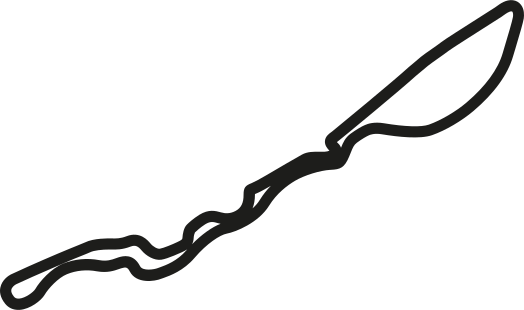
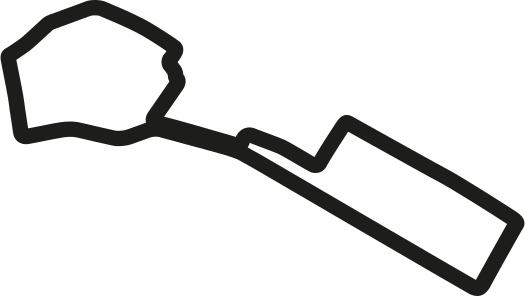
In its later and most famous form, used from 1934 to 1961, the circuit measured 25.801 kilometres. The route followed a roughly triangular shape, beginning just outside central Pescara before heading inland through villages such as Frascone, Valle Carbone, Spoltore, and Case Fornace. From there, the track dropped back down toward Cappelle sul Tavo, before running along two very long straights through Montesilvano and back toward Pescara.
These straights were among the circuit’s defining features. Each measured around 5.5 kilometres, with one section becoming known as “The Flying Kilometre.” This gave Pescara a unique rhythm: long periods at full speed were broken up by technical corners in the hills, where the narrow and uneven roads demanded accuracy and nerve.
The highest point of the circuit, at Spoltore, stood 185 metres above sea level, meaning the lap combined both topographical variety and major speed differences. Drivers had to tackle everything from flat-out blasts to slower, twisting bends through villages, often with little room for error.
Pescara also holds another notable place in motorsport history: it became the first Formula One circuit to use an artificial chicane, introduced in 1934 on the start-finish straight to reduce speed in the pit area after one of the circuit’s long flat-out sections.
For all its appeal, the circuit was deeply dangerous. Like many great road circuits of its era, it was narrow, bumpy, and lined by obstacles. Safety standards that might have been considered acceptable in the 1930s and 1950s quickly became untenable as racing speeds increased, and that reality would ultimately bring the circuit’s life to an end.
When was the first Pescara Grand Prix?
The first major race at Pescara was the Coppa Acerbo in 1924, establishing the circuit as an important venue in Italian motorsport. In the years that followed, Pescara hosted a range of significant events, including pre-war Grand Prix races and later non-championship Formula One contests.
Its only official Formula One World Championship appearance came in 1957, when the Pescara Grand Prix was added to the calendar. The race was included during a disrupted season affected by the Suez Crisis, which led to cancellations elsewhere and opened the door for Pescara to stage a championship event.
That race attracted more than 200,000 spectators, underlining the scale and prestige of the occasion. It was won by Stirling Moss, who mastered the immense circuit in his Vanwall, adding one of the most unusual and distinctive victories in F1 history.
Even by the standards of the time, however, Pescara was considered intimidating. The circuit’s danger was so great that Enzo Ferrari chose not to enter Ferrari cars in the 1957 race, reportedly out of concern for his drivers’ safety. That decision reflected the fearsome reputation the venue had among the leading figures of the sport.
The circuit continued in use after its Formula One appearance, but only briefly. Its final major event came in 1961, when it hosted a World Sportscar Championship race won by Lorenzo Bandini and Giorgio Scarlatti in a Ferrari 250 TR for Scuderia Centro Sud. After that, the circuit was permanently retired because the organisers could no longer guarantee the safety of drivers and spectators.
Pescara Circuit lap record
The official Formula One lap record for the Pescara Circuit is 9:44.600, set by Stirling Moss in a Vanwall VW 5 during the 1957 Pescara Grand Prix.
That remains one of the most remarkable lap record figures in Formula One history, not only because of the circuit’s extraordinary length, but also because Pescara still stands as the longest track ever to host a World Championship Grand Prix.