





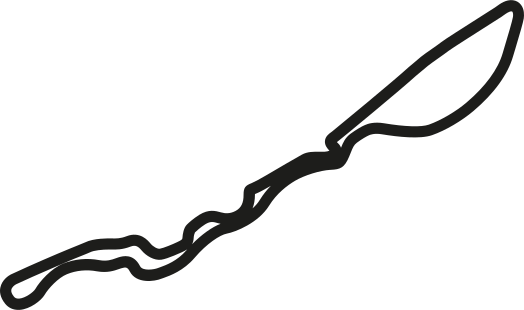


































Set among the wooded hills near Orival, close to Rouen in northern France, Rouen-Les-Essarts was one of the great classic road circuits of post-war Europe. Fast, flowing, and frighteningly unforgiving, the track ran on public roads through a dramatic landscape of blind corners, steep gradients, and long downhill sweeps. For many years, it was regarded as one of the finest circuits in France, combining speed, elevation, and technical challenge in a way that made it hugely respected by drivers.
From its opening in 1950, Rouen-Les-Essarts developed a reputation as a true driver’s circuit. The layout featured a mixture of medium-speed straights, rapid directional changes, and the famous Nouveau Monde hairpin, a cobbled corner at the southern end of the lap. One of the circuit’s defining characteristics was the steep climb from Nouveau Monde up to Grésil, a section that rose sharply through the forest and added to the track’s rhythm and difficulty.
Rouen hosted the French Grand Prix on five occasions during the Formula One World Championship era and also served as a major venue for Formula Two, motorcycle Grand Prix, and national French racing categories. Although it never achieved the same worldwide fame as circuits like Monaco, Monza, or Spa, Rouen-Les-Essarts remains one of the most admired lost circuits in European motorsport history.
See also…

Rouen-Les-Essarts
| First Grand Prix | 1952 French Grand Prix |
| Number of Laps | 54 |
| Circuit Length | 6.542 km (classic 1955–1971 layout) |
| Race Distance | 353.268 km |
| Lap Record | 2:11.400 Jack Brabham (1964) |
Circuit
When was Rouen-Les-Essarts built?
Rouen-Les-Essarts opened on 30 July 1950, using public roads on the outskirts of Rouen. From the beginning, it was recognised as a high-quality venue, with modern pits, grandstands, and a relatively wide track for the time. Even so, it remained very much a road circuit, with the natural contours of the landscape shaping the lap.
The original layout, used from 1950 to 1954, measured 5.100 kilometres. In 1955, major works extended the track to 6.542 kilometres, creating the configuration that would become its most famous and celebrated form. This longer version featured 12 turns and is the one most closely associated with the circuit’s Formula One history.
Rouen-Les-Essarts was known for its combination of speed and elevation. The course dropped downhill into the fast Six Frères section, then swept toward the tight Nouveau Monde hairpin, where the surface included cobblestones. From there, the track climbed steeply uphill through the forest toward Grésil, with gradients exceeding 9 per cent. This rise gave the circuit a distinctive rhythm and made car setup and driver commitment especially important.
The circuit changed again in the early 1970s when the construction of a new Autoroute cut across the old route. A replacement section was built, reducing the lap length to 5.543 kilometres from 1972 onward. Then, in 1974, a permanent chicane was added at Six Frères, with that area subsequently renamed Des Roches.
Although the venue remained active for many years after its Formula One era, it became increasingly difficult to run safely as a public-road circuit. By modern standards, the combination of speed, trees, barriers, and limited run-off made it unsuitable for top-level racing, and the circuit was eventually closed in 1994 for economic and safety reasons.
When was the first French Grand Prix at Rouen-Les-Essarts?
Rouen-Les-Essarts first hosted the French Grand Prix in 1952, giving the circuit an early place in the Formula One World Championship. It went on to stage the event again in 1957, 1962, 1964, and 1968, for a total of five Formula One French Grands Prix.
The venue quickly became known as a serious test for Grand Prix drivers. Its fast downhill corners, blind sections, and sharp climb from Nouveau Monde meant that a strong lap required both bravery and precision. The circuit’s road-course nature also gave it a more dangerous edge than many permanent facilities of the era.
Its final Formula One race, the 1968 French Grand Prix, is remembered for tragedy. During the race, French driver Jo Schlesser was killed in a fiery accident at the fast downhill Six Frères curve. That accident marked the end of Rouen’s Formula One story, although the track continued to host important Formula Two races until 1978 and later remained active for French national championships.
Outside Formula One, Rouen also staged the French motorcycle Grand Prix and other major categories, helping cement its reputation as one of France’s most important post-war circuits.
Rouen-Les-Essarts lap record
Because Rouen-Les-Essarts used several major layouts over its history, the lap record depends on the configuration.
For the classic 6.542-kilometre layout used for most of its Formula One history, the official Formula One lap record is 2:11.400, set by Jack Brabham in a Brabham BT7 during the 1964 French Grand Prix.