































Nestled in the Finger Lakes region of New York, just southwest of the village of Watkins Glen, Watkins Glen International is one of the most important and historic circuits in American motorsport. Known simply as “The Glen,” the venue became the spiritual home of Formula One in the United States for two decades and has also hosted nearly every major form of road racing, from endurance sports cars and Can-Am to NASCAR and IndyCar.
The circuit’s reputation was built on speed, rhythm, and natural terrain. Over the years, Watkins Glen evolved from public-road courses through the town into a permanent road circuit that combined sweeping esses, heavy-braking zones, and the famous Boot section on the full layout. Its setting, particularly during the autumn months when Formula One traditionally visited, helped make it one of the most beloved stops on the Grand Prix calendar.
Watkins Glen hosted the United States Grand Prix from 1961 to 1980, giving it one of the longest continuous runs of any Formula One venue in America. During that time, it became a favourite among teams and drivers alike, helped by strong prize money, passionate crowds, and a circuit that rewarded commitment and precision.
See also…
Watkins Glen
| First Grand Prix | 1961 United States Grand Prix |
| Number of Laps | 59 (1980) |
| Circuit Length | 5.435 km (1975–1980) |
| Race Distance | 320.665 km |
| Lap Record | 1:34.068 Alan Jones (1980) |
Circuit
When was Watkins Glen built?
Motor racing first came to Watkins Glen in 1948, when the inaugural Watkins Glen Grand Prix was staged on public roads through and around the village. Organised by Cameron Argetsinger, those early races quickly became popular, but after a fatal accident in 1952, the event moved away from the town centre to a safer public road route on nearby wooded hillsides.
The permanent circuit opened in 1956, creating the first purpose-built version of Watkins Glen as a dedicated race track. That original permanent course measured 2.350 miles (3.782 kilometres) and was used through 1970. Even in this early form, the circuit quickly established itself as one of the premier road racing venues in the United States.
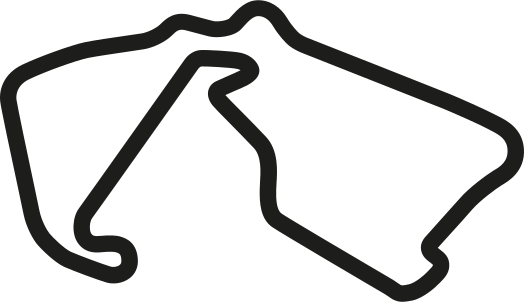
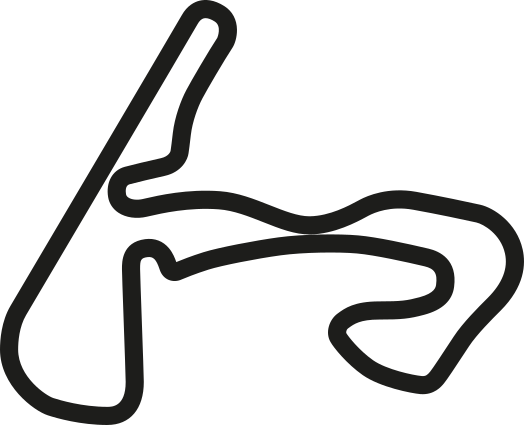
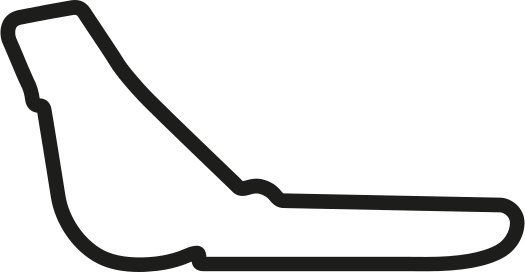
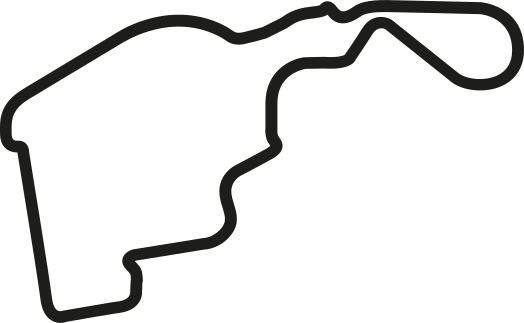
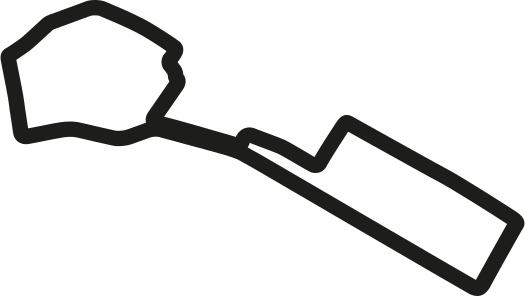
The biggest transformation came in 1971, when the track underwent a major redesign. A new pit straight and paddock complex was added, the start-finish line was moved, and the famous Boot section was introduced. This expanded the full Grand Prix layout to 3.377 miles (5.435 kilometres) and created the configuration most associated with Watkins Glen’s Formula One era.
The circuit changed again in 1975, when a chicane was added in the esses following the death of François Cevert in practice for the 1973 United States Grand Prix. Later, in 1992, the Inner Loop bus-stop chicane was installed on the back straight after several major accidents, including the fatal crash of NASCAR driver J. D. McDuffie in 1991.
Today, Watkins Glen uses two main layouts: the full Grand Prix circuit with the Boot and the shorter course that bypasses it. Despite various safety modifications, the venue’s essential character has remained intact for decades.
When was the first United States Grand Prix at Watkins Glen?
Watkins Glen first hosted the United States Grand Prix in 1961, when organisers needed a new permanent home for Formula One in America after unsatisfactory races at Sebring in 1959 and Riverside in 1960.
The 1961 race was won by Innes Ireland in a Lotus, marking the beginning of a remarkable 20-year run for the United States Grand Prix at Watkins Glen. During that period, the race became an autumn tradition and one of the most highly regarded events on the Formula One calendar.
The Glen earned a reputation for being especially popular with teams and drivers, who appreciated the organisation, atmosphere, and prize money. The event even won the Grand Prix Drivers’ Association award for best-organised Grand Prix in 1965, 1970, and 1972.
Many of Formula One’s biggest names won at Watkins Glen, and the race became closely associated with the final stretch of championship seasons. But by the late 1970s, rising costs, safety concerns, and growing financial problems began to threaten the event. After Alan Jones won the 1980 United States Grand Prix, the venue was removed from the championship calendar, and the race disappeared after the organisers failed to meet financial obligations.
Even after Formula One left, Watkins Glen remained a major American road-racing venue, continuing with endurance racing, NASCAR, IndyCar, and numerous national championships.
Watkins Glen International lap record
Because Watkins Glen has used several major Formula One layouts, the lap record varies by era.
For the 1975–1980 Grand Prix circuit with the Esses chicane, the official Formula One race lap record is 1:34.068, set by Alan Jones in a Williams FW07B during the 1980 United States Grand Prix.
For the earlier 1971–1974 Grand Prix circuit, the Formula One race lap record was 1:40.608, set by Carlos Pace in a Brabham BT44 during the 1974 United States Grand Prix.
On the original 1956–1970 permanent Grand Prix circuit, the Formula One race lap record was 1:02.740, set by Jacky Ickx in a Ferrari 312B during the 1970 United States Grand Prix.