





























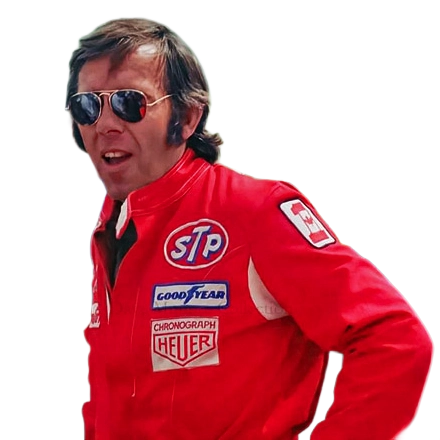
William Brack (born 26 December 1935) is a former Canadian racing driver whose career took him from sliding Minis around frozen Ontario circuits to competing at the highest level of international motorsport. A Formula One driver and later a major force in the Atlantic Championship, Brack became one of Canada’s famous racing figures during the 1960s and 1970s.
Driver Bio
| Nationality | Canadian |
| Birthplace | Toronto, Ontario, Canada |
| Born | 26 December 1935 |
| First Grand Prix | 1968 Canadian Grand Prix |
| Last Grand Prix | 1972 Canadian Grand Prix |
| Years Active | 1968–1969, 1972 |
| Current/Last Team | BRM |
Early Racing Career
Born in Toronto, Ontario, Canada, Brack did not begin his motorsport story in a glamorous Grand Prix paddock. Instead, his first serious taste of competition came on the ice.
During the early 1960s, Brack became involved in ice racing in Huntsville, Ontario, driving Minis — initially using a company car. It was a distinctly Canadian introduction to motorsport and one that demanded plenty of car control, with drivers having to master low-grip conditions rather than the smooth asphalt of a conventional racing circuit.
What began as an adventurous way into competition soon became considerably more serious. Brack went on to buy the racing Mini belonging to Gordon Brown, another Mini competitor who was also involved in the British-car trade. Brown worked as a dealer of British automobiles at Glendale Suburban Motors in Brampton.
The move gave Brack a proper competition car of his own and helped set him on a path that would eventually lead far beyond Ontario’s frozen racing courses.
Reaching Formula One
Brack’s progress through motorsport ultimately carried him all the way to Formula One, placing him among the relatively small number of Canadian drivers to reach Grand Prix racing.
During his Formula One career, he raced machinery associated with two of the sport’s famous British constructors: Lotus and BRM. It was a considerable leap from his beginnings in Minis, putting Brack into the intensely competitive world of Formula One during an era when the cars were becoming faster and increasingly sophisticated, while racing remained notoriously unforgiving.
Although Formula One became the highest-profile chapter of Brack’s career, it would not be the part in which he enjoyed his greatest run of championship success.
Formula Atlantic Succes
After his time in Formula One, Brack turned his attention to Atlantic racing and established himself as one of Canada’s leading competitors of the period.
The mid-1970s proved particularly successful, but his championship-winning streak actually began in 1973. Brack captured the Canadian Formula Atlantic Championship that season and then repeated the achievement in 1974.
Rather than stopping at two, he completed the hat-trick in 1975.
Three championships in three successive years — 1973, 1974 and 1975 — provided an emphatic conclusion to the competitive side of Brack’s racing career. His Formula Atlantic performances demonstrated that, while Formula One had given him an opportunity to compete on motorsport’s biggest stage, he remained a formidable championship racer after leaving Grand Prix competition behind.
Life After Racing
Following his successful spell in Formula Atlantic, Brack retired from racing and moved into the automotive business.
He opened Downtown Chrysler, a DaimlerChrysler dealership situated near the Canadian National Exhibition grounds in Toronto. It was a fitting second career for somebody whose working life had become so closely connected with cars, although selling them was undoubtedly rather less hazardous than racing them.
From ice-racing a company Mini in Ontario to Formula One machinery and three consecutive Canadian Formula Atlantic championships, Brack’s career followed an unusual route through Canadian motorsport.
William Brack and Kenny Bräck
Despite the similarity between their surnames — and the fact that both became successful racing drivers — William Brack is not related to Swedish racing driver Kenny Bräck.
The resemblance between the names has understandably caused occasional confusion, but their individual racing careers and family backgrounds are separate.
Grand Prix Stats
| Race Entries | 3 |
| Race Starts | 3 |
| Did Not Start | 0 |
| Best Race Start | 18th |
| Best Race Finish | NC |
| Retirements | 2 |
| First-Lap Retirements | 0 |
| Not Classified | 1 |
| Disqualified | 0 |
| Did Not Qualify | 0 |
Qualifying
| Qualifying Sessions | 3 |
| Reached Q3 | 0 |
| Q2 Eliminations | 0 |
| Q1 Eliminations | 0 |
| Did Not Qualify | 0 |
Stats by Season
| Year | Constructor | Entries | Starts | Wins | Podiums | Poles | Fastest Laps | Front Rows | DNF | Best Start | Best Result | Pts Finishes | Points | Championship |
|---|---|---|---|---|---|---|---|---|---|---|---|---|---|---|
| 1968 | Lotus | 1 | 1 | 0 | 0 | 0 | 0 | 0 | 1 | 20 | Ret | 0 | 0 | NC |
| 1969 | BRM | 1 | 1 | 0 | 0 | 0 | 0 | 0 | 0 | 18 | NC | 0 | 0 | NC |
| 1972 | BRM | 1 | 1 | 0 | 0 | 0 | 0 | 0 | 1 | 23 | Ret | 0 | 0 | NC |
Stats by Constructor
| Constructor | Years | Entries | Starts | Wins | Podiums | Poles | Fastest Laps | Front Rows | DNF | Best Start | Best Result | Pts Finishes | Points |
|---|---|---|---|---|---|---|---|---|---|---|---|---|---|
| Lotus | 1968 | 1 | 1 | 0 | 0 | 0 | 0 | 0 | 1 | 20 | Ret | 0 | 0 |
| BRM | 1969, 1972 | 2 | 2 | 0 | 0 | 0 | 0 | 0 | 1 | 18 | NC/Ret | 0 | 0 |
Teammates & Qualifying Head-to-Head
| Teammate | Years | Races | Qualifying H2H |
|---|---|---|---|
| Jackie Oliver | 1968, 1969 | 2 | – |
| Graham Hill | 1968 | 1 | – |
| John Surtees | 1969 | 1 | – |
| Howden Ganley | 1972 | 1 | – |
| Peter Gethin | 1972 | 1 | – |
| Jean-Pierre Beltoise | 1972 | 1 | – |