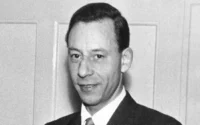























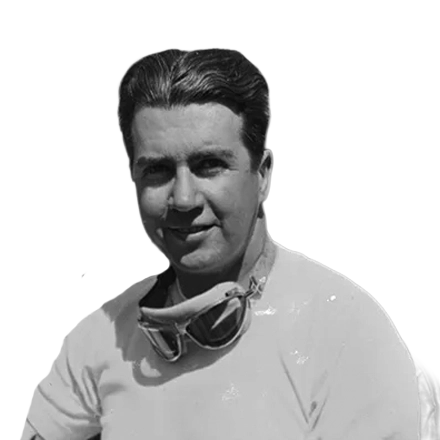
Willard Saulsbury “Bill” Holland was a formidable American racing driver from Philadelphia, Pennsylvania, best remembered for his 1949 victory at the Indianapolis 500. Consistently among the front-runners of his era, he also finished second in the famous race three times—in 1947, 1948, and 1950—and was runner-up in the 1947 American Automobile Association (AAA) National Championship.
Driver Bio
| Nationality | American |
| Birthplace | Philadelphia, Pennsylvania, USA |
| Born | 18 December 1907 |
| Died | 19 May 1984 |
| First Grand Prix | 1950 Indianapolis 500 |
| Last Grand Prix | 1953 Indianapolis 500 |
| Years Active | 1950, 1953–1954 |
| Current/Last Team | Privateer: Kurtis Kraft |
Holland was born into a sporting family—his father was both a fireman and a former professional baseball player. Early on, Holland showed athletic promise of his own, excelling in skating and even trying out for the 1932 Winter Olympics. Though that path didn’t pan out, it hinted at the discipline and competitive edge that would later define his racing career.
Driving career
Early success on the dirt tracks
Holland began to make a name for himself in “big car” racing (the forerunner to modern sprint cars) in the late 1930s. By 1937, he was already delivering strong performances, and in 1938 he claimed his first major victory at Mineola, New York.
What followed was a surge of success:
- Three wins in 1939
- Nine wins in 1940
That same year, he finished second to Joie Chitwood in the AAA Eastern Big Car championship, before going one better and claiming the title in 1941.
Like many drivers of his generation, his career was interrupted by World War II, which halted racing in the United States between 1942 and 1945. When competition resumed, Holland returned stronger than ever. In 1946 alone, he won 15 Eastern and one Midwestern races, finishing fourth in the national championship. That year also saw him win the very first AAA-sanctioned race at Selinsgrove Speedway—an achievement later honoured in his name.
Indianapolis glory and heartbreak
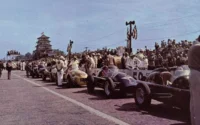
Holland’s reputation was cemented at Indianapolis, where he became a perennial contender.
In 1947, as a rookie, he came agonisingly close to victory. Leading late in the race, he mistakenly believed teammate Mauri Rose was a lap down and allowed him through—only to realise too late that he had given away the win.
He finished second again in 1948, reinforcing his status as one of the best drivers yet to claim the prize.
Finally, in 1949, everything came together. Driving for Lou Moore’s Blue Crown Spark Plug team, Holland held the lead while Rose—again his teammate—began to close in. Team orders instructed both drivers to hold position, but Rose pushed harder. Then, with just eight laps remaining, Rose’s car suffered a mechanical failure, leaving Holland to cruise to a well-earned victory.
The drama didn’t end there—Rose was dismissed from the team immediately after the race, underscoring the tension of that moment.
In 1950, Holland again finished second at Indianapolis, this time to Johnnie Parsons, after rain brought the race to an early conclusion.
Setbacks and return
In 1951, Holland’s career hit a controversial snag. He was suspended for a year by the AAA after competing in a NASCAR-sanctioned charity race—an act that violated strict rules prohibiting drivers from racing outside AAA events. The organisation enforced these rules rigorously, effectively blacklisting offenders.
Holland returned to Indy car racing in 1953 and continued competing at a high level until 1965. Over his career, he is believed to have amassed more than 40 sprint car feature wins and around 150 podium finishes.
Formula One connection
Due to the unique rules of the time, the Indianapolis 500 counted toward the Formula One World Championship from 1950 to 1960. As a result, Holland officially participated in two World Championship events at Indianapolis.
He recorded one top-three finish and scored six championship points—an unusual but notable link between American oval racing and the global Formula One stage.
Life beyond racing
After stepping back from competition, Holland and his wife, Myra, ran skating rinks in Bridgeport, Connecticut—returning, in a way, to the sport that first showcased his athletic talent. They later lived in Colorado Springs before settling in Tucson, Arizona, in the early 1970s.
Even in later life, Holland remained remarkably active, reportedly cycling up to 50 miles a day until shortly before his health declined.
Final years and legacy
In November 1983, Holland was diagnosed with Alzheimer’s disease. He died from complications of the illness on May 20, 1984.
His contributions to American motorsport were later recognised with induction into the Auto Racing Hall of Fame (1992) and the National Sprint Car Hall of Fame (2005). In tribute, a race at Selinsgrove Speedway was named the Bill Holland Classic, honouring both his victory there and his lasting influence on the sport.
Grand Prix Stats
| Race Entries | 3 |
| Race Starts | 2 |
| Did Not Start | 0 |
| Best Race Start | 10th |
| Best Race Finish | 2nd |
| Retirements | 0 |
| First-Lap Retirements | 0 |
| Not Classified | 0 |
| Disqualified | 0 |
| Did Not Qualify | 1 |
Podiums
| Podiums | 1 |
| First Podium | 1950 Indianapolis 500 |
| Last Podium | 1950 Indianapolis 500 |
| 1st Place | 0 |
| 2nd Place | 1 |
| 3rd Place | 0 |
| Most Consecutive Podiums | 0 |
| Most Podiums in a Single Season | 1 |
| Seasons with Podiums | 1 |
Qualifying
| Qualifying Sessions | 3 |
| Reached Q3 | 0 |
| Q2 Eliminations | 0 |
| Q1 Eliminations | 0 |
| Did Not Qualify | 1 |
Points
| Points Scored | 6 |
| Points Finishes | 1 |
| Most Points in a Single Season | 6 |
| Seasons with Points | 1 |
Stats by Season
| Year | Constructor | Entries | Starts | Wins | Podiums | Poles | Fastest Laps | Front Rows | DNF | Best Start | Best Result | Pts Finishes | Points | Championship |
|---|---|---|---|---|---|---|---|---|---|---|---|---|---|---|
| 1950 | Deidt | 1 | 1 | 0 | 1 | 0 | 0 | 0 | 0 | 10th | 2nd | 1 | 6 | 7th |
| 1953 | Privateer: Kurtis Kraft | 1 | 1 | 0 | 0 | 0 | 0 | 0 | 0 | – | – | 0 | 0 | NC |
| 1954 | Privateer: Kurtis Kraft | 1 | 0 | 0 | 0 | 0 | 0 | 0 | 0 | – | DNQ | 0 | 0 | NC |