



















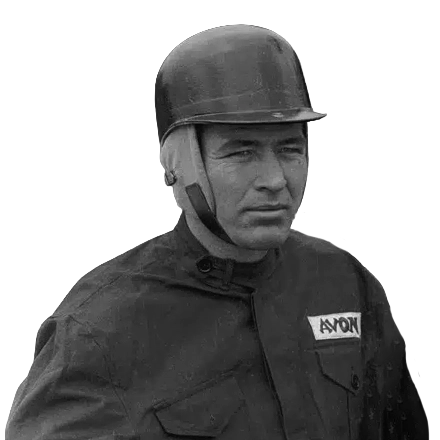
Carroll Shelby was one of the most influential figures in American motorsport—an elite racing driver, inspired engineer, fearless entrepreneur, and the driving force behind some of the most legendary performance cars ever built.
| Nationality | American |
|---|---|
| Born | Carroll Hall Shelby 11 January 1923 Leesburg, Texas, U.S. |
| Died | 10 May 2012 (aged 89) Dallas, Texas, U.S. |
Shelby’s name is inseparable from icons such as the AC Cobra, the Shelby Mustang, and Ford’s all-conquering GT40. Working alongside legendary driver Ken Miles, Shelby played a central role in developing the GT40 into a world-beater—one that went on to win the 24 Hours of Le Mans four consecutive times (1966–1969). As of 2024, the GT40 remains the only American-built car ever to win Le Mans overall, a feat later immortalised in the Academy Award–winning 2019 film Ford v Ferrari (released as Le Mans ’66 in parts of Europe).
Before he became a constructor and automotive visionary, Shelby was already a world-class racer. In 1959, he reached the summit of international endurance racing by winning the 24 Hours of Le Mans outright, co-driving an Aston Martin DBR1 with Roy Salvadori. The following year, he captured the 1960 SCCA/USAC Road Racing Sports Car Championship, winning at Riverside International Raceway in a Maserati Tipo 61 “Birdcage” and following up with victory at Continental Divide Raceway in a Chevrolet Scarab Mark II.
In 1962, Shelby founded Shelby American, the company that would turn his racing insight into production performance cars. Five years later, he published his autobiography, The Carroll Shelby Story (1967), documenting a life already packed with risk, resilience, and reinvention.
Early life
Carroll Shelby was born in Leesburg, Texas, to Warren Hall Shelby, a rural mail carrier, and Eloise Shelby (née Lawrence). By age seven, he was already battling serious heart valve issues—health challenges that would follow him throughout his life and ultimately shape many of his decisions.
From an early age, Shelby was drawn to speed in all its forms. After moving with his family to Dallas, he would ride his bicycle miles to nearby dirt tracks just to watch races. By 15, he was already driving and maintaining his father’s Ford, and while attending Woodrow Wilson High School, he sharpened his mechanical instincts working on his Willys automobile. He graduated in 1940 and briefly enrolled in the Georgia Institute of Technology, studying aeronautical engineering.
With World War II looming, Shelby enlisted in the United States Army Air Corps on April 11, 1941, months before Pearl Harbor. He began pilot training at Randolph Field, earning his wings as a staff sergeant pilot in 1942 before being commissioned as a second lieutenant later that year. During the war, Shelby served as a flight instructor and test pilot, training bombardiers and navigators while flying aircraft ranging from the AT-11 Kansan to the B-29 Superfortress. He was stationed at numerous air bases across Texas and Colorado before being discharged after V-J Day.
the road to racing
Civilian life initially proved turbulent. Shelby tried his hand at a dump truck business, worked as an oil-field roughneck, and later attempted to run a poultry farm, which collapsed into bankruptcy in 1952. That same year, he entered his first races—and everything changed.
Shelby began racing as an amateur, debuting in a friend’s MG TC at a drag meet at Grand Prairie Naval Air Station. He soon progressed to racing Cadillac-Allards, winning multiple events across Texas. Importantly, Shelby raced purely for trophies—refusing prize money—and by the end of 1952 had already claimed four wins.
By 1953, his reputation was growing. He continued winning races in Cad-Allards, collecting eight or nine victories in a single season. In 1954, Shelby stepped onto the international stage, competing in Argentina’s Mil Kilómetros de Buenos Aires, where he met John Wyer, Aston Martin’s team manager. That meeting led directly to factory drives for Aston Martin at Sebring, Aintree, Le Mans, and beyond.
Shelby’s European campaign accelerated rapidly. He raced at Monza, Silverstone, and Le Mans, where Aston Martin dominated events. In 1954 alone, Shelby was part of a three-car Aston Martin sweep at Silverstone with Peter Collins and Roy Salvadori.
Records and rising fame
In 1955, Shelby joined Donald Healey’s team, setting Class D national speed records at the Bonneville Salt Flats in Austin-Healey 100S variants. Alongside a small group of elite drivers and engineers, Shelby helped set roughly 70 speed records, 17 of them personally. That same year, he survived a severe crash in the Carrera Panamericana, followed by multiple surgeries—yet he returned to racing within months.
By 1956, Shelby was unstoppable. Driving Ferraris, he won around 30 races, opened Carroll Shelby Sports Cars in Dallas, and shattered hillclimb records at Mount Washington and Giants Despair. His performances earned him Sports Illustrated’s Driver of the Year award—an honor he repeated in 1957, even after surviving a brutal crash at Riverside Raceway that required extensive facial surgery.
Formula One
Carroll Shelby’s time in Formula One was brief, demanding, and anything but comfortable—but it completed his education at the very top of world motorsport.
Shelby entered Formula One not as a career single-seater specialist, but as an already accomplished sports car star. By the late 1950s, his reputation for speed, mechanical sympathy, and toughness made him a valuable asset to manufacturers looking for adaptable drivers who could handle difficult machinery under punishing conditions.
In 1958, Shelby drove a Maserati 250F for Scuderia Centro Sud, one of the era’s most respected privateer teams. His Formula One debut came at the 1958 Portuguese Grand Prix, where he finished 10th—a respectable result in a highly competitive field filled with factory-backed teams and established Grand Prix stars.
Shelby returned to Formula One in 1959, this time driving for Aston Martin, which had entered the championship with its front-engined DBR4 and later the DBR5. These cars were beautifully engineered but already outclassed by the new generation of rear-engined machines from Cooper and Lotus. Shelby competed in the Dutch Grand Prix, the British Grand Prix at Aintree, the Portuguese Grand Prix, and the Italian Grand Prix, often battling handling issues, reliability problems, and the fundamental disadvantage of outdated design.
Despite the machinery, Shelby earned a reputation in Formula One circles as a driver who could extract results from difficult cars. He was candid about the experience, later acknowledging that Formula One required a different rhythm and precision than sports car racing, but valuing the exposure to Grand Prix engineering and racecraft. The experience also deepened his understanding of chassis balance, aerodynamics, and high-speed stability—knowledge that would later prove invaluable as a constructor.
Shelby never pursued Formula One as a long-term ambition. Ongoing heart problems, combined with the physical strain of Grand Prix racing and his growing success in endurance events, made a full F1 campaign impractical. By the end of 1959, he shifted his focus back to sports cars, where he would soon achieve immortality at Le Mans.
While his Formula One career yielded no podiums and no championship points, it remains a crucial—if often overlooked—part of his story. Formula One sharpened Shelby’s technical instincts and reinforced a lesson that defined his later success: winning wasn’t just about driving fast—it was about building the right car.
In that sense, Shelby’s time in Formula One didn’t end in trophies—but it helped create the man who would go on to build cars that conquered the world.
Le Mans and final races
Shelby’s defining moment came in 1959, when he and Roy Salvadori drove the Aston Martin DBR1 to overall victory at the 24 Hours of Le Mans. Shelby later described it as the greatest thrill of his racing life—one that instantly transformed credibility into opportunity.
Despite ongoing health problems, Shelby continued racing through 1960, competing in Grand Prix events, endurance races, and international championships across Europe, the Americas, and New Zealand. His final race came at the Los Angeles Times Grand Prix, after which heart issues forced him to retire from driving.
From driver to constructor
Retirement didn’t slow Shelby—it redirected him. In 1961, he opened the Shelby School of High Performance Driving with Pete Brock, then launched Shelby-American, determined to build a truly American performance car.
That vision became the AC Cobra: a lightweight British chassis paired with a thunderous Ford V8. With backing from Ford Motor Company and AC Cars, Shelby brought the Cobra to life in 1962, selling 75 cars in its first year. Engine sizes grew rapidly, culminating in the fearsome 427 Cobra prototype by 1964.
To beat Ferrari at its own game, Shelby created the Daytona Coupe, an aerodynamically optimised Cobra variant that dominated GT racing. By 1965, Shelby American had won the International Championship for GT Manufacturers.
Shelby’s success led Ford to hand him control of the struggling GT40 program. Under Shelby’s leadership, the GT40 Mark II—powered by a 7.0-liter V8—delivered Ford’s historic 1-2-3 finish at Le Mans in 1966, followed by further wins in 1967, 1968, and 1969. The radical Mark IV, finalized under Shelby’s guidance, secured victory in 1967, during which Dan Gurney famously sprayed champagne on the podium—starting a tradition that endures today.
Mustangs and later years
Shelby’s partnership with Ford also produced the Shelby GT350 (1965) and GT500 (1967), transforming the Mustang into a world-class performance car. Shelby-produced Mustangs ran through 1968, after which Ford continued the brand internally.
In later decades, Shelby collaborated with Dodge (Chrysler) and Oldsmobile (GM), consulted on performance projects, and oversaw the production of “continuation” Cobras, officially designated the CSX4000 series, which remain in production.
His achievements earned him induction into the International Motorsports Hall of Fame (1991), the Motorsports Hall of Fame of America (1992), the Automotive Hall of Fame (1992), and the SCCA Hall of Fame (2013), among others.
In 2003, Shelby reunited with Ford as technical advisor for the modern Ford GT, and that same year founded Carroll Shelby International, ensuring that his influence on performance cars would continue well into the 21st century.
Carroll Shelby didn’t just race cars—he reshaped what American performance meant to the world.
Carroll Shelby Formula One World Championship career
| F1 Career | 1958–1959 |
|---|---|
| Teams | Aston Martin, non-works Maserati |
| Entries | 8 |
| Championships | 0 |
| Wins | 0 |
| Podiums | 0 |
| Career points | 0 |
| Pole positions | 0 |
| Fastest laps | 0 |
| First entry | 1958 French Grand Prix |
| Last entry | 1959 Italian Grand Prix |
Carroll Shelby Teammates
| 4 drivers | Involvement | First Year | Last Year |
|---|---|---|---|
| Gerino Gerini | 3 | 1958 | |
| Troy Ruttman | 1 | 1958 | |
| Masten Gregory | 1 | 1958 | |
| Roy Salvadori | 4 | 1959 |
Carroll Shelby Complete Formula One Results
| Year | Entrant | Chassis | Engine | 1 | 2 | 3 | 4 | 5 | 6 | 7 | 8 | 9 | 10 | 11 | WDC | Pts |
|---|---|---|---|---|---|---|---|---|---|---|---|---|---|---|---|---|
| 1958 | Scuderia Centro Sud | Maserati 250F | Maserati 250F1 2.5 L6 | ARG | MON | NED | 500 | BEL | FRA Ret | GBR 9 | GER | ITA Ret* | NC | 0 | ||
| Temple Buell | POR 9 | ITA 4* | MOR | NC | ||||||||||||
| 1959 | David Brown Corporation | Aston Martin DBR4/250 | Aston Martin RB6 2.5 L6 | MON | 500 | NED Ret | FRA | GBR Ret | GER | POR 8 | ITA 10 | USA | NC | 0 |