




























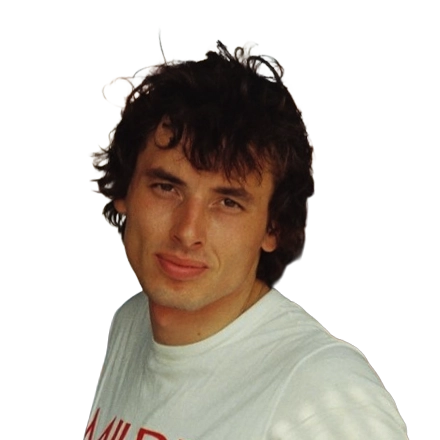
Jo Gartner was one of Austria’s most respected racing talents of the 1980s — a determined privateer who fought his way from grassroots motorsport into Formula One and international endurance racing through persistence, technical knowledge, and sheer speed. Although his Formula One career was short-lived, Gartner earned admiration throughout the paddock for his resilience and versatility, particularly in sports car racing, where he became one of Porsche’s standout drivers of the era.
Driver Bio
| Nationality | Austrian |
| Birthplace | Vienna, Austria |
| Born | 24 January 1954 |
| Died | 1 June 1986 |
| First Grand Prix | 1984 San Marino Grand Prix |
| Last Grand Prix | 1984 Portuguese Grand Prix |
| Years Active | 1984 |
| Current/Last Team | Osella |
Born in Vienna, Gartner’s route into motorsport was far from glamorous. In 1972, he began working behind the scenes for the Kaimann Formula Super Vee team in a technical role, learning the mechanical side of racing before seriously pursuing a driving career himself. Resourceful from the beginning, he bought, modified, and sold his own Formula Vee chassis before entering hillclimb competitions in 1976.
By 1977, at the age of 23, Gartner had committed fully to racing, competing in the Volkswagen-backed European Formula Super Vee Championship. A year later, he finished third in the standings, marking himself out as one of the category’s most promising young drivers.
His rise continued into the European Formula Three Championship in 1979, where he drove a Martini supported by Renault. In 1980, Gartner stepped up to Formula Two with an ageing March chassis. His debut weekend was overshadowed by tragedy when debris from the accident that killed fellow Austrian Markus Höttinger damaged Gartner’s car. In the aftermath, Gartner was invited to replace Höttinger in the BMW M1 Procar Championship — a spectacular series featuring Formula One stars — where he raced for fellow Austrian Helmut Marko.
Over the next several seasons, Gartner battled through the ultra-competitive Formula Two ranks with limited resources but growing respect. In 1981 he scored a point at Enna-Pergusa, and after joining the Merzario team later that season, continued to grind out respectable performances despite often uncompetitive machinery. His breakthrough finally arrived in 1983 driving his own ex-works Spirit 201. After an impressive fourth place at Hockenheim, Gartner inherited victory in the prestigious Pau Grand Prix when race winner Alain Ferté was disqualified for running an underweight car. The result became the launchpad for his Formula One ambitions.
Formula One
That opportunity arrived in 1984 with the struggling Italian Osella Formula One team. Gartner secured the second seat alongside Piercarlo Ghinzani, initially driving an older non-turbo FA1E before later switching to the newer turbocharged FA1F. He qualified for his Formula One debut at the 1984 San Marino Grand Prix, although engine failure ended his race early.
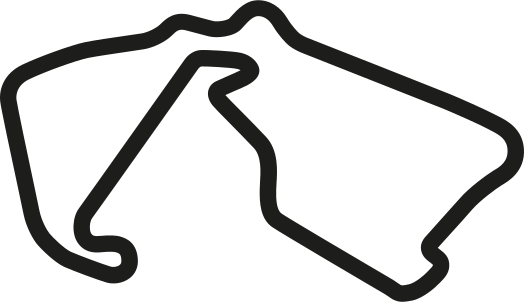
His rookie season became a constant battle against unreliable machinery and financial limitations, but Gartner’s determination repeatedly shone through. At the British Grand Prix, he was allowed onto the grid in 27th place due to the unusual circumstances surrounding the Tyrrell team’s appeal case, though he was eliminated in a first-lap accident involving Philippe Alliot and Eddie Cheever.
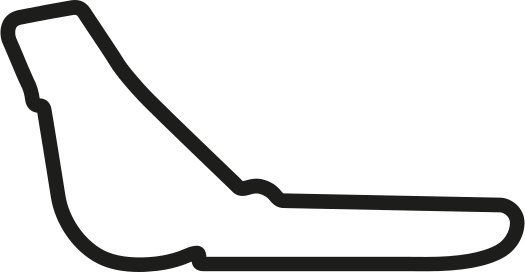
The defining moment of his Formula One career came later that year at Monza. Starting 24th in the Italian Grand Prix, Gartner drove brilliantly to finish fifth, even beating fellow Austrian Gerhard Berger to the line. Under normal circumstances, the result would have earned him two World Championship points. However, because Osella had officially entered only one car at the start of the season, Gartner was cruelly denied the points despite completing the achievement on track — one of the more unfortunate footnotes in Formula One history.
Unable to secure a competitive Formula One drive for 1985 despite discussions with Arrows, Toleman, and Osella, Gartner increasingly focused on endurance racing, where his reputation rapidly grew. Driving Porsche sports cars for Fitzpatrick Racing and Bob Akin’s IMSA team, he established himself as an elite long-distance racer. He finished fourth at the 1985 24 Hours of Le Mans in a Porsche 962C alongside David Hobbs and Guy Edwards, and in 1986 scored a dramatic victory at the 12 Hours of Sebring with Bob Akin and Hans-Joachim Stuck — famously bringing the damaged Porsche home on just three wheels.
By 1986, Gartner was viewed as a serious contender for a future factory Porsche drive with the Rothmans-backed works team.
Tragically, that future never arrived.
Death
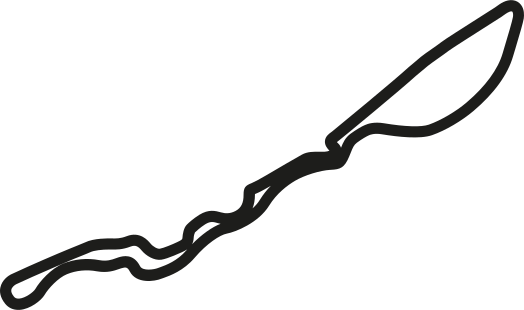
During the 1986 24 Hours of Le Mans, Gartner was driving for Kremer Racing alongside Sarel van der Merwe and Kunimitsu Takahashi when disaster struck in the early hours of Sunday morning. At around 2:10 a.m., his Porsche 962 suffered a catastrophic failure on the Mulsanne Straight while travelling at approximately 160 mph (260 km/h). The car suddenly veered hard left into the barriers, somersaulted violently down the circuit, struck a telephone pole, tore through trees, and burst into flames after coming to rest atop the barriers.
The impact destroyed over 100 metres of guardrail and scattered debris across 200 metres of track. Gartner was killed instantly by a broken neck. Although the precise cause of the accident was never conclusively determined, marshals reported seeing him brake moments before the crash, suggesting a possible gearbox failure.
His death sent shockwaves through endurance racing. Gartner became the last driver to lose his life during the race itself at Le Mans until the death of Allan Simonsen in 2013.
Grand Prix Stats
| Race Entries | 8 |
| Race Starts | 8 |
| Did Not Start | 0 |
| Best Race Start | 22nd |
| Best Race Finish | 5th |
| Retirements | 6 |
| First-Lap Retirements | 1 |
| Not Classified | 0 |
| Disqualified | 0 |
| Did Not Qualify | 0 |
Qualifying
| Qualifying Sessions | 8 |
| Reached Q3 | 0 |
| Q2 Eliminations | 0 |
| Q1 Eliminations | 0 |
| Did Not Qualify | 0 |
Stats by Season
| Year | Constructor | Entries | Starts | Wins | Podiums | Poles | Fastest Laps | Front Rows | DNF | Best Start | Best Result | Pts Finishes | Points | Championship |
|---|---|---|---|---|---|---|---|---|---|---|---|---|---|---|
| 1984 | Osella | 8 | 8 | 0 | 0 | 0 | 0 | 0 | 6 | 22 | 5 | 0 | 0 | NC |
Stats by Constructor
| Constructor | Years | Entries | Starts | Wins | Podiums | Poles | Fastest Laps | Front Rows | DNF | Best Start | Best Result | Pts Finishes | Points |
|---|---|---|---|---|---|---|---|---|---|---|---|---|---|
| Osella | 1984 | 8 | 8 | 0 | 0 | 0 | 0 | 0 | 6 | 22 | 5 | 0 | 0 |
Teammates & Qualifying Head-to-Head
| Teammate | Years | Races | Qualifying H2H |
|---|---|---|---|
| Piercarlo Ghinzani | 1984 | 8 | 2-6 |