






















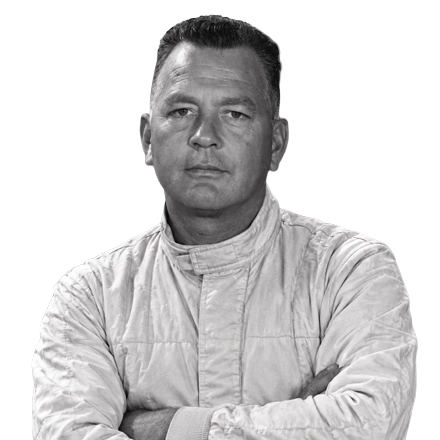
Ray Crawford (26 October 1915 – 1 February 1996) was an American fighter ace, test pilot, racing driver and businessman. Known as “The Flying Grocer,” he moved from combat in a P-38 Lightning to testing America’s earliest jets, then built a motor-racing career as one of the post-war era’s pioneering owner-drivers.
Driver Bio
| Nationality | American |
| Birthplace | Roswell, New Mexico, USA |
| Born | 26 October 1915 |
| Died | 1 February 1996 |
| First Grand Prix | 1955 Indianapolis 500 |
| Last Grand Prix | 1959 Indianapolis 500 |
| Years Active | 1955–1959 |
| Current/Last Team | Elder |
Military career
Born in Roswell, New Mexico, Crawford joined the U.S. Army Air Corps and flew the Lockheed P-38 Lightning in combat over North Africa during 1943.
He was credited with destroying six enemy aircraft, with another listed as probably destroyed. That record left him tied as the leading fighter ace of the 97th Fighter Squadron.
After returning to the United States, Crawford became one of the country’s early jet pilots. Near the end of the war, he was stationed at Lockheed’s Burbank facility and helped evaluate the P-80 Shooting Star. Crawford had been scheduled to fly the same aircraft in which America’s leading ace, Richard Bong, was later killed.
His military decorations included the Distinguished Flying Cross and the Air Medal with 14 Oak Leaf Clusters. Crawford left active service with the rank of captain in February 1946 but remained in the Air Force Reserve until April 1953.
Racing career
Crawford’s introduction to motor racing came through former high-school classmate Sam Hanks. His competitive interests extended to both cars and unlimited hydroplanes, although automobiles ultimately supplied his best-known results.
From 1954 through 1959, Crawford made nine starts in the AAA and USAC Championship Car series. Three of those appearances came at the Indianapolis 500, which he contested in 1955, 1956 and 1959.
He was among the first post-war drivers to enter the Indianapolis Motor Speedway in machinery he owned himself. Crawford privately financed and raced his cars rather than relying on an established team, an approach that made him part driver, part entrant and part businessman.
His cars also reached the Indianapolis 500 with other drivers, qualifying for the race in 1953, 1954 and 1962.
Mexico, Monza and Sebring
Crawford’s greatest international result came in the 1954 Carrera Panamericana. Driving a Lincoln, he won the stock-car category in the fearsome nine-stage road race across Mexico, an event spread over five days.
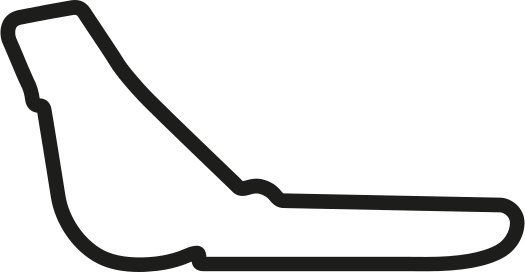
He later travelled to Italy for the invitational Race of Two Worlds at Monza, where American oval racers confronted European machinery on the circuit’s high-speed banking. Crawford finished seventh in the 1957 edition and improved to fourth in 1958.
His most extraordinary feat came at the 1955 12 Hours of Sebring. Crawford drove a Lincoln-Kurtis sports car for the entire race without assistance from a co-driver and finished 13th. He remains the only competitor known to have completed Sebring’s full 12-hour distance entirely alone.
Crawford generally competed with his own machinery, but Chevrolet provided a notable exception. In 1956, he joined the manufacturer’s inaugural Corvette team for the 12 Hours of Sebring. That December, he also drove the experimental Corvette SR-2 during Bahamas Speedweeks.
A serious crash at the 1959 Indianapolis 500 left Crawford badly injured and effectively brought his driving career to an end.
Business and influence
Crawford’s family operated a successful supermarket chain based in El Monte, California. His twin associations with aviation and grocery retail produced the memorable nickname “The Flying Grocer.”
His influence also reached the next generation of American speed specialists. Mickey Thompson later identified Crawford as an important early inspiration in his autobiography, Challenger. Crawford gave Thompson his first direct experience of the Indianapolis 500 by adding him to the pit crew.
Later life
Crawford died in Los Angeles on 1 February 1996 following a battle with Alzheimer’s disease. He was buried at Riverside National Cemetery in Riverside, California.
His life was documented in Andrew Layton’s 2015 biography, Ray Crawford – Speed Merchant, which also featured contributions from noted racing photographer and publisher Dick Wallen.
Grand Prix Stats
| Race Entries | 5 |
| Race Starts | 3 |
| Did Not Start | 0 |
| Best Race Start | 17th |
| Best Race Finish | – |
| Retirements | 3 |
| First-Lap Retirements | 0 |
| Not Classified | 0 |
| Disqualified | 0 |
| Did Not Qualify | 2 |
Qualifying
| Qualifying Sessions | – |
| Reached Q3 | – |
| Q2 Eliminations | – |
| Q1 Eliminations | – |
| Did Not Qualify | 2 |
Stats by Season
| Year | Constructor | Entries | Starts | Wins | Podiums | Poles | Fastest Laps | Front Rows | DNF | Best Start | Best Result | Pts Finishes | Points | Championship |
|---|---|---|---|---|---|---|---|---|---|---|---|---|---|---|
| 1955 | Kurtis Kraft | 1 | 1 | 0 | 0 | 0 | 0 | 0 | 1 | 26th | 23rd | 0 | 0 | NC |
| 1956 | Kurtis Kraft | 1 | 1 | 0 | 0 | 0 | 0 | 0 | 1 | 17th | 29th | 0 | 0 | NC |
| 1959 | Elder | 1 | 1 | 0 | 0 | 0 | 0 | 0 | 1 | 32nd | 23rd | 0 | 0 | NC |