





























Formula 1’s latest return to ground-effect philosophy is already drawing to a close. In 2026, ‘Active Aero’ takes centre stage, with the potential to fundamentally alter how drivers attack, defend, and manage performance over a lap.
While the regulations see the return of a flat floor and rear diffuser layout, concepts the teams are well versed in, the framework surrounding their use has evolved significantly. Designers now face a new set of challenges as they integrate these elements into cars that must be efficient, stable, and race-ready in traffic.
See also…


A regulation shaped by compromise
The 2026 season rules have been carefully designed to mitigate some of the consequences of the new power unit architecture and to address one of Formula 1’s long-standing problems: wake turbulence.
At the heart of that effort lies the most visually striking change of the new era – the introduction of ‘Active Aero’. For the first time, both the front and rear wings will feature movable elements designed to reduce drag on designated straights. These elements flatten when drag reduction is required, then revert to their high-downforce configuration for cornering, restoring balance and grip.
Familiar ideas, expanded further
At the rear of the car, this concept will look familiar. The sport has used DRS since 2011 to promote overtaking, and fans have become accustomed to seeing the rear wing open along the straights.
What will take some getting used to is the front wing adopting similar behaviour. Although unusual in the modern era, this is not entirely new territory for Formula 1.
Brawn GP famously ran a movable front wing solution on the BGP001 during the 2009 regulation reset. Drivers were permitted to adjust the front wing flaps twice per lap, with the aim of improving balance while following another car.
In practice, the concept failed to deliver the intended gains and was quietly abandoned after two seasons. DRS subsequently became the sole driver-operated aerodynamic device.
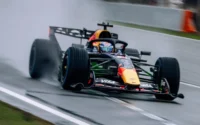
Interestingly, the pod-style actuator arrangement seen on the Brawn BGP001 bears similarities to solutions already previewed in 2026 renders. Racing Bulls have shown a twin-pod configuration, while sister team Red Bull has opted for a single central actuator beneath the nose.
Active Aero, front and rear
Unlike previous experiments, Active Aero in 2026 is a fully integrated system that works in unison at both ends of the car.
The front wing undergoes a notable simplification. Instead of four elements spanning its width, the new regulations allow just three. Of those, the upper two are movable, with teams free to decide how aggressively the flap or flaps are flattened on the straights.
This flexibility gives designers another powerful tuning tool, allowing them to balance straight-line efficiency against cornering performance depending on their overall aerodynamic concept.
Rear wing: smaller box, bigger challenge
The rear wing also evolves under the new rules. It may now comprise three elements rather than two, but the volume within which those elements must sit – the allowable box region – is significantly reduced compared with the previous generation.
That constraint significantly increases the difficulty. Designers must generate sufficient downforce for cornering while ensuring the car sheds drag effectively when Active Aero is deployed on the straights.
The result is a regulatory environment that rewards efficiency, precision and clever mechanical integration, rather than brute-force downforce alone.
Seen in: