




































Automobiles Ettore Bugatti was a French automobile manufacturer famed for producing some of the world’s most successful luxury and racing cars during the early twentieth century. Founded in 1909 by Italian-born engineer Ettore Bugatti in Molsheim, Alsace, the company established a global reputation through Grand Prix wins and technical innovation long before the creation of the Formula One World Championship.
| Nationality | French |
| Years Active | 1956 |
| First Race | 1956 French Grand Prix |
| Last Race | 1956 French Grand Prix |
| Race Entries | 1 |
| Race Starts | 1 |
| Wins | 0 |
| Podiums | 0 |
| Pole Positions | 0 |
| Fastest Laps | 0 |
| Points | 0 |
| Constructors’ Championships | 0 |
| Drivers’ Championships | 0 |
| Best Start | 18th |
| Did Not Start | 0 |
| Did Not Qualify | 0 |
| Retirements | 1 |
Although Bugatti dominated pre-war motorsport, its involvement in the Formula One World Championship was remarkably brief. The marque made just a single World Championship appearance at the 1956 French Grand Prix with the innovative Bugatti Type 251, a project that ultimately marked the company’s final attempt to compete at the highest level of Grand Prix racing.
Background
During the 1920s and 1930s, Bugatti was one of Europe’s premier racing manufacturers. Cars such as the legendary Type 35 achieved extraordinary success, winning hundreds of races and becoming one of the most successful competition cars in motorsport history. The company also enjoyed victories in prestigious events including the French Grand Prix, Targa Florio, and numerous international Grand Prix races, cementing Bugatti’s status as one of the defining names of pre-war motor racing.
Following the death of company founder Ettore Bugatti in 1947, the manufacturer struggled to recover from the economic effects of the Second World War. Limited investment, declining sales, and increasing competition left the company in a weakened financial position. By the early 1950s, Bugatti had largely withdrawn from competitive motorsport, and automobile production had effectively ceased.
Despite these difficulties, the company sought to revive its sporting reputation through a return to Grand Prix racing under the Formula One regulations introduced in 1954.
The Bugatti Type 251
Bugatti’s Formula One project centred on the Type 251, a revolutionary Grand Prix car designed by renowned Italian engineer Gioachino Colombo, whose earlier work included championship-winning Alfa Romeo and Ferrari racing cars.
The Type 251 was unconventional in almost every respect. While the majority of Formula One cars of the mid-1950s retained a traditional front-engine layout, Colombo adopted a transverse rear-mounted inline-eight engine, positioned behind the driver to improve weight distribution and handling. This arrangement was highly innovative for its time and anticipated the rear-engined revolution that would sweep Formula One only a few years later with the success of Cooper.
Power came from a naturally aspirated 2.5-litre straight-eight engine, built to the contemporary Formula One regulations. The chassis also featured advanced suspension geometry and a low centre of gravity, demonstrating Bugatti’s willingness to challenge established design conventions. However, the complexity of the project and the company’s limited resources meant that development remained incomplete when the car reached competition.
Formula One debut
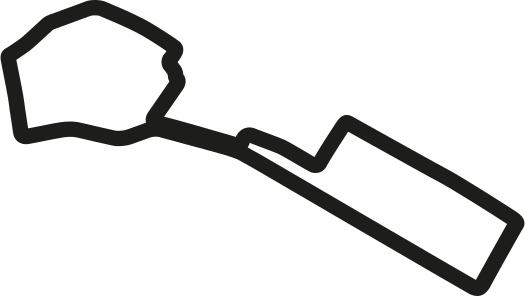
Bugatti made its sole World Championship appearance at the 1956 French Grand Prix, held at the Reims-Gueux circuit. The team entered a single Type 251 for experienced French driver Maurice Trintignant, who was already an established Grand Prix winner.
Although the Type 251 attracted considerable attention because of its unusual engineering, its competitive debut proved disappointing. The car lacked the pace of the leading Ferraris, Maseratis, and Vanwalls, while persistent mechanical problems hampered its performance throughout the event. After completing 18 laps, Trintignant retired from the race with mechanical failure, ending what would become the Type 251’s only World Championship start.
The disappointing performance, combined with Bugatti’s worsening financial position, brought development of the project to an immediate conclusion. The Type 251 never raced in another Formula One World Championship event.
Withdrawal and legacy
Following its unsuccessful Formula One return, Bugatti abandoned Grand Prix racing altogether. The company’s financial difficulties continued to deepen throughout the late 1950s, and production effectively came to an end. In 1963, the remaining assets of Automobiles Ettore Bugatti were acquired by Hispano-Suiza, bringing the original Bugatti company to a close.
Although the Type 251 was unsuccessful in competition, it has since gained recognition as one of Formula One’s most technically ambitious cars of the 1950s. Its rear-engine configuration anticipated the design philosophy that became standard across the sport within a few years, illustrating Bugatti’s continued passion for engineering innovation despite its declining fortunes.
Through its dominance of pre-war motorsport and its pioneering engineering, Bugatti remains one of the most historically significant names in the history of international motor racing.
Bugatti Stats by Season
| Year | Engine | Drivers | Entries | Starts | Wins | Podiums | Poles | Fastest Laps | Front Rows | DNF | Best Start | Best Result | Points | Championship |
|---|---|---|---|---|---|---|---|---|---|---|---|---|---|---|
| 1956 | Bugatti | Maurice Trintignant | 1 | 1 | – | – | – | – | – | 1 | 18 | – | – | – |