












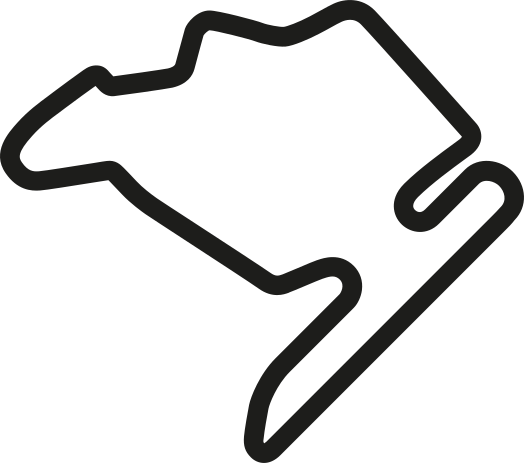











Located in Kent, England, Brands Hatch is one of the United Kingdom’s most iconic racing circuits and one of the most beloved venues in British motorsport. Known for its dramatic elevation changes and natural amphitheatre layout, the track has hosted everything from club racing and motorcycle events to Formula One Grands Prix.
Originally developed from farmland used for motorcycle racing, Brands Hatch grew into a world-class venue during the 1960s. Between 1964 and 1986, the circuit hosted the British Grand Prix twelve times, sharing the event with Silverstone during that period.
Today, the venue remains a central part of British motorsport, hosting major national series such as the British Touring Car Championship and British Superbike Championship, as well as historic racing and international events.
See also…
Brands Hatch
| First Grand Prix | 1964 British Grand Prix |
| Number of Laps | 76 |
| Circuit Length | 4.207 km |
| Race Distance | 319.7 km |
| Lap Record | 1:09.593 Nigel Mansell (1986) |
Circuit
When was Brands Hatch built?
Brands Hatch began life as a grass-track motorcycle venue in the 1920s on farmland near the village of West Kingsdown.
Cyclists originally used dirt paths created by farm vehicles as a makeshift racing circuit. Motorcycles soon followed, and the track developed into an informal racing venue during the interwar years.
After the Second World War, the venue was rebuilt and tarmacked in 1950, creating Britain’s first purpose-built post-war motor racing circuit. Early races were organised primarily for 500cc Formula 3 cars, which helped establish the track’s reputation for close and exciting racing.
During the 1960s, the circuit was expanded to a full Grand Prix configuration of 4.265 km, allowing it to host international events, including Formula One.
What makes Brands Hatch special?
Brands Hatch is famous for its natural bowl-shaped layout, allowing spectators to see large portions of the circuit from a single vantage point.
The track features dramatic elevation changes and several iconic corners:
- Paddock Hill Bend – a fast downhill right-hander taken blind from the start straight
- Druids – a tight uphill hairpin that provides overtaking opportunities
- Graham Hill Bend – a tricky downhill corner leading onto the Cooper Straight
- Hawthorn Bend – one of the fastest corners on the circuit
- Sheene Curve – a blind, high-speed left-hand corner through woodland
These features create a flowing and technically demanding lap that rewards driver precision and bravery.
Brands Hatch also offers two primary layouts:
- Grand Prix Circuit – 3.916 km (2.433 mi)
- Indy Circuit – 1.944 km (1.208 mi)
The shorter Indy layout sits entirely within the natural amphitheatre and is widely considered one of the best short circuits in the world.
When was the first British Grand Prix at Brands Hatch?
Brands Hatch hosted its first Formula One World Championship race with the 1964 British Grand Prix.
The race was won by Jim Clark driving for Lotus, beginning a period in which the British Grand Prix alternated between Brands Hatch and Silverstone.
Some memorable moments from its Formula One history include:
- 1968 British Grand Prix – Jo Siffert scored a famous privateer victory
- 1976 British Grand Prix – controversy surrounding James Hunt’s disqualification
- 1985 European Grand Prix – Nigel Mansell’s first Formula One victory
- 1986 British Grand Prix – the final F1 race held at Brands Hatch
After 1986, the British Grand Prix moved permanently to Silverstone, largely due to safety concerns and limited expansion space at Brands Hatch.
Brands Hatch lap record
The fastest official Formula One race lap at Brands Hatch was set by Nigel Mansell, 1:09.593 during the 1986 British Grand Prix, driving a Williams FW11.
Later changes to the circuit altered the layout slightly, but Mansell’s lap remains one of the most famous in the venue’s Formula One history.