



















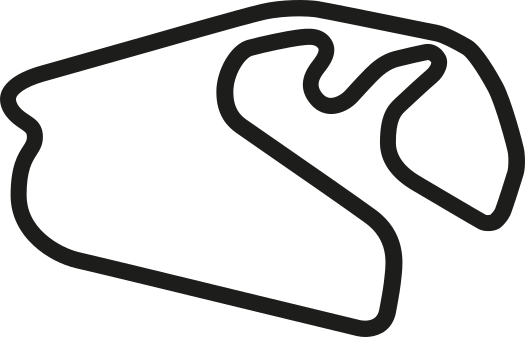








Nestled in Clarington, Ontario, around 75 kilometres east of Toronto, Motorsport Park is one of Canada’s most historic and best-loved racing venues. Better known to many fans by its former name, Mosport, the circuit has built a reputation as a fast, flowing, and unforgiving road course that rewards commitment and precision. Unlike many modern tracks, its layout has remained largely true to its original form, helping it retain a classic character that drivers continue to praise.
The circuit combines dramatic elevation changes with high-speed corners and narrow margins for error, making it one of the most challenging permanent road courses in North America. Wide open seating around the venue gives fans spectacular views of the action, while famous sections such as Moss Corner, Clayton Corner, and the run through Turns 8 and 9 have become iconic parts of the track’s identity.
Canadian Tire Motorsport Park has hosted an enormous variety of top-level motorsport events over the decades, including Formula One, Can-Am, IMSA, IndyCar, World Superbike, and major national stock car and motorcycle racing. Its place in Formula One history is especially significant, having staged the Canadian Grand Prix during the early years of the event before the race moved permanently to Montréal.
See also…

Mosport Park
| First Grand Prix | 1961 Canadian Grand Prix |
| Number of Laps | 80 |
| Circuit Length | 3.957 km |
| Race Distance | 316.56 km |
| Lap Record | 1:13.299 Mario Andretti (1977) |
Circuit
When was Mosport Park built?
Construction of the circuit began in 1960, and the venue officially opened in June 1961. Designed by Alan Bunting, it was one of the earliest purpose-built road racing circuits in Canada and quickly became a landmark venue for Canadian motorsport. Built at a cost of $500,000, the circuit was created in rural Ontario and soon developed a reputation for attracting major international racing series.
Originally known as Mosport Park, the name came from the company formed to build the track, combining the words motor and sport. Over time, the venue became widely known simply as Mosport, a name that remains deeply associated with the circuit among fans and drivers. In 2012, following a partnership with Canadian Tire, the venue was officially renamed Canadian Tire Motorsport Park.
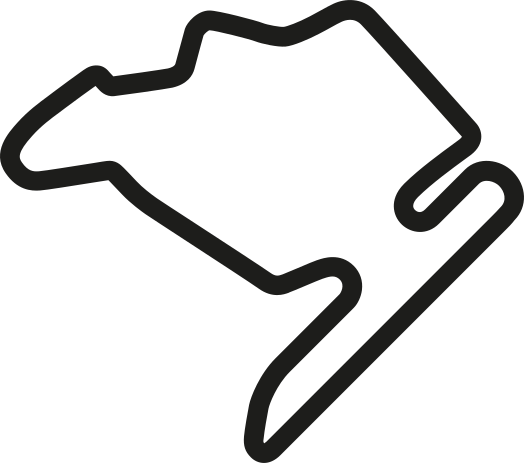
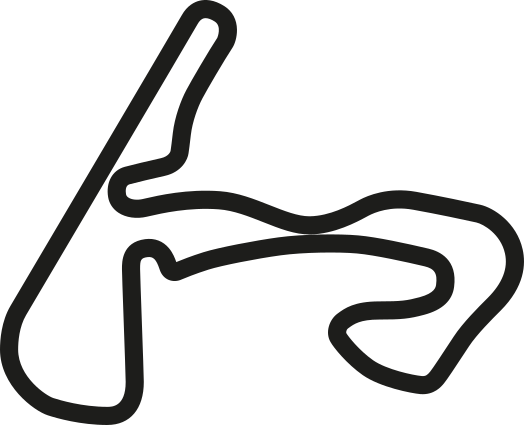
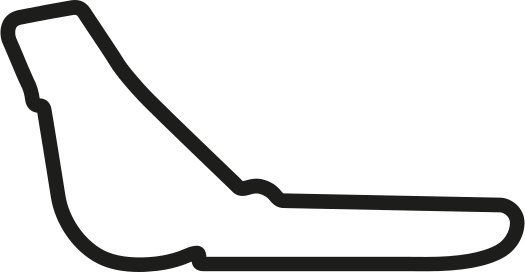
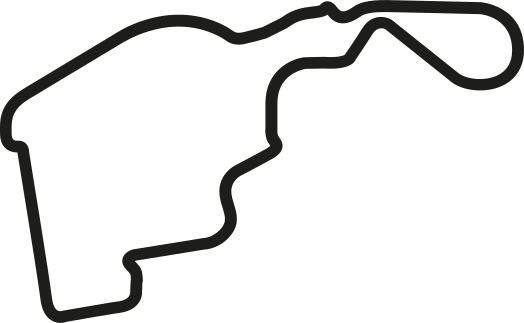
The Grand Prix circuit measures 3.957 kilometres and features 10 turns. It runs clockwise and is famous for its natural elevation changes, quick direction changes, and fast cornering sequences. Unlike many historic circuits that have been heavily redesigned over the years, Mosport’s core layout has remained largely unchanged since its opening, preserving much of its original character.
One of the most famous sections of the circuit is Moss Corner, named in honour of Stirling Moss, who won the venue’s first major race in 1961. At his suggestion, the original hairpin was altered into two distinct corners to create a more interesting challenge for both drivers and spectators. That legacy remains one of the most recognisable features of the track.
In 2001, the entire circuit was repaved to meet FIA standards, while efforts were made to preserve the old racing lines and the essential feel of the track. Drivers were consulted during the process to ensure that the circuit’s traditional character was not lost. The result was a modernised surface combined with the same fast, committed layout that had made Mosport famous.
Beyond the main road course, the venue has also expanded over time to include a Driver Development Centre, karting facilities, and formerly an oval speedway. Even with those additions, the Grand Prix circuit remains the heart of the complex and the reason the venue continues to be regarded as one of Canada’s great racing landmarks.
When was the first Canadian Grand Prix at Mosport?
Mosport first hosted major international racing in 1961, but its first Formula One Canadian Grand Prix came in 1967. That race formed part of Canada’s centennial celebrations and marked the beginning of Mosport’s role in Formula One history.
The circuit went on to host the Canadian Grand Prix in 1967, 1969, 1971, 1972, 1973, 1974, 1976, and 1977. During that period, it welcomed some of Formula One’s greatest drivers, including Jack Brabham, Jacky Ickx, Jackie Stewart, Emerson Fittipaldi, James Hunt, and Jody Scheckter, all of whom won Grand Prix races at the track.
Mosport’s fast and challenging layout made it a respected stop on the Formula One calendar, but by the late 1970s the Canadian Grand Prix moved to Montréal, where it has remained ever since. Even so, Mosport retained its importance in North American racing through events such as Can-Am, IMSA, and numerous sports car and motorcycle championships.
The venue became especially important in sports car racing, with its annual endurance and prototype races helping establish it as one of the continent’s premier road courses. Over the years, it has hosted everything from World Sportscar Championship machinery to American Le Mans Series and the modern IMSA SportsCar Championship.
Today, Canadian Tire Motorsport Park remains a key venue in Canadian motorsport and continues to host top-level competition, particularly in sports cars, stock cars, motorcycles, and junior formula racing.
Mosport Park lap record
The official Formula One lap record for the Grand Prix circuit is 1:13.299, set by Mario Andretti in the Lotus 78 during the 1977 Canadian Grand Prix.