






















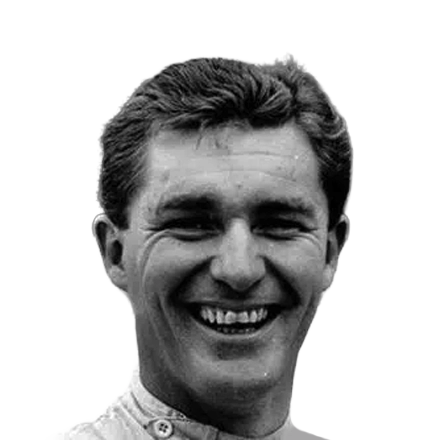
Robert Hugh Fearon Anderson was a determined and versatile British racer who made his mark on both two- and four-wheels. From battling it out in Grand Prix motorcycle racing to taking on the giants of Formula One, Anderson built a reputation as a fiercely independent competitor. He raced motorcycles at world level between 1958 and 1960, then stepped into Formula One from 1963 to 1967—at a time when the sport was rapidly professionalising. He also claimed victory twice at the North West 200 in Northern Ireland, one of the most demanding road races in the world. Notably, Anderson was among the last true privateer drivers in Formula One—racing largely on his own terms before rising costs and sponsorship deals made such independence almost impossible.
Driver Bio
| Nationality | British |
| Birthplace | Hendon, London |
| Born | 19 May 1931 |
| Died | 14 August 1967 |
| First Grand Prix | 1963 British Grand Prix |
| Last Grand Prix | 1967 British Grand Prix |
| Years Active | 1963–1967 |
| Current/Last Team | Privateer: Brabham |
Racing career
Motorcycle racing roots
Born in Hendon, North London, Anderson later settled in Bedfordshire. His path into racing wasn’t immediate—he initially trained as an agricultural engineer before leaving after a year to work as a mechanic. That hands-on experience proved invaluable once he discovered his passion for racing.
He began competing in 1953 on a 500cc Triumph Special at Cadwell Park, quickly showing promise. By 1955, he was riding a Matchless G45 at circuits like Crystal Palace and Castle Combe, finishing a respectable eighth in the Senior Manx Grand Prix that year.
A move to a Norton in 1956 marked a turning point: Anderson finished second in the Senior Manx Grand Prix and took victory in the 500cc class at the North West 200.
Momentum continued into 1957, when he established himself as one of Britain’s leading national riders. Wins came at Cadwell Park, Crystal Palace, Snetterton, and Brands Hatch, alongside another triumph—this time in the 350cc class—at the North West 200.
In 1958, Anderson stepped onto the world stage. He finished second to reigning champion John Surtees in the prestigious Senior TT at the Isle of Man TT, widely regarded as the pinnacle of motorcycle racing. That same year, he began competing in Grand Prix events, securing another runner-up finish behind Geoff Duke in the 350cc Swedish Grand Prix.
From bikes to Formula One
At the end of 1960, a back injury sustained while racing in South Africa forced Anderson to rethink his career. At 29—late by racing standards—he made the bold switch to car racing.
He debuted in 1961 in a Formula Junior race at Snetterton, driving a Lola. Progress came steadily, and he soon joined Team Lotus in the Formula Junior series. There, he scored a win at the Autodrome de Montlhéry and finished second at Monaco—clear signs that his talent translated beyond motorcycles.
The privateer in Formula One
Anderson entered Formula One in 1963, doing things his own way. Driving a Lola Mk4 under his self-run outfit, DW Racing Enterprises, he competed against far better-funded teams. In reality, “team” was a generous term—DW Racing was essentially Anderson himself, supported by a small group of mechanics.
Despite limited resources, he achieved a remarkable victory in the non-championship Rome Grand Prix during his debut season. In subsequent years, he continued as a private entrant, running Brabham cars under the same banner.
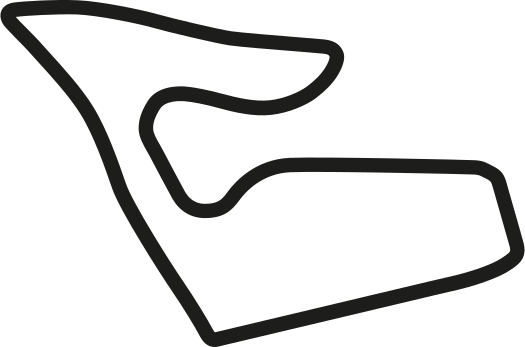
His finest championship result came in 1964, when he finished third in the Austrian Grand Prix. That performance earned him the Von Trips Memorial Trophy as the most successful privateer of the year—a fitting recognition for someone competing against the odds.
Final season and legacy
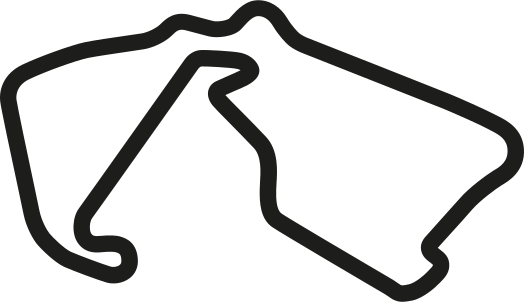
In 1967, tragedy struck. While testing at Silverstone in wet conditions, Anderson lost control of his car and crashed into a marshal’s post. He suffered severe chest and neck injuries and later died in the hospital.
In an era just before Formula One became dominated by big money and corporate sponsorship, Anderson stood as one of its last true privateers—a racer driven more by passion than resources, and one who proved that determination could still carry you to the front.
Grand Prix Stats
| Race Entries | 29 |
| Race Starts | 25 |
| Did Not Start | 3 |
| Best Race Start | 7th |
| Best Race Finish | 3rd |
| Retirements | 10 |
| First-Lap Retirements | 0 |
| Not Classified | 2 |
| Disqualified | 0 |
| Did Not Qualify | 1 |
Podiums
| Podiums | 1 |
| First Podium | 1964 Austrian Grand Prix |
| Last Podium | 1964 Austrian Grand Prix |
| 1st Place | 0 |
| 2nd Place | 0 |
| 3rd Place | 1 |
| Most Consecutive Podiums | 0 |
| Most Podiums in a Single Season | 1 |
| Seasons with Podiums | 1 |
Qualifying
| Qualifying Sessions | – |
| Reached Q3 | – |
| Q2 Eliminations | – |
| Q1 Eliminations | – |
| Did Not Qualify | 1 |
Points
| Points Scored | 8 |
| Points Finishes | 4 |
| Most Points in a Single Season | 5 |
| Seasons with Points | 3 |
Stats by Season
| Year | Constructor | Entries | Starts | Wins | Podiums | Poles | Fastest Laps | Front Rows | DNF | Best Start | Best Result | Pts Finishes | Points | Championship |
|---|---|---|---|---|---|---|---|---|---|---|---|---|---|---|
| 1963 | Privateer: Lola | 2 | 2 | 0 | 0 | 0 | 0 | 0 | 0 | 16 | 12 | 0 | 0 | NC |
| 1964 | Privateer: Brabham | 8 | 7 | 0 | 1 | 0 | 0 | 0 | 2 | 7 | 3 | 2 | 5 | 11th |
| 1965 | Privateer: Brabham | 7 | 5 | 0 | 0 | 0 | 0 | 0 | 3 | 9 | 9 | 0 | 0 | NC |
| 1966 | Privateer: Brabham | 7 | 6 | 0 | 0 | 0 | 0 | 0 | 2 | 8 | 6 | 1 | 1 | 17th |
| 1967 | Privateer: Brabham | 5 | 5 | 0 | 0 | 0 | 0 | 0 | 3 | 9 | 5 | 1 | 2 | 16th |
Stats by Constructor
| Constructor | Years | Entries | Starts | Wins | Podiums | Poles | Fastest Laps | Front Rows | DNF | Best Start | Best Result | Pts Finishes | Points |
|---|---|---|---|---|---|---|---|---|---|---|---|---|---|
| Privateer: Lola | 1963 | 2 | 2 | 0 | 0 | 0 | 0 | 0 | 0 | 16 | 12 | 0 | 0 |
| Privateer: Brabham | 1964–1967 | 27 | 23 | 0 | 1 | 0 | 0 | 0 | 10 | 7 | 3 | 4 | 8 |
Teammates & Qualifying Head-to-Head
| Teammate | Years | Races | Qualifying H2H |
|---|---|---|---|
| Paul Hawkins | 1965 | 2 | – |