






























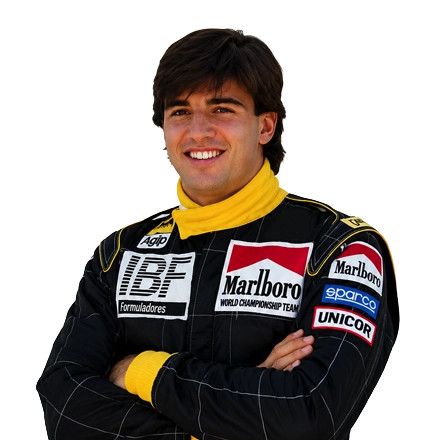
Christian Fittipaldi (born 18 January 1971) is a Brazilian former racing driver whose career covered Formula One, CART, NASCAR and top-level sports-car racing. Once regarded as one of the brightest young talents of the early 1990s, he went on to start 43 Formula One Grands Prix for Minardi and Footwork before building an equally substantial career in the United States.
Driver Bio
| Nationality | Brazilian |
| Birthplace | Sao Paulo, Brazil |
| Born | 18 January 1971 |
| First Grand Prix | 1992 South African Grand Prix |
| Last Grand Prix | 1994 Australian Grand Prix |
| Years Active | 1992–1994 |
| Current/Last Team | Footwork |
Fittipaldi’s résumé includes two CART victories, runner-up in the 1995 Indianapolis 500, three wins in the 24 Hours of Daytona, victory in the 12 Hours of Sebring and three triumphs in the 6 Hours of Watkins Glen. He also won back-to-back IMSA SportsCar Championships with Action Express Racing in 2014 and 2015.
Racing was hardly an unusual career choice in the Fittipaldi household. Christian is the son of former Formula One driver and team owner Wilson Fittipaldi and the nephew of two-time Formula One World Champion and Indianapolis 500 winner Emerson Fittipaldi. He is also part of the wider racing dynasty that includes Emerson Fittipaldi Jr., Pietro Fittipaldi and Enzo Fittipaldi.
Early years
Born in São Paulo, Fittipaldi was named after Brazilian racer Christian Heins, who was killed during the 1963 24 Hours of Le Mans.
His own career gathered momentum quickly. He finished runner-up in Brazilian Formula Ford in 1988, then took third in South American Formula 3 the following year. In 1990 he won the Formula 3 Sudamericana championship while also finishing fourth in British Formula 3.
Europe beckoned in 1991, and Fittipaldi promptly made himself impossible to ignore. Racing in International Formula 3000, he won twice and stood on the podium seven times in just ten races, beating Alessandro Zanardi to the championship. He later added third place in the Macau Grand Prix.
Formula One was the obvious next destination.
Formula One
Fittipaldi joined Minardi for 1992, entering Formula One with one of the smallest teams on the grid. Even so, he managed to score a World Championship point during his rookie season. He also became the first Formula One driver born in the 1970s.
His second year brought better results. Fittipaldi collected five championship points during 1993, although Minardi parted company with him with two races still remaining.
He moved to Footwork for 1994 and produced two fourth-place finishes, scoring six points in total. Those results showed his potential, but with opportunities at the sharper end of the grid proving difficult to secure, Fittipaldi decided that three seasons in Formula One were enough.
At the end of 1994, he turned his attention to America.
Years later, his Formula One performances received an unusual statistical endorsement. A 2016 academic study using mathematical modelling to separate the influence of driver and machinery ranked Fittipaldi 11th among Formula One drivers in its all-time assessment.
CART
Fittipaldi moved into CART and quickly earned a reputation for consistency. He was not always the outright fastest man in the field, but he had an impressive ability to stay in contention and bring the car home.
That approach nearly delivered one of motorsport’s biggest prizes immediately. At the 1995 Indianapolis 500, Fittipaldi finished second and earned Rookie of the Year honours.
He went on to finish fifth in the CART championship in 1996, establishing himself as a genuine front-runner. His progress was interrupted at Surfers Paradise in 1997 when he broke his leg – one of two serious leg injuries he would suffer during his CART years.
Fittipaldi recovered and eventually claimed his first CART victory at Road America in 1999. A second win followed later in his career, and he again finished fifth in the championship in 2002.
Despite those results, injuries and circumstance prevented him from putting together the sustained title challenge his talent had suggested. He did, however, emerge from his American open-wheel career with two victories, an Indianapolis 500 runner-up finish and a reputation as one of the series’ most dependable competitors.
He even made a brief appearance in the 2001 film Driven, which used CART racing as its backdrop.
NASCAR
With his Champ Car career winding down, Fittipaldi decided to try something very different: NASCAR.
He made three Busch Series appearances across 2001 and 2002 before attracting the attention of Richard Petty. Late in 2002, Petty Enterprises signed him and gave him his Winston Cup debut at Phoenix.
In 2003, Fittipaldi made his only Daytona 500 start, driving in a one-race deal with Andy Petree. He also made several ARCA appearances before being handed one of the most famous cars in NASCAR history – Petty’s No. 43 – following the departure of John Andretti.
The transition from open-wheel cars to heavyweight stock cars was not straightforward. Fittipaldi struggled for results and was moved out of the No. 43 later that year, although he remained with Petty Enterprises and continued in the team’s No. 44.
NASCAR ultimately proved to be more of an adventurous detour than a defining chapter, but Fittipaldi had once again shown his willingness to tackle an entirely different style of racing.
Sports cars
Sports-car racing proved to be where Fittipaldi enjoyed some of the greatest successes of his career.
Even while competing in Formula One, he was already building an endurance-racing résumé. He won the 24 Hours of Spa in 1993 and the Brazilian 1000 Miles in 1994.
His first 24 Hours of Daytona appearance came in 2003 with Bell Motorsports, where he finished sixth in a Doran-Chevrolet Daytona Prototype. Just one year later he was back – and this time he won, sharing a Doran-Pontiac in the 2004 race.
Further Grand-Am appearances followed with Bell, and Fittipaldi later joined The Racer’s Group in a Riley-Pontiac. That programme brought a victory at Phoenix, second place in the 6 Hours of Watkins Glen and third in the shorter Watkins Glen 200-mile race.
He also raced with Eddie Cheever‘s team, while expanding his endurance programme to Le Mans. In 2006 he drove a Saleen S7 to sixth in the GT1 class at the 24 Hours of Le Mans.
Fittipaldi returned to Le Mans in 2007 in a Team Modena Aston Martin DB9, finishing tenth in GT1, before again driving the Aston in 2008. That same season he contested the opening four American Le Mans Series rounds with Andretti Green, sharing an Acura LMP2 with Bryan Herta and collecting finishes of fourth, fifth, sixth and seventh.
He later returned to Grand-Am with Cheever’s Coyote-Pontiac, adding another second-place finish to an already increasingly varied sports-car record.
A hugely important relationship began with Action Express Racing. Fittipaldi joined the team for the 2011 24 Hours of Daytona and finished third overall alongside a line-up that included Max Papis and João Barbosa. He returned in 2012 with Action Express’s Chevrolet Corvette Daytona Prototype and finished fifth.
For 2013, he became a regular Action Express driver. Partnering primarily with Barbosa, Fittipaldi won at Mid-Ohio and in the 6 Hours of Watkins Glen, added two second places and finished seventh in the Daytona Prototype championship.
Then came one of the biggest victories of his career.
In 2014, Fittipaldi shared Action Express’s Corvette DP with João Barbosa and Sébastien Bourdais and won the Rolex 24 at Daytona. It was his second victory in the race, a full decade after his first.
That success formed part of an outstanding late-career run. Fittipaldi and Action Express won the IMSA SportsCar Championship in both 2014 and 2015, while his list of major endurance victories continued to grow.
He won the 12 Hours of Sebring in 2015 and added further 6 Hours of Watkins Glen victories in 2016 and 2017. In 2018, he completed a remarkable Daytona hat-trick by winning the 24-hour race for the third time.
It meant that a driver once best known as a promising Formula One graduate ultimately built perhaps his strongest legacy in endurance racing.
From Formula 3000 champion to Formula One points scorer, Indianapolis 500 runner-up, CART winner, NASCAR experimenter and three-time Daytona champion, Christian Fittipaldi’s career rarely stayed in one lane for very long – and was considerably richer for it.
Grand Prix Stats
| Race Entries | 43 |
| Race Starts | 40 |
| Did Not Start | 0 |
| Best Race Start | 6th |
| Best Race Finish | 4th |
| Retirements | 16 |
| First-Lap Retirements | 0 |
| Not Classified | 0 |
| Disqualified | 1 |
| Did Not Qualify | 3 |
Qualifying
| Qualifying Sessions | 43 |
| Reached Q3 | 0 |
| Q2 Eliminations | 0 |
| Q1 Eliminations | 0 |
| Did Not Qualify | 3 |
Points
| Points Scored | 12 |
| Points Finishes | 5 |
| Most Points in a Single Season | 6 (1994) |
| Seasons with Points | 3 |
Stats by Season
| Year | Constructor | Entries | Starts | Wins | Podiums | Poles | Fastest Laps | Front Rows | DNF | Best Start | Best Result | Pts Finishes | Points | Championship |
|---|---|---|---|---|---|---|---|---|---|---|---|---|---|---|
| 1992 | Minardi | 13 | 10 | 0 | 0 | 0 | 0 | 0 | 4 | 12th | 6th | 1 | 1 | 18th |
| 1993 | Minardi | 14 | 14 | 0 | 0 | 0 | 0 | 0 | 5 | 13th | 4th | 2 | 5 | 13th |
| 1994 | Footwork | 16 | 16 | 0 | 0 | 0 | 0 | 0 | 7 | 6th | 4th | 2 | 6 | 15th |
Stats by Constructor
| Constructor | Years | Entries | Starts | Wins | Podiums | Poles | Fastest Laps | Front Rows | DNF | Best Start | Best Result | Pts Finishes | Points |
|---|---|---|---|---|---|---|---|---|---|---|---|---|---|
| Minardi | 1992–1993 | 27 | 24 | 0 | 0 | 0 | 0 | 0 | 9 | 12th | 4th | 3 | 6 |
| Footwork | 1994 | 16 | 16 | 0 | 0 | 0 | 0 | 0 | 7 | 6th | 4th | 2 | 6 |
Teammates & Qualifying Head-to-Head
| Teammate | Years | Races | Qualifying H2H |
|---|---|---|---|
| Gianni Morbidelli | 1992, 1994 | 29 | 10–19 |
| Fabrizio Barbazza | 1993 | 8 | 8–0 |
| Pierluigi Martini | 1993 | 6 | 2–4 |