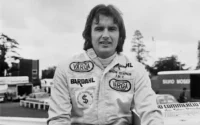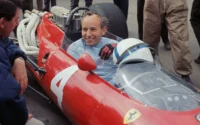






















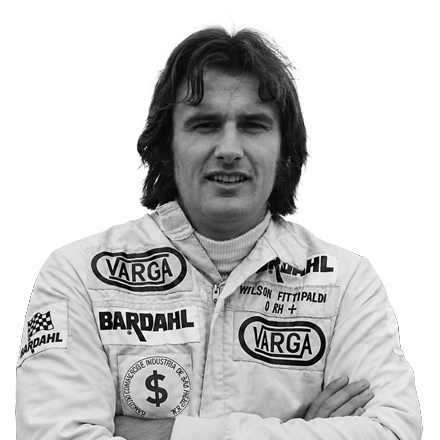
Wilson Fittipaldi Júnior (25 December 1943 – 23 February 2024) was a Brazilian racing driver, constructor and Formula One team owner. He entered 38 World Championship Grands Prix, beginning on 1 May 1972, and scored three points. His more ambitious contribution came away from the cockpit: between 1974 and 1982, he ran the Brazilian Formula One operation that became Fittipaldi Automotive.
Driver Bio
| Nationality | Brazilian |
| Birthplace | São Paulo, Brazil |
| Born | 25 December 1943 |
| Died | 23 February 2024 |
| First Grand Prix | 1972 Spanish Grand Prix |
| Last Grand Prix | 1975 United States Grand Prix |
| Years Active | 1972–1973, 1975 |
| Current/Last Team | Fittipaldi |
Known affectionately as Wilsinho, meaning “Little Wilson,” and also as Tigrão, Fittipaldi competed in numerous non-Championship Formula One races as well as the World Championship. He later enjoyed success in Brazilian stock cars and long-distance racing.
Personal life
Born on Christmas Day in 1943, Wilson grew up in a household already steeped in motorsport. His father, Wilson Sr, was a prominent racing journalist and radio commentator of Italian descent. His mother, Juzy, came from a Russian family. Both parents competed in production-car races during the years following the Second World War.
Wilson Sr also created the first Mil Milhas Brasil in São Paulo in 1956, taking inspiration from Italy’s Mille Miglia. With racing discussed at home, broadcast through his father’s work and practised by both parents, Wilsinho’s enthusiasm was hardly accidental.
He was the elder brother of Emerson Fittipaldi, who became a two-time Formula One world champion and later won the CART title. Wilson’s own achievements were frequently measured against those of his more celebrated younger sibling, much as happened with Jimmy Stewart and Ian Scheckter in other racing families.
Wilson married Suzy and had two children. His son, Christian Fittipaldi, continued the family tradition by racing in Formula One, CART and NASCAR. His daughter is named Roberta.
On 25 December 2023, his 80th birthday, Fittipaldi suffered a cardiac arrest during dinner. According to his wife, he had choked on a piece of food, and the resulting oxygen deprivation caused his heart to stop. He was resuscitated, admitted to hospital and placed under sedation on a ventilator.
Fittipaldi died in São Paulo on 23 February 2024. He was 80.
Racing career
From home-built karts to Europe
Wilson and Emerson began by building and racing their own karts in Brazil during the 1960s. Wilson subsequently progressed into Formula Vee, developing his career within Brazil before attempting to establish himself in Europe.
His first trip across the Atlantic came in 1966, when he hoped to compete in Formula Three. A disagreement involving the team for which he raced in Brazil caused the opportunity to collapse, and he did not return to England until 1970. By then, Emerson’s success in Formula Two had helped draw international attention to the family.
Wilson joined British Formula Three in a Jim Russell Driving School Lotus 59. At Silverstone, he defeated a field that included Carlos Pace and works Lotus driver Dave Walker to win a BARC Championship round. During the season he also raced against future Formula One world champions Niki Lauda and James Hunt.
Further strong performances followed, particularly in the latter part of the year. Two victories in non-Championship races helped Wilson earn promotion to the European Formula Two Championship for 1971.
Formula Two
Wilson raced alongside Emerson at Team Bardahl-Fittipaldi, using Lotus and March chassis. He reached the podium at Hockenheim and recorded fourth-place finishes at Rouen and Mantorp Park.
Those results were sufficient to secure a Formula One contract with Brabham for 1972. The drive required sponsorship money, but it finally placed Wilsinho at the highest level.
Formula One with Brabham
Fittipaldi’s first Formula One highlight came before his World Championship debut. At the non-Championship 1972 Brazilian Grand Prix, he reached the podium in front of his home crowd.
That performance was not repeated immediately in the championship. Wilson operated as a respectable midfield runner throughout 1972 but finished the season without scoring a point.
His three World Championship points all arrived in 1973. He placed sixth in Buenos Aires and fifth at the Nürburgring, then considered one of the most intimidating circuits in the sport. His best qualifying performances were ninth at Monaco and tenth at Mosport.
Life inside Brabham was less satisfying than the results suggested. Wilson was tired of paying for his place and frustrated by his status behind team leader Carlos Reutemann. Under owner Bernie Ecclestone, he felt unable to challenge the Argentine on equal terms.
Rather than continue as somebody else’s supporting act, Fittipaldi chose a vastly more difficult route: he decided to build a Brazilian Formula One team of his own.
Creating Copersucar-Fittipaldi
Fittipaldi stepped away from regular driving at the beginning of 1974 to establish the new operation. He did make one further appearance for Brabham that year, contesting the non-Championship Grande Prêmio Presidente Emílio Médici.
Backed by the Brazilian sugar and alcohol company Copersucar, the team prepared to enter Formula One in 1975. Its radical first car, the FD01, carried national hopes as well as the pressure faced by any new constructor attempting to compete with established European teams.
The debut proved dramatic and destructive, with the original car badly damaged. It was eventually restored in 2004.
Wilson served as the team’s only driver during its first championship season. Reliability and pace were both difficult to find. He reached the finish six times, with a best result of tenth—and last—at the United States Grand Prix at Watkins Glen. Several other weekends ended before the race when he failed to qualify.
For 1976, Wilson left the cockpit and concentrated on running the organisation. Emerson made the extraordinary decision to leave McLaren and join his brother’s Brazilian project, giving the team a former world champion as its lead driver.
The operation continued in Formula One through 1982, later competing under the Fittipaldi Automotive name. Although it never achieved the sustained success its founders imagined, creating and operating a Brazilian constructor in Formula One remained a formidable undertaking.
Wilson’s three championship points made him the most successful sibling of a Formula One world champion until Ralf Schumacher arrived in the series in 1997.
Return to competition
Retirement from Formula One did not mean retirement from driving. During the 1980s and early 1990s, Fittipaldi competed in Stock Car Brasil and won several rounds.
The Mil Milhas Brasil held particular significance for the family, having been founded by Wilson Sr. Wilsinho won the race for Porsche in both 1994 and 1995. For the first of those victories, he shared the car with his son Christian, linking three generations of Fittipaldi involvement with the event.
In February 1998, Wilson announced another return to the Brazilian Stock Car Championship.
His versatility surfaced again in 2000, when Mercedes-Benz invited him to contest the Nürburgring round of the FIA European Truck Racing Cup. Fittipaldi finished eighth in one race and 11th in the other—respectable results in machinery far removed from the light single-seaters of his youth.
One more family reunion followed in 2008. Wilson and Emerson entered the Brazilian GT3 Championship together, sharing a Porsche 997 GT3 prepared by WB Motorsports.
Fittipaldi’s career was never defined solely by his three World Championship points. He raced, designed, organised and managed, then persuaded a double world champion to leave McLaren for an audacious Brazilian team built around family ambition. In doing so, Wilsinho became far more than simply Emerson Fittipaldi’s older brother.
Grand Prix Stats
| Race Entries | 38 |
| Race Starts | 35 |
| Did Not Start | 1 |
| Best Race Start | 9th |
| Best Race Finish | 5th |
| Retirements | 21 |
| First-Lap Retirements | 1 |
| Not Classified | 1 |
| Disqualified | 0 |
| Did Not Qualify | 2 |
Qualifying
| Qualifying Sessions | 38 |
| Reached Q3 | 0 |
| Q2 Eliminations | 0 |
| Q1 Eliminations | 0 |
| Did Not Qualify | 2 |
Points
| Points Scored | 3 |
| Points Finishes | 2 |
| Most Points in a Single Season | 3 |
| Seasons with Points | 1 |
Stats by Season
| Year | Constructor | Entries | Starts | Wins | Podiums | Poles | Fastest Laps | Front Rows | DNF | Best Start | Best Result | Pts Finishes | Points | Championship |
|---|---|---|---|---|---|---|---|---|---|---|---|---|---|---|
| 1972 | Brabham | 10 | 10 | 0 | 0 | 0 | 0 | 0 | 6 | 11th | 7th | 0 | 0 | NC |
| 1973 | Brabham | 15 | 15 | 0 | 0 | 0 | 0 | 0 | 10 | 9th | 5th | 2 | 3 | 15th |
| 1975 | Fittipaldi | 13 | 10 | 0 | 0 | 0 | 0 | 0 | 5 | 21st | 10th | 0 | 0 | NC |
Stats by Constructor
| Constructor | Years | Entries | Starts | Wins | Podiums | Poles | Fastest Laps | Front Rows | DNF | Best Start | Best Result | Pts Finishes | Points |
|---|---|---|---|---|---|---|---|---|---|---|---|---|---|
| Brabham | 1972–1973 | 25 | 25 | 0 | 0 | 0 | 0 | 0 | 16 | 9th | 5th | 2 | 3 |
| Fittipaldi | 1975 | 13 | 10 | 0 | 0 | 0 | 0 | 0 | 5 | 21st | 10th | 0 | 0 |
Teammates & Qualifying Head-to-Head
| Teammate | Years | Races | Qualifying H2H |
|---|---|---|---|
| Graham Hill | 1972 | 10 | – |
| Carlos Reutemann | 1972, 1973 | 23 | – |