






























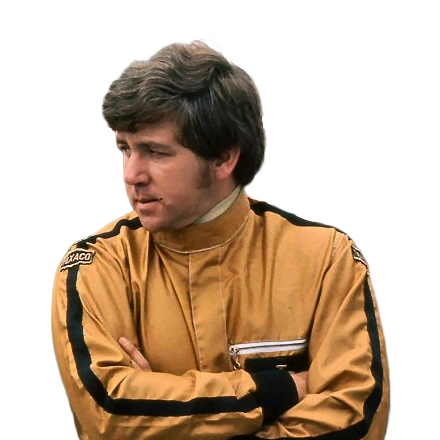
David Walker was an Australian racing driver best known for his time with Team Lotus during the 1971 and 1972 Formula One World Championships. A dominant force in junior categories, Walker’s rise to Formula One came with high expectations—yet his time at the top level became one of the sport’s more puzzling contrasts between promise and results. He died in Queensland on 24 May 2024, aged 82.
Driver Bio
| Nationality | Australian |
| Birthplace | Sydney, Australia |
| Born | 10 June 1941 |
| Died | 24 May 2024 |
| First Grand Prix | 1971 Dutch Grand Prix |
| Last Grand Prix | 1972 United States Grand Prix |
| Years Active | 1971–1972 |
| Current/Last Team | Maki |
Racing career
Early promise and Formula Ford success
Walker gained early international experience in the mid-1960s, competing in the Tasman Series on demanding Australian circuits such as Longford and Sandown. He later raced in Formula 5000 machinery, including a notable fifth-place finish at the 1970 Australian Grand Prix at Warwick Farm.
Despite flashes of speed, his progress through the 1960s was uneven. His breakthrough finally came in 1969, when he won the British Formula Ford Championship and finished third in the European series—results that re-established him as a serious prospect.
Formula Three dominance
Walker’s career truly caught fire in Formula Three. Driving for Team Lotus, he became one of the most dominant drivers of his era.
In 1971, he won an astonishing 25 out of 32 races, including high-profile support races at both the Monaco Grand Prix and the British Grand Prix. By the end of the season, he had secured both the Shell and Forward Trust UK Formula Three titles.
His performances impressed many—including future Formula One star James Hunt, who would later express surprise that Walker never translated that success into F1 results.
Formula One: opportunity and struggle
Walker’s Formula One debut came in 1971 at the Dutch Grand Prix, driving the unconventional Lotus 56B turbine car. In wet conditions, he briefly showcased its potential—charging from 22nd to 10th in just a few laps—before spinning out.
For 1972, he was promoted to a full-time seat alongside reigning champion Emerson Fittipaldi, driving the iconic Lotus 72. Expectations were high, but the season quickly became difficult.
While Fittipaldi dominated—winning five races and the World Championship—Walker struggled to adapt to Formula One machinery. His best official finish was ninth place in Spain, though he showed glimpses of pace, including:
- A strong charge at the South African Grand Prix, where he climbed from 19th before running out of fuel
- A promising battle for fifth in Spain, again undone by fuel issues
- A spirited performance at the British Grand Prix, where he briefly pressured and even passed Fittipaldi during a chaotic phase of the race
However, inconsistency, mechanical failures, and a driving style described by team management as too aggressive for F1 cars all hindered his progress.
Tensions grew within the team. Lotus accused Walker of lacking finesse and mechanical sensitivity, while Walker believed he was given inferior equipment and far less attention than his teammate.
He was dropped for parts of the season and ultimately not retained for 1973, replaced by Ronnie Peterson.
A unique Formula One record
Walker holds a curious place in Formula One history: he remains the only driver not to score a single World Championship point in a season where his teammate won the Drivers’ title.
Legacy
David Walker’s career stands as one of motorsport’s great “what if” stories. His dominance in Formula Three suggested a future star, yet Formula One proved far less forgiving.
Even so, his brief flashes of speed, combined with his remarkable junior record, ensure he is remembered as a driver of significant natural talent—one whose Formula One chapter never quite matched the promise that came before it.
Grand Prix Stats
| Race Entries | 11 |
| Race Starts | 11 |
| Did Not Start | 0 |
| Best Race Start | 12th |
| Best Race Finish | 9th |
| Retirements | 7 |
| First-Lap Retirements | 0 |
| Not Classified | 0 |
| Disqualified | 1 |
| Did Not Qualify | 0 |
Qualifying
| Qualifying Sessions | 11 |
| Reached Q3 | Not applicable (historical data pre-dates modern qualifying format) |
| Q2 Eliminations | Not applicable (historical data pre-dates modern qualifying format) |
| Q1 Eliminations | Not applicable (historical data pre-dates modern qualifying format) |
| Did Not Qualify | 0 |
Complete Formula One World Championship results
| Year | Entrant | Chassis | Engine | 1 | 2 | 3 | 4 | 5 | 6 | 7 | 8 | 9 | 10 | 11 | 12 | 13 | 14 | WDC | Points |
|---|---|---|---|---|---|---|---|---|---|---|---|---|---|---|---|---|---|---|---|
| 1971 | Gold Leaf Team Lotus | Lotus 56B | Pratt & Whitney STN76 TBN | RSA | ESP | MON | NED Ret | FRA | GBR | GER | AUT | ITA | CAN | USA | NC | 0 | |||
| 1972 | John Player Team Lotus | Lotus 72D | Ford Cosworth DFV 3.0 V8 | ARG DSQ | RSA 10 | ESP 9 | MON 14 | BEL 14 | FRA 18 | GBR Ret | GER Ret | AUT Ret | ITA | CAN | USA Ret | NC | 0 | ||
| 1975 | Citizen Maki F1 | Maki F101C | Ford Cosworth DFV 3.0 V8 | ARG | BRA | RSA | ESP | MON | BEL WD | SWE WD | NED | FRA | GBR | GER | AUT | ITA | USA | NC | 0 |
Teammates & Qualifying Head-to-Head
| Teammate | Years | Races | Qualifying H2H |
|---|---|---|---|
| Reine Wisell | 1971, 1972 | 2 | – |
| Emerson Fittipaldi | 1972 | 10 | – |