






















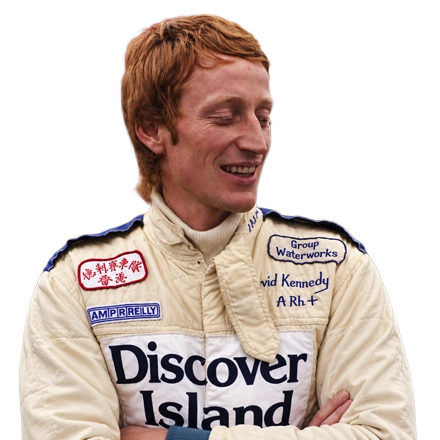
David Paul Kennedy (born 15 January 1953) is a former racing driver from the Republic of Ireland who became one of the pioneers of his country’s push into international motorsport. One of Ireland’s earliest Grand Prix drivers, Kennedy went on to build a career that stretched far beyond the cockpit, encompassing driver management, Formula One broadcasting, team ownership and a long association with Mondello Park.
Driver Bio
| Nationality | Irish |
| Birthplace | Sligo, Ireland |
| Born | 15 January 1953 |
| First Grand Prix | 1980 Argentine Grand Prix |
| Last Grand Prix | 1980 French Grand Prix |
| Years Active | 1980 |
| Current/Last Team | Shadow |
Early career
Kennedy emerged at the front of a talented generation of Irish drivers beginning to make their mark internationally during the 1970s.
His breakthrough season came in 1976.
Driving a Crosslé-Minister 30F, Kennedy won both the RAC British Formula Ford Championship and the Townsend Thoresen Formula Ford 1600 Championship, becoming the first Irish driver to win a British single-seater title.
He came close to adding European honours that same year, finishing a narrow second in the European Formula Ford 1600 series.
For 1977, Kennedy graduated to Formula Three with the factory-supported AFMP March European team. The opportunity quickly unravelled when the operation folded early in the season, forcing him to find another route forward.
He switched to the much smaller Argo team and produced a string of giant-killing performances in Jo Marquart’s JM1 chassis.
Kennedy finished sixth in the championship in 1978, but before the year was over he had already taken another major step.
British Formula One
Kennedy moved into the British Formula One Championship during 1978, driving a Wolf WR3 run by Theodore Racing.
His arrival could hardly have gone better.
He won on his British F1 debut at Snetterton, immediately proving he could handle Grand Prix machinery.
A full campaign followed in 1979, with Kennedy finishing runner-up in the British Formula One Championship.
Those performances opened the door to the World Championship.
Grand Prix racing
For 1980, Kennedy joined Shadow in Formula One.
Unfortunately, he had arrived at one of the most difficult periods in the team’s history.
Shadow was chronically short of money, while its DN11 chassis proved badly engineered and uncompetitive. Teddy Yip – whose Theodore Racing operation had previously run Kennedy – took control of the team after the opening races in an attempt to turn its fortunes around.
A replacement car, the DN12, followed.
It was little better.
Kennedy nevertheless managed to qualify and race the 1980 Spanish Grand Prix, only for the event to become caught up in Formula One’s political turmoil and subsequently lose its World Championship status.
As a result, Kennedy’s appearance did not become the official World Championship start it might otherwise have been.
Can-Am and sports cars
After the Shadow experience, Kennedy headed across the Atlantic for a partial season in North America’s Can-Am championship in 1981, driving a Frissbee chassis.
He subsequently returned to Europe and redirected his career towards sports-car racing.
It proved a productive move.
Kennedy eventually became closely associated with the factory Mazdaspeed operation, competing extensively at Le Mans, in Japan and in the World Sportscar Championship.
He raced a succession of Mazda’s distinctive rotary-powered sports prototypes, including machinery that achieved important class successes.
By the beginning of the 1990s, Kennedy was also part of the relatively exclusive group of overseas professional drivers able to make a living in Japan’s booming and highly competitive domestic racing scene.
Mazda and the 1991 Le Mans victory
Kennedy had already begun moving into driver management while he was still competing himself, and in 1991 those two sides of his career came together in remarkable fashion.
He was responsible for putting together the driver line-up of Johnny Herbert, Volker Weidler and Bertrand Gachot for Mazda’s Le Mans programme.
That trio went on to win the 1991 24 Hours of Le Mans, delivering both Mazda and Japan their breakthrough overall victory in the great endurance race.
Kennedy was racing in the same event.
Sharing another Mazda with his former Formula One and Formula Three teammate Stefan Johansson and Maurizio Sandro Sala, Kennedy finished an impressive sixth overall.
It meant that during one of the most important races in Mazda’s history, Kennedy contributed both behind the scenes and behind the wheel.
He continued racing until 1994 before ending his professional driving career and moving full-time into management.
Driver management
Kennedy subsequently helped guide the careers of a number of successful single-seater racers.
Among them was Ralph Firman, who became Formula Nippon champion before reaching Formula One with Jordan Grand Prix.
Kennedy also worked with Richard Lyons, another Formula Nippon champion, and Damien Faulkner, who won the Formula Palmer Audi title and twice finished runner-up in Indy Lights.
All three subsequently enjoyed successful careers in GT and sports-car competition.
Kennedy’s own experience – from Formula Ford and Formula Three through Formula One machinery, Can-Am, Japan and Le Mans – gave him an unusually broad perspective from which to advise younger drivers.
Formula One broadcasting
While developing his management career, Kennedy also became a familiar voice to Irish Formula One audiences.
Beginning in 1995, he served as RTÉ’s permanent Formula One co-commentator alongside Peter Collins.
He remained in the role through 2003.
From 2004 until 2009, Kennedy continued covering Formula One for Setanta Sports, working alongside Declan Quigley at Grands Prix.
He also became a long-standing columnist for the Sunday Independent, developing a reputation for an analytical – and often unconventional – view of Formula One and the personalities within it.
Mondello Park
Despite spending much of his career competing internationally, Kennedy retained close links with Irish club motorsport.
That connection was particularly strong with Mondello Park, the circuit where his own career had begun during the early 1970s.
Kennedy became a director of Mondello Park in 1986 and served on the board of the circuit’s freehold company, which was controlled by former Lola owner Martin Birrane.
It brought his career neatly back to its beginnings: having been among the Irish drivers who ventured abroad to establish themselves internationally, Kennedy remained involved with the circuit helping to develop the sport at home.
A1GP and Status Grand Prix
Kennedy’s involvement in team ownership and management expanded again in 2006 when he became part of the consortium that took control of A1 Team Ireland in the A1GP World Cup of Motorsport.
The project ultimately delivered a championship.
With Adam Carroll behind the wheel, Ireland became the 2008/09 A1GP champion, winning what proved to be the final season of the series.
Following A1GP’s collapse, the Irish operation moved into the newly created GP3 Series in 2009 as Status Grand Prix.
There was also a striking connection to Kennedy’s own racing past.
Status Motorsport was headed by Teddy Yip Jr., whose father, Teddy Yip, had owned the Theodore and Shadow Formula One teams Kennedy raced for between 1978 and 1980.
Decades after Kennedy’s own Grand Prix opportunity, the same motorsport families had effectively crossed paths again.
Personal life
Kennedy has maintained business interests outside motor racing alongside his many roles within the sport.
His wife, Fiona, also has racing experience, having previously competed in Formula Ford.
The couple have three children.
From Formula Ford champion to Formula One hopeful, Mazda works driver, Le Mans competitor, driver manager, broadcaster and team shareholder, Kennedy’s career has touched almost every corner of professional motorsport.
His own World Championship opportunity may have been frustrated by Shadow’s decline and the political fallout surrounding the 1980 Spanish Grand Prix, but his wider influence proved considerably greater. As one of the first Irish drivers to establish himself on the international stage – and later someone who helped other drivers and teams do the same – David Kennedy became an important figure in the development of modern Irish motor racing.
Grand Prix Stats
| Race Entries | 7 |
| Race Starts | 0 |
| Did Not Start | 0 |
| Best Race Start | – |
| Best Race Finish | – |
| Retirements | 0 |
| First-Lap Retirements | 0 |
| Not Classified | 0 |
| Disqualified | 0 |
| Did Not Qualify | 7 |
Qualifying
| Qualifying Sessions | 7 |
| Reached Q3 | 0 |
| Q2 Eliminations | 0 |
| Q1 Eliminations | 7 |
| Did Not Qualify | 7 |
Stats by Season
| Year | Constructor | Entries | Starts | Wins | Podiums | Poles | Fastest Laps | Front Rows | DNF | Best Start | Best Result | Pts Finishes | Points | Championship |
|---|---|---|---|---|---|---|---|---|---|---|---|---|---|---|
| 1980 | Shadow | 7 | 0 | 0 | 0 | 0 | 0 | 0 | 0 | N/A | N/A | 0 | 0 | Never classified |
Stats by Constructor
| Constructor | Years | Entries | Starts | Wins | Podiums | Poles | Fastest Laps | Front Rows | DNF | Best Start | Best Result | Pts Finishes | Points |
|---|---|---|---|---|---|---|---|---|---|---|---|---|---|
| Shadow | 1980 | 7 | 0 | 0 | 0 | 0 | 0 | 0 | 0 | N/A | N/A | 0 | 0 |
Teammates & Qualifying Head-to-Head
| Teammate | Years | Races | Qualifying H2H |
|---|---|---|---|
| Stefan Johansson | 1980 | 2 | – |
| Geoff Lees | 1980 | 5 | – |