


























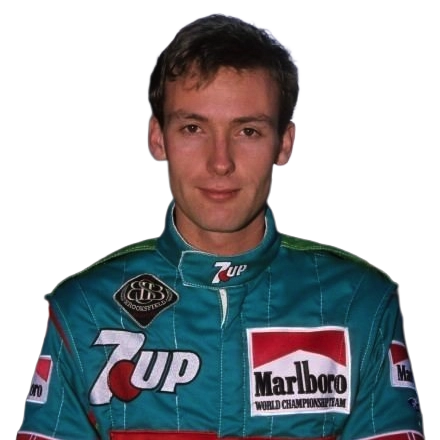
Bertrand Jean Louis Gachot (born 23 December 1962) is a former racing driver and businessman who competed in Formula One between 1989 and 1995. His career was anything but conventional: he arrived in Grand Prix racing as one of the most highly rated young drivers of his generation, raced for a string of ambitious and struggling teams, won the 24 Hours of Le Mans in 1991 with Mazda, lost his Jordan seat after being imprisoned, and later became a team shareholder and businessman.
| Born | Bertrand Jean Louis Gachot 23 December 1962 Luxembourg City, Luxembourg |
|---|---|
| Spouse | Amanda Brady (m. 1998) |
| Children | 3 |
| Nationality | Belgian (1989–1991) French (1992, 1994–1995) |
| Active years | 1989–1992, 1994–1995 |
| Teams | Onyx, Rial, Coloni, Jordan, Larrousse, Venturi, Pacific |
| Entries | 84 (47 starts) |
| Championships | 0 |
| Wins | 0 |
| Podiums | 0 |
| Career points | 5 |
| Pole positions | 0 |
| Fastest laps | 1 |
| First entry | 1989 Brazilian Grand Prix |
| Last entry | 1995 Australian Grand Prix |
Born in Luxembourg City to a French father and German mother, Gachot began karting at the age of 15 before working his way through the junior categories. By the late 1980s, his results in Formula Ford, Formula Three and Formula 3000 had marked him out as a driver with genuine Formula One potential.
His Grand Prix career would eventually span Onyx, Rial, Coloni, Jordan, Larrousse, Venturi, and Pacific, but the defining season was undoubtedly 1991. That year brought Formula One points, a fastest lap, victory at Le Mans and one of the most dramatic interruptions to a driver’s career in modern Formula One history.
Career
Gachot was born in Luxembourg City on 23 December 1962. His father was French and worked as an official for the European Commission, while his mother was German.
He began competing in karting at the age of 15 and soon decided that motorsport was something he wanted to pursue seriously.
In 1983, he attended the famous Winfield Racing School at Paul Ricard. Among the other young drivers chasing a breakthrough were future Formula One names Damon Hill, Jean Alesi and Eric Bernard.
The prize on offer was the Volant Elf, which provided the winner with a financially backed season in Formula Renault. Bernard ultimately claimed the prize, but Gachot had seen enough to commit himself fully to racing. He subsequently left university to concentrate on his motorsport career.
Gachot moved into Formula Ford 1600 in 1984 and quickly demonstrated his ability. That year he finished third in the Formula Ford Festival, one of the category’s most important international events.
His progress continued in 1985, when he raced for Pacific Racing and won the European Formula Ford championship. The following season brought another step forward into Formula Ford 2000. Gachot developed a fierce rivalry with fellow rising star Mark Blundell. The honours were effectively shared: Gachot won the British championship, while Blundell captured the European series.
By this stage, Gachot’s reputation was growing quickly and in 1987, Gachot graduated to the British Formula Three Championship with West Surrey Racing where he enjoyed another strong campaign, eventually finishing second in the championship behind Johnny Herbert.
Gachot and Herbert also made a guest appearance at Silverstone in the 1987 ESSO MG Metro Turbo Challenge towards the end of August. At the time, the pair were fierce junior single-seater competitors. Four years later, they would find themselves sharing one of the most important victories of their careers.
Formula 3000
Gachot progressed to International Formula 3000 in 1988, then the main feeder category immediately below Formula One.
Once again, he showed flashes of front-running speed. At Silverstone, Gachot took pole position and went on to finish second in the race behind Roberto Moreno, who ultimately became that season’s Formula 3000 champion. Gachot ended the championship fifth overall.
The combination of his junior-category results, outright speed and commercial ability meant that Formula One teams were beginning to take serious notice.
Formula One
By 1989, Gachot was considered one of the most promising young drivers outside Formula One.
He signed for the newly created Onyx Grand Prix team, where he was partnered by the experienced Stefan Johansson. Gachot also played a part in helping Onyx secure backing from businessman Jean-Pierre Van Rossem and his Moneytron company. The team had money, but getting onto a Formula One grid proved considerably harder.
As a new entrant, Onyx was required to go through pre-qualifying, and the team’s car had been completed late. Gachot therefore spent the opening part of his rookie season simply trying to earn the right to take part in normal qualifying.
His breakthrough finally came at the 1989 French Grand Prix. Gachot qualified an impressive 11th, two places ahead of teammate Johansson, and ran inside the points during the race. Battery problems eventually cost him ground, and he finished 13th and last, but the weekend demonstrated the pace that had earned him his Formula One opportunity.
Gachot qualified for four of the following five races, but his relationship with the team was deteriorating.
He became increasingly frustrated by the amount of testing available to him and complained about the situation. His private grievances were then made public by Onyx in a press release, and the disagreement effectively ended his time with the team.
Van Rossem fired Gachot and replaced him with JJ Lehto.
In early October, Gachot tested for Arrows at Silverstone as the team considered him for a 1990 race seat, but the opportunity never developed into a contract. Instead, he joined the struggling Rial team for the final two races of 1989.
The team’s ageing car was no longer competitive, and Gachot failed to qualify for either event. Rial subsequently disappeared from Formula One during the winter.
Gachot’s next move looked intriguing on paper.
For 1990, he joined the small Italian Coloni team, which had secured an exclusive partnership with Subaru. The project centred around a new Subaru 1235 flat-12 engine, designed by Carlo Chiti and built by Motori Moderni. Gachot would drive the team’s only car.
Unfortunately, the engine proved both overweight and underpowered, producing a car with poor handling and extremely limited reliability. The package was so uncompetitive that escaping pre-qualifying became an almost impossible task.
At the opening race in Phoenix, things went wrong almost immediately. Gachot’s gear-selector rod broke on his first flying lap, preventing him from setting a meaningful time.
The situation barely improved as the season continued and Subaru finally abandoned the project after the 1990 British Grand Prix.
Coloni then returned to a more conventional Cosworth DFR engine, which improved the car, while the withdrawal of Onyx reduced the number of competitors and helped Gachot progress into the main qualifying sessions.
Even so, the Coloni remained too slow. Gachot failed to qualify for a single Grand Prix throughout 1990 but despite the miserable Coloni campaign, Gachot’s reputation had survived. He remained highly regarded both for his driving ability and his skill in attracting commercial support.
For 1991, he was signed to lead the brand-new Jordan Grand Prix team.
Jordan had backing from 7-Up, Ford HB engines and, most importantly, an excellent first Formula One chassis in the Gary Anderson-designed Jordan 191. After some early reliability problems, the car emerged as a genuine midfield threat.
Gachot seized the opportunity.
He finished fifth in Canada and also recorded two sixth-place finishes, establishing himself as a regular contender for points. His performances earned considerable praise and appeared to be finally delivering on the promise he had shown throughout the junior categories.
Le Mans
Then came an even bigger success outside Formula One.
In June 1991, Gachot joined Johnny Herbert and Volker Weidler in Mazda’s famous 787B at the 24 Hours of Le Mans. The trio won the race outright. It was a landmark victory for Mazda and one of the greatest achievements of Gachot’s driving career.
For Gachot and Herbert, it was also a remarkable reunion. Four years earlier, they had fought one another for the British Formula Three title; now they were standing together as Le Mans winners.
Arrest & Prison
Back in Formula One, Gachot continued his strong season. At the Hungarian Grand Prix, a late tyre change helped him record the fastest lap of the race.
Everything seemed to be moving in the right direction. Then, within days, his career changed dramatically.
The incident that eventually removed Gachot from his Jordan seat had occurred months earlier. On 10 December 1990, he was driving through London while on his way to a meeting with Jordan and representatives from 7-Up.
Running late, Gachot became involved in an altercation with a taxi driver at Hyde Park Corner. His car had made contact with the rear of the taxi, although neither vehicle was damaged.
Gachot later maintained that the taxi driver grabbed him by his tie and raised a fist. Gachot responded by spraying the driver with CS gas, saying that he had acted in self-defence.
He subsequently hid the CS gas canister in a toilet cistern in a nearby building.
Gachot was arrested and charged with actual bodily harm and possession of a prohibited weapon. His trial took place shortly before the 1991 Belgian Grand Prix. Gachot had expected either a fine or a suspended sentence and was even scheduled to test at Monza after the hearing. Instead, the court sentenced him to 18 months in prison.
He was initially held at HMP Brixton and later at HMP Northeye in Bexhill-on-Sea. The sentence immediately removed him from Formula One at the strongest point of his career.
Gachot’s absence created one of Formula One history’s most famous opportunities. With Jordan suddenly requiring a replacement driver for the Belgian Grand Prix, team owner Eddie Jordan gave the seat to a young German making his Formula One debut: Michael Schumacher.
Schumacher’s stunning qualifying performance at Spa attracted the attention of Benetton, and he soon switched teams.
Jordan subsequently used Roberto Moreno and then Alessandro Zanardi while Gachot remained unavailable.
A support campaign for Gachot was organised by Belgian racing driver Pascal Witmeur and at Spa, supporters displayed flags and wore T-shirts, graffiti appeared around the circuit, and Witmeur carried prominent campaign branding on his Formula 3000 car.
Gachot later said that he received around 10,000 letters of support while imprisoned.
After approximately two months in prison, Gachot’s sentence was reduced by the Court of Appeal and he was released. He had missed four Grands Prix.
Return to F1
Gachot returned to the paddock at Suzuka and attempted to reclaim his Jordan seat from Alessandro Zanardi, but the team declined. He did, however, find another opportunity before the season ended.
Larrousse needed a replacement for the injured Eric Bernard at the Australian Grand Prix, and Gachot was given the drive. He failed to qualify the unfamiliar car, but Larrousse was impressed enough to offer him a full-time seat for 1992.
The following season, Larrousse used a Robin Herd-designed Venturi chassis powered by Lamborghini V12 engines. The package had potential but suffered from chronic financial and reliability problems. Gachot was partnered by Ukyo Katayama, and simply finishing races proved difficult.
Between them, the two drivers managed only six classified finishes from 31 starts. They also managed the less desirable distinction of colliding with one another twice.
Gachot nevertheless produced the team’s only World Championship point of the season by finishing sixth at Monaco.
Away from Formula One, he returned to Le Mans with Mazda and finished an impressive fourth but Gachot was without a Formula One drive in 1993. But he did not disappear from racing. He made a one-off appearance for Dick Simon Racing in CART, finishing 12th at the Molson Indy Toronto.
He also competed in Japanese touring cars for Honda.
At the same time, Gachot became increasingly involved with Keith Wiggins’ Pacific Racing team as it prepared to enter Formula One. The connection was particularly fitting: Gachot had driven for Pacific during his successful Formula Ford days in 1985. He subsequently became a shareholder in the team and was appointed its lead Formula One driver for 1994.
Gachot was partnered by Paul Belmondo for Pacific’s first Formula One season. The team’s PR01 had its origins in Reynard’s abandoned Formula One project and used ageing 1992-specification Ilmor V10 engines.
It was never going to be easy.
At the season-opening Brazilian Grand Prix, Gachot managed to outqualify Roland Ratzenberger and put Pacific onto the grid for its first Formula One race. After that, the situation became much tougher.
Pacific was unable to beat fellow newcomer Simtek on outright qualifying pace for the remainder of the year. Reduced entry numbers following a series of accidents in Formula One meant Gachot did manage to start four additional races, but he failed to finish any of them.
He generally held the upper hand over Belmondo, particularly by the time of the Canadian Grand Prix, but after Canada Gachot failed to qualify for another race that season.
Gachot remained with Pacific for 1995 and the team now had the PR02 chassis, Cosworth ED engines and additional experienced personnel following a merger with what remained of Team Lotus. With only 26 cars being entered, qualifying was no longer the constant battle it had been in 1994.
The car was also considerably more reliable but that did not make Pacific competitive, however. Gachot and teammate Andrea Montermini generally found themselves fighting at the back of the field, and financial problems once again became a major issue.
As both a driver and shareholder, Gachot agreed to step aside during the season so that Pacific could sell his seat to pay drivers Giovanni Lavaggi and Jean-Denis Délétraz. The team desperately needed the income.
When Délétraz’s sponsors failed to make the promised payments, Pacific looked for another paying driver. Formula Nippon racer Katsumi Yamamoto was lined up for the Japanese races but was denied a Super Licence. That meant Gachot had to return to the cockpit. He also planned to hand his car to Pacific test driver Oliver Gavin for the season finale in Australia, but Gavin was likewise refused a Super Licence. Once again, Gachot found himself back behind the wheel.
The 1995 Australian Grand Prix became Gachot’s final appearance in Formula One. In an attrition-filled race, he kept the Pacific running and finished eighth, equalling the best result in the team’s history. It was an unexpectedly respectable ending to a Formula One career that had contained almost every possible variation of fortune.
Pacific folded at the end of 1995, bringing Gachot’s Grand Prix career to a close.
After Formula 1
After leaving Formula One, Gachot formed his own sports-car team with the intention of competing in the 1996 24 Hours of Le Mans. The team entered a Welter Racing LM94 with factory backing and an engine from SsangYong, in what was a rare international motorsport programme for the South Korean manufacturer.
The car took part in pre-qualifying but failed to earn a place in the Le Mans race itself.
Later that year, it appeared again in the Coupes d’Automne, a four-hour sports-car event held on the Le Mans Bugatti circuit. There, the car qualified an excellent third, although it failed to finish the race. Gachot continued to make occasional appearances in sports-car and GT competition afterwards, driving for a number of different manufacturers and private teams.
Gachot increasingly concentrated on business after his Formula One career came to an end. In 1997, he signed a distribution agreement with Hype Energy Drinks. The company had been founded in 1994 by Hard Rock Cafe founder Brian Cox and had already used motorsport, including Formula One sponsorship, as part of its marketing strategy. Gachot initially planned to introduce the brand into the French market.
By 2000, however, his role had expanded significantly and he had taken a leadership position within Hype Energy. He began restructuring the business and simplified its product range, reducing the portfolio to four principal flavours.
The company subsequently expanded and in 2014, Gachot helped return Hype Energy to Formula One through sponsorship of André Lotterer. A year later came a particularly neat link with his own racing past.
Hype Energy announced a sponsorship agreement with Force India – the Formula One team whose ancestry could be traced directly back to Jordan Grand Prix, the outfit for which Gachot had enjoyed his best Formula One season in 1991. Gachot used motorsport and other sponsorships to push Hype into additional markets, including launching sales in the United States later in 2015.
By 2017, the company’s promotional activity had expanded deeper into the music business, working with artists and producers including Migos, Mike WiLL Made It and Prince Royce. Gachot went on to serve as CEO of Hype Energy. He also became the owner of F1i.com, a Formula One news website.
Nationality
Gachot’s nationality has always been an interesting part of his story. Born in Luxembourg to a French father and German mother, he raced under different sporting licences during his career despite holding a French passport. During the earlier part of his Formula One career, Gachot competed using a Belgian FIA Super Licence. From the 1992 season onwards, he raced under a French licence.
Gachot has also been outspoken about identifying himself more broadly as European rather than attaching himself strongly to any single nationality. That outlook became part of his racing identity.
His helmet prominently featured the circle of yellow stars on a blue background associated with the European flag, and the same European symbolism occasionally appeared alongside his name on racing cars.
Bertrand Gachot Complete Formula One results
| Year | Entrant | Chassis | Engine | 1 | 2 | 3 | 4 | 5 | 6 | 7 | 8 | 9 | 10 | 11 | 12 | 13 | 14 | 15 | 16 | 17 | WDC | Points |
|---|---|---|---|---|---|---|---|---|---|---|---|---|---|---|---|---|---|---|---|---|---|---|
| 1989 | Moneytron Onyx Formula One | Onyx ORE-1 | Ford DFR 3.5 V8 | BRA DNPQ | SMR DNPQ | MON DNPQ | MEX DNPQ | USA DNPQ | CAN DNPQ | FRA 13 | GBR 12 | GER DNQ | HUN Ret | BEL Ret | ITA Ret | POR | ESP | NC | 0 | |||
| Rial Racing | Rial ARC2 | Ford DFR 3.5 V8 | JPN DNQ | AUS DNQ | ||||||||||||||||||
| 1990 | Subaru Coloni Racing | Coloni C3B | Subaru 1235 F12 | USA DNPQ | BRA DNPQ | SMR DNPQ | MON DNPQ | CAN DNPQ | MEX DNPQ | FRA DNPQ | GBR DNPQ | NC | 0 | |||||||||
| Coloni Racing Srl | Coloni C3C | Ford DFR 3.5 V8 | GER DNPQ | HUN DNPQ | BEL DNQ | ITA DNQ | POR DNQ | ESP DNQ | JPN DNQ | AUS DNQ | ||||||||||||
| 1991 | Team 7UP Jordan | Jordan 191 | Ford HB4 3.5 V8 | USA 10 | BRA 13 | SMR Ret | MON 8 | CAN 5 | MEX Ret | FRA Ret | GBR 6 | GER 6 | HUN 9 | BEL | ITA | POR | ESP | JPN | 13th | 4 | ||
| Larrousse F1 | Lola LC91 | Ford DFR 3.5 V8 | AUS DNQ | |||||||||||||||||||
| 1992 | Central Park Venturi Larrousse | Venturi Larrousse LC92 | Lamborghini 3512 3.5 V12 | RSA Ret | MEX 11 | BRA Ret | ESP Ret | SMR Ret | MON 6 | CAN DSQ | FRA Ret | GBR Ret | GER 14 | HUN Ret | BEL 18 | ITA Ret | POR Ret | JPN Ret | AUS Ret | 19th | 1 | |
| 1994 | Pacific Grand Prix Ltd | Pacific PR01 | Ilmor 2175A 3.5 V10 | BRA Ret | PAC DNQ | SMR Ret | MON Ret | ESP Ret | CAN Ret | FRA DNQ | GBR DNQ | GER DNQ | HUN DNQ | BEL DNQ | ITA DNQ | POR DNQ | EUR DNQ | JPN DNQ | AUS DNQ | NC | 0 | |
| 1995 | Pacific Team Lotus | Pacific PR02 | Ford EDC 3.0 V8 | BRA Ret | ARG Ret | SMR Ret | ESP Ret | MON Ret | CAN Ret | FRA Ret | GBR 12 | GER | HUN | BEL | ITA | POR | EUR | PAC Ret | JPN Ret | AUS 8 | NC | 0 |
Teammates & Qualifying Head-to-Head
| Teammate | Years | Races | Qualifying H2H |
|---|---|---|---|
| Stefan Johansson | 1989 | 12 | 5-7 |
| Pierre-Henri Raphanel | 1989 | 2 | 1-1 |
| Andrea de Cesaris | 1991 | 10 | 3-7 |
| Aguri Suzuki | 1991 | 1 | 0-1 |
| Ukyo Katayama | 1992 | 16 | 12-4 |
| Paul Belmondo | 1994 | 16 | 14-2 |
| Andrea Montermini | 1995 | 11 | 5-6 |