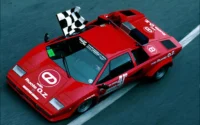

























Modena Team SpA was an Italian Formula One constructor that competed during the 1991 Formula One World Championship. Although officially entered as Modena Team, the outfit became widely known as the “Lamborghini” or simply “Lambo” team due to its close association with the Italian supercar manufacturer, which designed both its chassis and engine.
Despite contesting the full 1991 season, Modena Team struggled to establish itself in an increasingly competitive field. The team entered 16 World Championship Grands Prix, qualified for six races and failed to score a championship point. Its strongest result came at the opening round of the season, where Nicola Larini finished seventh in the 1991 United States Grand Prix.
| Nationality | Italian |
| Years Active | 1991 |
| First Race | 1991 United States Grand Prix |
| Last Race | 1991 Australian Grand Prix |
| Race Entries | 16 |
| Race Starts | 6 |
| Wins | 0 |
| Podiums | 0 |
| Pole Positions | 0 |
| Fastest Laps | 0 |
| Points | 0 |
| Constructors’ Championships | 0 |
| Drivers’ Championships | 0 |
| Best Start | 17th |
| Best Finish | 7th |
| Did Not Start | 0 |
| Did Not Qualify | 12 |
| Retirements | 3 |
Origins
The project began life in early 1990 under the name GLAS. Financial backing was expected from wealthy Mexican businessman Fernando González Luna, who was reportedly investing around $20 million in the new operation. The team was managed by former Italian journalist Leopoldo Canettoli and quickly established an ambitious technical partnership with Lamborghini.
Lamborghini had entered Formula One as an engine supplier in 1989 after creating Lamborghini Engineering the previous year to oversee its racing activities. The GLAS project presented the company with its first opportunity to design and build an entire Formula One car, rather than simply supplying engines. Former Alfa Romeo and Spirit driver Mauro Baldi was identified as both a potential driver and financial supporter of the team.
Lamborghini Engineering entrusted legendary designer Mauro Forghieri, assisted by Mario Tolentino, with creating the new car. By the middle of 1990, development had progressed to the point where a rolling chassis was ready for testing. Just as the project appeared to be gathering momentum, González Luna disappeared, taking the promised funding with him and leaving the team’s future in serious doubt.
Rather than abandon the programme, Lamborghini stepped in with enough financial support to keep the project alive. The operation relocated to Modena, Italy, where it adopted the name Modena Team SpA. Carlo Patrucco, the former head of sportswear company Fila, was appointed Team Principal as preparations continued for the 1991 Formula One season.
Despite Lamborghini’s extensive involvement in designing and building the car, the manufacturer was keen to avoid the perception of operating a factory Formula One team. Officially, the entry was listed as Modena Team SpA, although the media and fans almost universally referred to it as Lamborghini or simply “Lambo”. Following Lamborghini’s initial investment, however, the team operated as an independent business and received no further financial backing from the manufacturer.
The Lambo 291
The team’s unusual identity caused confusion throughout its only Formula One campaign. While the entrant was officially Modena Team, the chassis was designed and built by Lamborghini Engineering, carried Lamborghini branding and was powered by a Lamborghini V12 engine. As a result, the car appeared on official entry lists as the Lambo 291.
Adding to the confusion was the presence of Italian driver Stefano Modena on the Formula One grid with Tyrrell. Although sharing the same name as the team, Stefano Modena had no connection with the project, despite also coming from the city of Modena.
Technically, the Lambo 291 featured several distinctive ideas, including striking blue bodywork, triangular sidepods and heavily inclined radiators. The slanted radiator layout would later become a common design feature throughout Formula One.
Mauro Baldi carried out the first test programme during late 1990 before the team finalised its race line-up. Former Minardi engineer Jaime Manca Graziadei was appointed Team Manager but resigned before the opening Grand Prix. The race seats ultimately went to former Formula 3 champion Nicola Larini and 1990 International Formula 3000 runner-up Eric van de Poele. Mario Tolentino served as Larini’s race engineer, while former Formula One driver Dave Morgan worked with van de Poele.
1991 Formula One Season
Like several new teams, Modena Team was required to take part in pre-qualifying during the first half of the 1991 season. Escaping the crowded Friday morning sessions proved difficult, with each driver successfully qualifying for just one race during that period.
Larini delivered the team’s best result of the year by finishing seventh at the opening United States Grand Prix, narrowly missing out on the points under the scoring system used at the time. Van de Poele came even closer to a remarkable finish at the San Marino Grand Prix, running fifth and on course to score two World Championship points before a fuel system failure stopped the car on the final lap, within sight of the chequered flag. Although classified, he was relegated to ninth place.
Larini’s seventh-place finish eventually proved valuable. When Formula One reorganised the pre-qualifying system midway through the season, the result was enough to move Modena Team out of the Friday morning sessions. Unfortunately, improved track access did little to improve results.
Financial difficulties continued to hamper development as the team struggled to attract major sponsorship, while Lamborghini refused to inject additional funding. Larini qualified for four more Grands Prix during the remainder of the season, retiring after spinning in Germany, finishing 16th in both Hungary and Italy, and ending his Australian Grand Prix after colliding with Jean Alesi.
Away from the circuit, Mauro Forghieri stepped down as Technical Director during the season to concentrate on his responsibilities at Lamborghini Engineering, where he was overseeing development of the manufacturer’s new Formula One engine for 1992.
Final Months
By the end of the 1991 season, Modena Team’s financial position had become critical. With growing debts and no further support from Lamborghini, the future of the operation looked increasingly uncertain.
Forghieri returned in an effort to reorganise the team as an independent constructor. Alternative plans included a possible merger with Larrousse or integrating the project into Reynard’s proposed Formula One programme, but neither option progressed beyond discussions.
Even as its future hung in the balance, Modena Team commissioned respected designer Sergio Rinland to develop a new car for the 1992 Formula One season. Work on the chassis began in October 1991, with the team considering either Judd V8 engines or a continued relationship with Lamborghini for power units.
Ultimately, none of those plans came to fruition. Unable to secure the funding needed to continue, Modena Team ceased operations before the start of the 1992 Formula One season.
Legacy
Today, one of the surviving Lambo 291 chassis is preserved at the Museo Lamborghini in Sant’Agata Bolognese, where it serves as a reminder of the manufacturer’s only attempt to build a complete Formula One car.
Lamborghini Stats by Season
| Year | Engine | Drivers | Entries | Starts | Wins | Podiums | Poles | Fastest Laps | Front Rows | DNF | Best Start | Best Result | Points | Championship |
|---|---|---|---|---|---|---|---|---|---|---|---|---|---|---|
| 1991 | Lamborghini | Nicola Larini, Eric van de Poele | 16 | 6 | 0 | 0 | 0 | 0 | 0 | 3 | 17 | 7 | 0 | NC |