

























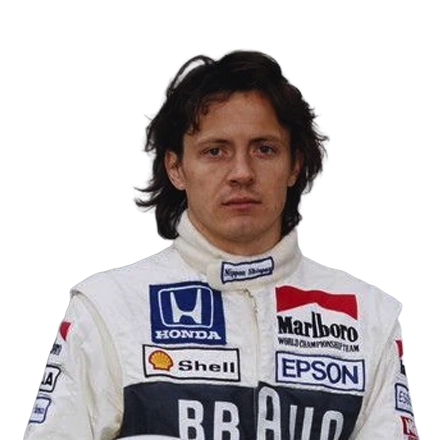
Stefano Modena is an Italian former racing driver who competed in Formula One from 1987 to 1992. Widely regarded as one of the most naturally gifted talents of his generation, Modena combined blistering qualifying speed with flashes of brilliance that suggested far greater results than his statistics ultimately show.
Driver Bio
| Nationality | Italian |
| Birthplace | San Prospero, Italy |
| Born | 12 May 1963 |
| First Grand Prix | 1987 Australian Grand Prix |
| Last Grand Prix | 1992 Australian Grand Prix |
| Years Active | 1987–1992 |
| Current/Last Team | Jordan |
Born and raised in Modena—a city steeped in motorsport heritage and home to marques such as Ferrari and Maserati—he seemed destined for a life in racing.
He began in karting and quickly became one of Europe’s standout young prospects, winning the junior World Cup in 1978 and then back-to-back senior European Karting Championships in 1983 and 1984.
Junior career
Formula Ford and Formula Three
After karting success, Modena spent two seasons in the Italian Formula Ford championship before moving into Italian Formula Three Championship in 1985 with Euroracing.
His first season was modest, but in 1986 he switched to Team Seresina and immediately blossomed. Driving a Reynard chassis, he won three races, finished fourth overall, took second in the Monaco support race, and won a European championship round at Imola Circuit.
He also announced himself globally by taking pole position for the prestigious Macau Grand Prix.
Formula 3000 champion
In 1987, Modena joined Onyx Race Engineering in International Formula 3000 Championship.
He won three races and claimed the championship in his rookie season—a remarkable achievement that marked him as a future Formula One star. Many believed Italy had found its next Grand Prix winner.
Formula One career
Across 81 Grands Prix, Modena raced for Brabham, EuroBrun, Tyrrell and Jordan Grand Prix, scoring two podiums and 17 championship points.
Brabham debut
Modena’s Formula One debut came as a one-off with Brabham at the 1987 Australian Grand Prix in Adelaide.
He impressed by qualifying 15th, but struggled with the power delivery of the turbocharged BMW engine. Multiple tyre stops and physical exhaustion ended his race early. Even so, his pace caught attention.
EuroBrun struggles
A full-time seat followed in 1988 with EuroBrun, but the team’s EuroBrun ER188 was badly uncompetitive.
Modena spent the year near the back, though he consistently outpaced teammate Oscar Larrauri. It was a frustrating season that masked his talent.
Brabham return and Monaco podium
Brabham returned in 1989 under new ownership, and Modena was brought back alongside Martin Brundle.
Using Pirelli qualifying tyres to great effect, Modena regularly placed the Judd-powered Brabham high on the grid, starting in the top ten eight times. Reliability, however, was poor.
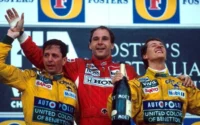
The standout moment came at the 1989 Monaco Grand Prix, where he finished third, earning his first Formula One podium.
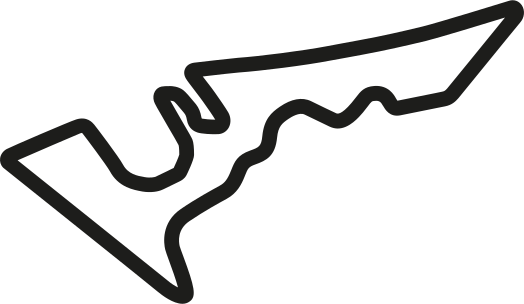
In 1990, amid financial chaos after owner Joachim Lüthi’s imprisonment for fraud, Modena still managed fifth place at the season-opening United States Grand Prix.
Tyrrell and career peak (1991)
Modena’s biggest chance arrived in 1991 when he replaced Ferrari-bound Jean Alesi at Tyrrell.
With Honda power, sponsorship backing, and the respected Tyrrell 020 chassis, expectations were high.
He began strongly with fourth at Phoenix, then nearly scored a podium at Imola before transmission failure. At Monaco, he sensationally qualified on the front row beside friend and world champion Ayrton Senna and pressured the Brazilian early in the race before retiring with engine failure.
His finest Formula One result came at the 1991 Canadian Grand Prix, where he finished second after Nigel Mansell retired dramatically on the final lap while leading.
After that, tyre development problems and balance issues with the heavy Honda engine hurt the team. Modena scored only one further point, finishing sixth in Japan.
Though respectable on paper, the season was viewed as a missed opportunity given the early promise.
Jordan disappointment
In 1992, Modena moved to Jordan Grand Prix after the team’s impressive debut season.
Unfortunately, the underpowered Yamaha V12 engine blunted the car’s competitiveness. Modena failed to qualify four times and endured a difficult relationship with the team.
He scored Jordan’s only point of the season by finishing sixth at the 1992 Australian Grand Prix, but it was not enough to secure another Formula One seat.
That race proved to be his last in Grand Prix racing.
Touring cars and later work
Modena moved into touring cars with Alfa Romeo from 1993 to 1999, racing in Italian and German championships and taking occasional wins. He later spent a season with Opel before retiring from active motorsport in 2000.
In 2003, he joined Bridgestone as a tyre test and development driver, travelling globally and working across racing and road tyre programmes.
Personal life
Since the late 1990s, Modena has lived in Rome with his wife, former actress Sveva Altieri. They have two children, Ascanio and Vittoria.
He became known in Formula One for eccentric habits that amused and baffled paddock insiders. Among them: insisting his car not be parked on the left side of the garage, disliking anyone touching the car once he was strapped in, and racing with his gloves inside out. He later insisted this was not superstition—just preference.
Grand Prix Stats
| Race Entries | 81 |
| Race Starts | 70 |
| Did Not Start | 2 |
| Best Race Start | 2nd |
| Best Race Finish | 2nd |
| Retirements | 40 |
| First-Lap Retirements | 3 |
| Not Classified | 1 |
| Disqualified | 0 |
| Did Not Qualify | 9 |
Podiums
| Podiums | 2 |
| First Podium | 1989 Monaco Grand Prix |
| Last Podium | 1991 Canadian Grand Prix |
| 1st Place | 0 |
| 2nd Place | 1 |
| 3rd Place | 1 |
| Most Consecutive Podiums | 0 |
| Most Podiums in a Single Season | 1 |
| Seasons with Podiums | 2 |
Qualifying
| Qualifying Sessions | 81 |
| Reached Q3 | 0 |
| Q2 Eliminations | 0 |
| Q1 Eliminations | 0 |
| Did Not Qualify | 9 |
Points
| Points Scored | 17 |
| Points Finishes | 6 |
| Most Points in a Single Season | 10 |
| Seasons with Points | 4 |
Front Row Starts
| Front Row Starts | 1 |
| Poles | 0 |
| 2nd on Grid | – |
| Most Front Row Starts in a Season | 1 |
| Seasons with Front Row Starts | 1 |
Stats by Season
| Year | Constructor | Entries | Starts | Wins | Podiums | Poles | Fastest Laps | Front Rows | DNF | Best Start | Best Result | Pts Finishes | Points | Championship |
|---|---|---|---|---|---|---|---|---|---|---|---|---|---|---|
| 1987 | Brabham | 1 | 1 | 0 | 0 | 0 | 0 | 0 | 1 | 15 | – | 0 | 0 | NC |
| 1988 | EuroBrun | 16 | 10 | 0 | 0 | 0 | 0 | 0 | 4 | 15 | 11 | 0 | 0 | NC |
| 1989 | Brabham | 16 | 15 | 0 | 1 | 0 | 0 | 0 | 10 | 7 | 3 | 1 | 4 | 16th |
| 1990 | Brabham | 16 | 16 | 0 | 0 | 0 | 0 | 0 | 10 | 10 | 5 | 1 | 2 | 16th |
| 1991 | Tyrrell | 16 | 16 | 0 | 1 | 0 | 0 | 1 | 7 | 2 | 2 | 3 | 10 | 8th |
| 1992 | Jordan | 16 | 12 | 0 | 0 | 0 | 0 | 0 | 8 | 12 | 6 | 1 | 1 | 17th |
Stats by Constructor
| Constructor | Years | Entries | Starts | Wins | Podiums | Poles | Fastest Laps | Front Rows | DNF | Best Start | Best Result | Pts Finishes | Points |
|---|---|---|---|---|---|---|---|---|---|---|---|---|---|
| Brabham | 1987, 1989–1990 | 33 | 32 | 0 | 1 | 0 | 0 | 0 | 21 | 7 | 3 | 2 | 6 |
| EuroBrun | 1988 | 16 | 10 | 0 | 0 | 0 | 0 | 0 | 4 | 15 | 11 | 0 | 0 |
| Tyrrell | 1991 | 16 | 16 | 0 | 1 | 0 | 0 | 1 | 7 | 2 | 2 | 3 | 10 |
| Jordan | 1992 | 16 | 12 | 0 | 0 | 0 | 0 | 0 | 8 | 12 | 6 | 1 | 1 |
Teammates & Qualifying Head-to-Head
| Teammate | Years | Races | Qualifying H2H |
|---|---|---|---|
| Andrea de Cesaris | 1987 | 1 | 0-1 |
| Oscar Larrauri | 1988 | 14 | 13-1 |
| Martin Brundle | 1989 | 16 | 9-7 |
| Gregor Foitek | 1990 | 2 | 2-0 |
| David Brabham | 1990 | 14 | 14-0 |
| Satoru Nakajima | 1991 | 16 | 15-1 |
| Mauricio Gugelmin | 1992 | 16 | 7-9 |