


























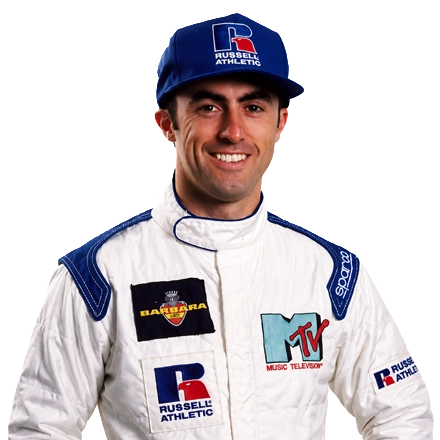
David Brabham (born 5 September 1965) is an Australian racing driver whose career has spanned Formula One, touring cars and international sports car racing. Although he competed in Formula One during the 1990 and 1994 seasons, Brabham achieved his greatest success in endurance racing, winning the 2009 24 Hours of Le Mans outright and claiming consecutive American Le Mans Series titles in 2009 and 2010.
Driver Bio
| Nationality | Australian |
| Birthplace | Wimbledon, England, UK |
| Born | 5 September 1965 |
| First Grand Prix | 1990 San Marino Grand Prix |
| Last Grand Prix | 1994 Australian Grand Prix |
| Current/Last Team | Simtek |
The youngest son of three-time Formula One World Champion Sir Jack Brabham, David forged his own reputation as one of Australia’s most accomplished endurance racers, becoming only the fourth Australian to win the 24 Hours of Le Mans.
Early Life
Born in Wimbledon, London, Brabham spent most of his childhood in Australia. Despite growing up in one of motorsport’s most famous families, he showed little interest in racing during his early years. Instead, he played football, first taking up soccer before switching to Australian rules football after the family relocated to Sydney.
Unlike many second-generation racing drivers, Brabham was never pressured into following his father’s footsteps. It was only at the age of 17, after discovering karting, that he developed a passion for motorsport. Together with a neighbour, he bought a second-hand kart and began racing competitively.
Early Career
Brabham’s professional racing career began in Australia in 1983 with karting before he progressed into the Ford Laser one-make championship in 1985. He moved into Formula Ford the following year and then Australian Formula 2, where he won the 1987 Australian Drivers’ Championship.
His title-winning performance was particularly memorable. After qualifying only 38th for the championship-deciding race at the Adelaide Grand Prix circuit due to carburettor and electrical problems, Brabham produced a remarkable drive through the field, overtaking leader Rohan Onslow on lap 13 of the 15-lap race before winning by 1.7 seconds.
During 1987 he also gained experience in New Zealand Formula Atlantic, American Formula Atlantic and South American Formula Three before moving to Europe in 1989 with Camel sponsorship. Racing for Bowman Motorsport, he claimed the British Formula Three Championship, establishing himself as one of the sport’s brightest young talents.
Formula One
Brabham graduated to Formula One in 1990 with the Brabham team, although by that stage the famous constructor founded by his father had changed ownership several times and was struggling financially.
After choosing to miss the opening two rounds to complete additional testing and preparation, Brabham made his first appearance at the San Marino Grand Prix, where he failed to qualify. His Formula One debut came at the following Monaco Grand Prix, a circuit that held special significance for the Brabham family after Sir Jack’s victory there in 1959.
The underfunded Brabham team proved uncompetitive throughout the season. Driving the Judd-powered BT59, Brabham qualified for six of the 14 Grands Prix he entered, including his home race in Australia. However, a lack of results and the team’s ongoing financial difficulties, coupled with the sponsorship required to retain his seat, brought his first Formula One spell to an end.
In 1991, Brabham moved into sports car racing with Tom Walkinshaw Racing’s Jaguar programme and immediately enjoyed success, winning the Spa 24 Hours alongside Naoki Hattori and Anders Olofsson in a Nissan Skyline GT-R.
He returned to Formula One in 1994 with the new Simtek team after his father became a shareholder in the operation. Despite the limitations of the overweight Simtek S941, which used a conventional manual gearbox and customer Cosworth engines, Brabham qualified for every race he entered.
The season was overshadowed by the tragic death of teammate Roland Ratzenberger during qualifying for the San Marino Grand Prix. Although many expected Simtek to withdraw from the event, Brabham chose to continue racing in support of the devastated team. He retired from the race following a suspension failure, but his leadership throughout the remainder of the season played an important role in helping the small constructor complete its campaign. While the car rarely challenged for points, Brabham consistently extracted the maximum from the package and regularly outperformed his teammates.
At the end of 1994, Brabham left Formula One to accept a works drive with BMW in the British Touring Car Championship.
Touring Cars
Brabham’s first BTCC campaign with BMW in 1995 proved challenging, but success quickly followed elsewhere. In 1996 he won the Japanese GT Championship GT500 title driving the McLaren F1 GTR, becoming part of the only non-Japanese team to win the championship.
The following year he claimed victory in the 1997 AMP Bathurst 1000 alongside his brother Geoff Brabham. Although they initially crossed the finish line in second place, they inherited victory after their BMW Motorsport Australia teammates were disqualified for exceeding the maximum permitted driving time.
Sports Car Racing
Endurance racing became the defining chapter of Brabham’s career. From the late 1990s onwards he established himself as one of the world’s leading sports car drivers, competing for manufacturers including Panoz, Bentley, Aston Martin, Peugeot and Highcroft Racing.
He won the Professional Sports Car Championship with Panoz in 1998 before adding victory in the 1999 Petit Le Mans. In the American Le Mans Series, Brabham became one of the championship’s standout competitors, collecting 23 race victories across four different classes and winning consecutive overall LMP titles in 2009 and 2010 with Highcroft Racing.
Brabham also built an outstanding record at the 24 Hours of Le Mans. He finished second overall with Bentley in 2003 before claiming GT1 class victories with Aston Martin in 2007 and 2008. His greatest triumph came in 2009, when he drove the Peugeot 908 HDi FAP to outright victory alongside Alexander Wurz and Marc Gené.
The win made Brabham only the fourth Australian to claim overall victory at Le Mans, following Bernard Rubin, Vern Schuppan and his older brother Geoff. It also meant that both Jack and Geoff Brabham had now been joined by David as outright winners of one of the world’s greatest endurance races.
Following his Le Mans success, Brabham secured back-to-back American Le Mans Series championships in 2009 and 2010 before continuing his endurance racing career in the FIA World Endurance Championship and GT competition, including spells with JRM Racing and United Autosports.
Project Brabham and Brabham Automotive
Away from driving, Brabham turned his attention to new motorsport ventures. In 2014 he launched Project Brabham, an innovative initiative that aimed to build a professional racing team through fan engagement and crowdfunding while creating a digital platform connecting supporters with the project.
Four years later, he helped relaunch the famous Brabham name with the creation of Brabham Automotive. The company’s first car, the Brabham BT62, debuted in 2018, with Brabham himself sharing driving duties during its maiden race at Brands Hatch. The BT62 won on its competitive debut, marking the first victory for both the new company and its inaugural model.
Family
David Brabham is the youngest son of three-time Formula One World Champion Sir Jack Brabham and the younger brother of racing drivers Geoff and Gary Brabham. He is also the brother-in-law of former Formula One driver Mike Thackwell through his wife, former racing driver Lisa Brabham (née Thackwell).
The family’s motorsport legacy has continued into another generation through David’s son, Sam Brabham, and his nephew, Matthew Brabham, both of whom have competed in junior formula racing categories.
Grand Prix Stats
| Race Entries | 30 |
| Race Starts | 24 |
| Did Not Start | 0 |
| Best Race Start | 21st |
| Best Race Finish | 10th |
| Retirements | 17 |
| First-Lap Retirements | 0 |
| Not Classified | 0 |
| Disqualified | 0 |
| Did Not Qualify | 6 |
Qualifying
| Qualifying Sessions | 30 |
| Reached Q3 | 0 |
| Q2 Eliminations | 0 |
| Q1 Eliminations | 0 |
| Did Not Qualify | 6 |
Stats by Season
| Year | Constructor | Entries | Starts | Wins | Podiums | Poles | Fastest Laps | Front Rows | DNF | Best Start | Best Result | Pts Finishes | Points | Championship |
|---|---|---|---|---|---|---|---|---|---|---|---|---|---|---|
| 1990 | Brabham | 14 | 8 | 0 | 0 | 0 | 0 | 0 | 7 | 21 | 15 | 0 | 0 | NC |
| 1994 | Simtek | 16 | 16 | 0 | 0 | 0 | 0 | 0 | 10 | 21 | 10 | 0 | 0 | NC |
Stats by Constructor
| Constructor | Years | Entries | Starts | Wins | Podiums | Poles | Fastest Laps | Front Rows | DNF | Best Start | Best Result | Pts Finishes | Points |
|---|---|---|---|---|---|---|---|---|---|---|---|---|---|
| Brabham | 1990 | 14 | 8 | 0 | 0 | 0 | 0 | 0 | 7 | 21 | 15 | 0 | 0 |
| Simtek | 1994 | 16 | 16 | 0 | 0 | 0 | 0 | 0 | 10 | 21 | 10 | 0 | 0 |
Teammates & Qualifying Head-to-Head
| Teammate | Years | Races | Qualifying H2H |
|---|---|---|---|
| Stefano Modena | 1990 | 14 | 0-14 |
| Roland Ratzenberger | 1994 | 3 | 3-0 |
| Andrea Montermini | 1994 | 1 | 1-0 |
| Jean-Marc Gounon | 1994 | 7 | 6-1 |
| Domenico Schiattarella | 1994 | 2 | 2-0 |
| Taki Inoue | 1994 | 1 | 1-0 |


