





























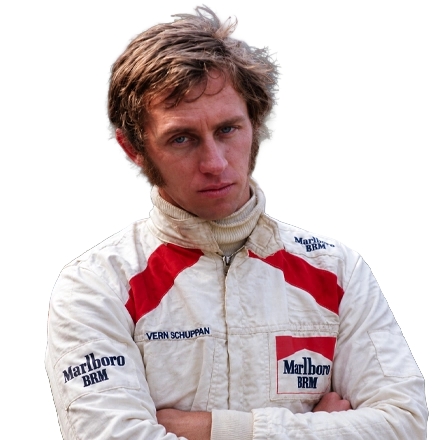
Vernon John Schuppan AM (born 19 March 1943) is an Australian former racing driver whose career crossed Formula One, the Indianapolis 500, Formula 5000, touring cars and international sports-car racing.
Driver Bio
| Nationality | Australian |
| Birthplace | Booleroo Centre, Australia |
| Born | 19 March 1943 |
| First Grand Prix | 1972 Belgian Grand Prix |
| Last Grand Prix | 1977 Dutch Grand Prix |
| Years Active | 1972, 1974–1975, 1977 |
| Current/Last Team | Surtees |
Schuppan always regarded himself primarily as a single-seater driver, but his defining victory came in endurance racing. Sharing a factory Rothmans Porsche 956 with Hurley Haywood and Al Holbert, he won the 1983 24 Hours of Le Mans.
In 1984, Schuppan was appointed a Member of the Order of Australia for his service to motor racing.
Early career and Formula One
Schuppan began in karting, collecting numerous Australian state and national titles before deciding to pursue a professional career overseas.
He and his wife, Jennifer, moved to Britain with a self-imposed deadline: if Schuppan had not established himself within two years, they would return home. The plan worked. He won the 1971 British Formula Atlantic Championship and earned a test role with BRM.
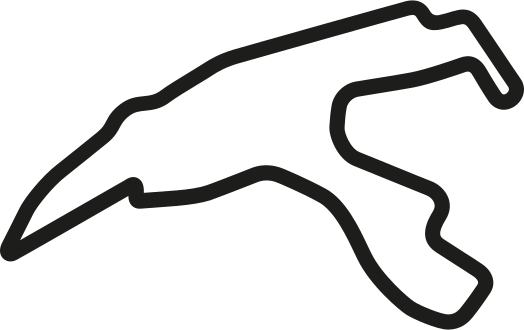
Schuppan qualified a BRM for the 1972 Belgian Grand Prix at Nivelles, but never started the race. Teammate Helmut Marko took over his car, leaving Schuppan on the sidelines. He did, however, represent BRM in several non-Championship Formula One events.
A proper World Championship opportunity arrived with Ensign in 1974. Schuppan finished 15th on his debut at the Belgian Grand Prix, then crashed out after four laps in Monaco.
The remainder of the season became an eventful tour of Formula One’s rulebook. He was disqualified in Sweden after starting illegally from 26th position and excluded in the Netherlands for receiving a tyre change away from the pits. He failed to qualify in France and Britain, while gearbox trouble ended his German Grand Prix after four laps.
Schuppan made one Formula One appearance in 1975, driving for Graham Hill and his Embassy team in Sweden. Transmission failure prevented him from reaching the finish.
His final Grand Prix campaign came with Surtees in 1977. He placed 12th in Britain and recorded a career-best seventh in Germany, followed by 16th in Austria. A failure to qualify in the Netherlands brought his Formula One career to an end.
Schuppan later described team owner John Surtees as an autocratic figure who rarely listened to his drivers. He also believed that teammate Vittorio Brambilla received superior equipment, limiting what he could achieve with the team.
Sports-car success
If Formula One offered frustration, endurance racing allowed Schuppan’s adaptability and mechanical sympathy to flourish.
His first Le Mans podium came in 1975, when he shared a Mirage GR8-Ford Cosworth DFV with Jean-Pierre Jaussaud and finished third. Two years later, he and Jean-Pierre Jarier took a turbocharged Mirage GR8-Renault to second place.
Schuppan returned to the runner-up position in 1982, sharing a Rothmans Porsche 956 with Jochen Mass. Twelve months later, he finally reached the top step.
Winning Le Mans
For the 1983 race, Schuppan joined Americans Al Holbert and Hurley Haywood in the No. 3 factory Porsche 956.
The finish was desperately close. A blockage restricted airflow to the radiator that cooled the cylinder heads, leaving the Porsche overheating and trailing steam. Holbert nursed the wounded car through the final lap, and the engine seized as he crossed the line.
Only 17 seconds behind was the sister No. 1 Rothmans Porsche, driven at the finish by Derek Bell and shared with defending winners Jacky Ickx. After 24 hours, Schuppan’s greatest race had been decided by little more than the length of an ordinary pit stop.
The victory made him the second Australian-born driver to win Le Mans, following Bernard Rubin in 1928. Schuppan is sometimes described as Australia’s first winner, but that distinction belongs to Rubin.
His remarkable 1983 season continued in Japan, where he won the Japanese Sports-Prototype Championship.
The extraordinary 1984 finish
The factory Rothmans team boycotted the 1984 Le Mans race in protest at new fuel-consumption regulations introduced by the Automobile Club de l’Ouest. Porsche initially refused to release its contracted drivers to private teams, but relaxed its position less than two weeks before the event.
That allowed defending winner Schuppan to join Kremer Racing in a Porsche 956B. He shared the Kenwood-backed car with Jarier and Australian Formula One world champion Alan Jones, who was making his first and only Le Mans appearance.
Schuppan and Jones challenged for the lead during the opening hours, fighting the Lancia LC2 of Bob Wollek and Alessandro Nannini. Their progress was interrupted at Mulsanne Corner when the spinning car of Roger Dorchy damaged the Porsche’s nose, costing several laps in repairs.
The Kremer entry recovered impressively. Late in the race, Jarier was running two laps behind the leading Joest Porsche of Klaus Ludwig and Henri Pescarolo but closing at more than ten seconds per lap.
Jarier handed the car to Schuppan for the final stint, only for a connecting rod to fail after approximately a lap and a half. With 90 minutes remaining, the Porsche appeared finished.
Le Mans regulations required classified cars to complete their final lap within a specified time. Near the end, Schuppan restarted the damaged machine and coaxed it around for one last tour, securing sixth place.
Other endurance results
Schuppan accumulated numerous additional World Sportscar Championship podiums. He finished second in the Spa 1000 Kilometres in 1973 and 1982, took third at the Fuji 1000 Kilometres in 1983 and 1984, and placed third in the 1985 Selangor 800 Kilometres.
He also finished third in the All Japan Sports Prototype Championship in three consecutive seasons: 1984, 1985 and 1986.
Indianapolis and other single-seaters
Schuppan started three Indianapolis 500s. He was named Rookie of the Year on his first appearance in 1976, returned in 1979 and achieved his best result in 1981.
Driving a McLaren-Ford, Schuppan finished third in the 1981 race. Across his American open-wheel career, he made 32 starts in USAC and CART Championship events.
Macau provided another pair of major single-seater victories. Schuppan won the Macau Grand Prix in 1974 and 1976, dominating the first of those races by four laps.
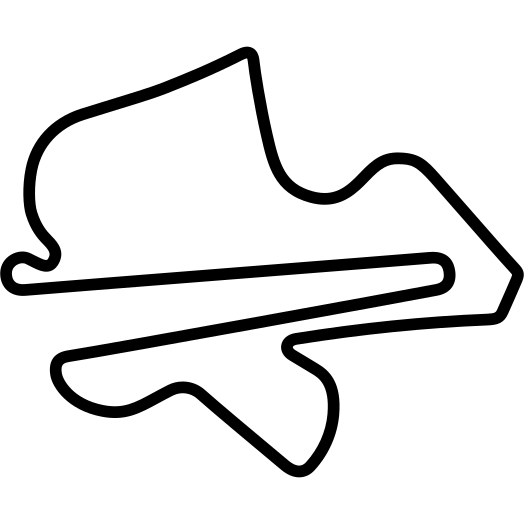
He also won the Singapore Grand Prix in 1973, having finished second there the previous year. Another runner-up result came at the 1972 Malaysian Grand Prix.
Alongside those appearances, Schuppan raced Formula 5000 in Europe during 1974 and 1975 and in North America from 1974 through 1976.
Racing in Australia
Despite his international schedule, Schuppan returned regularly to compete in Australia.
He won the 1976 Rothmans International Series in a Chevrolet-powered Lola T332. That year’s Australian Grand Prix at Sandown produced an agonisingly close second place: driving an Elfin MR8-Chevrolet, Schuppan finished only half a second behind John Goss in the Matich A53-Repco Holden.
Schuppan returned to the Rothmans series in 1978 with Garrie Cooper’s factory-supported Ansett Team Elfin. Once again driving an MR8-Chevrolet, he finished second in the championship.
His reputation made him a popular endurance co-driver for leading Australian touring-car operations, including Allan Moffat Racing, Dick Johnson Racing and Peter Brock’s Holden Dealer Team.
At the 1976 Bathurst 1000, Schuppan and Moffat started from pole position and led the race in a Ford XB Falcon GT Hardtop before engine failure forced their retirement on lap 87. Schuppan later described Moffat’s Falcon as the finest touring car he had driven.
His best Bathurst result came in 1978, when he partnered Dick Johnson to fifth place in a Ford XC Falcon.
Schuppan joined the Holden Dealer Team in 1981 and shared a VC Commodore with John Harvey. After Schuppan started the Hang Ten 400 at Sandown, the pair finished fourth.
Their Bathurst weekend ended before Schuppan could take the wheel. A broken front wheel sent Harvey into the guardrail on lap 37, eliminating the car.
The Schuppan road cars
After his frontline racing career, Schuppan became involved in an ambitious project to transform Porsche’s fearsome 962 prototype into an exclusive road car.
Backed by Japanese investment, his company initially produced the 962R. The first example, registered in Britain as H726 LDP, retained the honeycomb chassis and much of the bodywork from its racing career.
A more extensively redesigned road-going version followed as the Schuppan 962CR. It used distinctive bodywork rather than simply reproducing the racing 962 and carried an extraordinary price of 195 million yen, then approximately US$1.5 million.
Only six examples were built. The immense construction costs, a worldwide recession and the failure of a Japanese customer to pay for two delivered cars pushed the business into bankruptcy.
Team ownership and Scott Dixon
Schuppan later co-owned an Indy Lights team with former Formula One driver Stefan Johansson. Together, the pair helped manage the early career of New Zealand driver Scott Dixon.
The partnership eventually ended after Schuppan and Johansson fell out, prompting Schuppan to leave the operation. Dixon went on to become one of the most successful drivers in American open-wheel racing.
Bringing Formula One to Adelaide
Schuppan also played an important part in bringing the Australian Grand Prix to Adelaide.
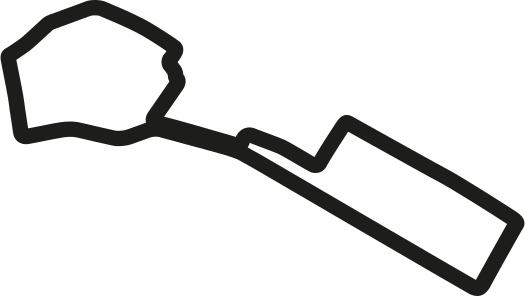
Formula One boss Bernie Ecclestone had initially favoured Sydney as the race’s home. South Australian premier John Bannon asked Schuppan, who knew Ecclestone personally, to persuade him to inspect Adelaide as an alternative.
The visit changed the direction of the project. Ecclestone was sufficiently impressed for Adelaide to secure the Grand Prix, which remained in the city for 11 seasons from 1985 through 1995.
In May 2006, Schuppan was elected to Monaco’s Club International des Anciens Pilotes de Grand Prix F1.
As of 2014, he and Jennifer had been married for more than 45 years and were living in a converted warehouse beside the Adelaide Street Circuit. After more than four decades travelling through international motorsport, Schuppan joked that city living itself felt like a new experience.
He also became a regular supporter of the Targa Adelaide tarmac rally—remaining close to competition in the city he had helped place on Formula One’s world stage.
Grand Prix Stats
| Race Entries | 13 |
| Race Starts | 9 |
| Did Not Start | 1 |
| Best Race Start | 14th |
| Best Race Finish | 7th |
| Retirements | 3 |
| First-Lap Retirements | 0 |
| Not Classified | 0 |
| Disqualified | 2 |
| Did Not Qualify | 3 |
Qualifying
| Qualifying Sessions | 13 |
| Reached Q3 | 0 |
| Q2 Eliminations | 0 |
| Q1 Eliminations | 0 |
| Did Not Qualify | 3 |
Stats by Season
| Year | Constructor | Entries | Starts | Wins | Podiums | Poles | Fastest Laps | Front Rows | DNF | Best Start | Best Result | Pts Finishes | Points | Championship |
|---|---|---|---|---|---|---|---|---|---|---|---|---|---|---|
| 1972 | BRM | 1 | 0 | 0 | 0 | 0 | 0 | 0 | 0 | – | – | 0 | 0 | NC |
| 1974 | Ensign | 7 | 5 | 0 | 0 | 0 | 0 | 0 | 2 | 14 | 15 | 0 | 0 | NC |
| 1975 | Hill | 1 | 1 | 0 | 0 | 0 | 0 | 0 | 1 | 26 | – | 0 | 0 | NC |
| 1977 | Surtees | 4 | 3 | 0 | 0 | 0 | 0 | 0 | 0 | 19 | 7 | 0 | 0 | NC |
Stats by Constructor
| Constructor | Years | Entries | Starts | Wins | Podiums | Poles | Fastest Laps | Front Rows | DNF | Best Start | Best Result | Pts Finishes | Points |
|---|---|---|---|---|---|---|---|---|---|---|---|---|---|
| BRM | 1972 | 1 | 0 | 0 | 0 | 0 | 0 | 0 | 0 | – | – | 0 | 0 |
| Ensign | 1974 | 7 | 5 | 0 | 0 | 0 | 0 | 0 | 2 | 14 | 15 | 0 | 0 |
| Hill | 1975 | 1 | 1 | 0 | 0 | 0 | 0 | 0 | 1 | 26 | – | 0 | 0 |
| Surtees | 1977 | 4 | 3 | 0 | 0 | 0 | 0 | 0 | 0 | 19 | 7 | 0 | 0 |
Teammates & Qualifying Head-to-Head
| Teammate | Years | Races | Qualifying H2H |
|---|---|---|---|
| Howden Ganley | 1972 | 1 | Not provided |
| Peter Gethin | 1972 | 1 | Not provided |
| Jean-Pierre Beltoise | 1972 | 1 | Not provided |
| Tony Brise | 1975 | 1 | Not provided |


