







































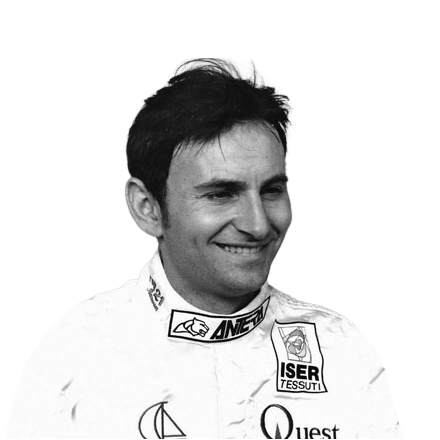
Andrea Montermini is an Italian racing driver whose career has spanned Formula One, Indy-style single-seaters, endurance racing, and GT competition across more than three decades.
Driver Bio
| Nationality | Italian |
| Birthplace | Sassuolo, Italy |
| Born | 30 May 1964 |
| First Grand Prix | 1994 Spanish Grand Prix |
| Last Grand Prix | 1996 British Grand Prix |
| Years Active | 1994–1996 |
| Current/Last Team | Forti |
Known for his adaptability and longevity, Montermini became one of the many talented Italian drivers of the 1990s who fought their way into Formula One during an intensely competitive era. Although his Grand Prix career unfolded under difficult circumstances and with struggling teams, he built an international racing career that extended far beyond Formula One.
Montermini first emerged in Italian Formula 3 in 1989, quickly showing impressive speed against a highly competitive field. One of his standout performances came in the prestigious Monaco Grand Prix support race, where he finished second — an achievement that immediately elevated his profile among European teams and talent scouts.
That same year, he finished fourth in the Italian Formula 3 Championship, proving himself as one of the country’s most promising young drivers.
Formula 3000 Success
Following his strong Formula 3 performances, Montermini graduated to International Formula 3000, then regarded as the final major stepping stone before Formula One.
He spent three seasons in the category, steadily gaining experience before producing a breakthrough campaign in 1992 while driving for the Il Barone Rampante team. That season, Montermini finished runner-up in the championship after winning three races, firmly establishing himself as a legitimate Formula One prospect.
A Difficult Formula One Debut
Montermini’s Formula One debut came under deeply tragic circumstances.
In May 1994, the Simtek team needed a replacement for Roland Ratzenberger, who had been killed during qualifying for the San Marino Grand Prix at Imola — one of the darkest weekends in Formula One history.
Montermini was chosen to step into the seat and made his Formula One debut on 29 May 1994. It was an incredibly difficult environment for any rookie driver: Formula One was still reeling from the deaths of Ratzenberger and Ayrton Senna, while safety concerns dominated the sport.
Just weeks later, Montermini suffered a terrifying accident of his own during practice for the 1994 Spanish Grand Prix. The crash left him with a broken left heel and fractures to his right foot, sidelining him and abruptly ending his first Formula One campaign almost as soon as it had begun.
The accident was another harsh reminder of how dangerous Formula One remained during the mid-1990s transition period.
Pacific and Forti Years
Despite the injuries, Montermini fought his way back to Formula One in 1995 with the struggling Pacific Grand Prix team.
Like many smaller teams of the era, Pacific operated with limited resources and uncompetitive machinery, making points-scoring opportunities virtually impossible.
In 1996, he joined fellow Italian Luca Badoer at Forti, another underfunded team battling simply to survive in Formula One’s increasingly expensive environment.
The season proved difficult both financially and competitively. Forti struggled throughout the year before eventually collapsing entirely by the season’s end. Montermini’s Formula One career effectively ended alongside the team.
Across 29 Grand Prix starts between 1994 and 1996, he failed to score championship points, though the statistics rarely reflected the realities of the cars he drove.
Montermini also holds a unique Formula One record: at 1.57 metres (5 feet 1 inch) tall, he is recognised as the shortest driver in F1 history.
The Lola Project and American Racing
Montermini remained closely connected to Formula One after leaving the grid and was signed as a test driver for the ambitious MasterCard Lola project in 1997.
However, the team famously collapsed after just a single Grand Prix appearance, ending another potential opportunity before it had properly begun.
Away from Formula One, Montermini also competed in the American Champ Car series across three separate seasons in 1993, 1994, and 1999.
Driving for the underfunded Euromotorsport team during his first stint, he produced an impressive fourth-place finish in Detroit, highlighting his ability to adapt quickly to very different styles of racing.
He later returned to Champ Car in 1999 for Dan Gurney’s legendary All American Racers team during Gurney’s final season as team owner. Frequently stepping in as a substitute driver throughout the year, Montermini’s best finish came with 11th place in Vancouver.
GT and Endurance Racing Success
While Formula One brought frustration, Montermini ultimately found his greatest success in GT and endurance racing.
He competed in the 2001 24 Hours of Daytona before becoming a regular presence in the FIA GT Championship, where he raced primarily with Ferrari machinery.
Over the years, he established himself as one of the most experienced and dependable GT racers in Europe, earning multiple class victories and podium finishes. His smooth driving style made him especially effective in endurance competition.
In 2006, he also competed with the famous Zakspeed team, sharing a Saleen alongside Jarek Janis and Sascha Bert.
One of the defining periods of his later career came in the International GT Open championship. In 2007, Montermini won the GTA class title driving a Ferrari F430 for Scuderia Playteam alongside Michele Maceratesi. The pair then went one step further the following season, becoming overall series champions.
Montermini added another overall championship title in 2013, proving his competitiveness had endured long after his Formula One years ended.
Legacy
Andrea Montermini’s Formula One career may have unfolded largely with struggling teams during one of the sport’s toughest eras, but his broader racing career tells a far richer story.
From Formula 3000 race winner to Formula One survivor, from Champ Car competitor to championship-winning GT driver, Montermini carved out a career with a passion for racing.
Few drivers experienced as many setbacks — tragic circumstances, serious injury, collapsing teams, and missed opportunities — yet continued competing successfully across so many categories for so many years.
Grand Prix Stats
| Race Entries | 29 |
| Race Starts | 20 |
| Did Not Start | 3 |
| Best Race Start | 19th |
| Best Race Finish | 8th |
| Retirements | 14 |
| First-Lap Retirements | 1 |
| Not Classified | 1 |
| Disqualified | 1 |
| Did Not Qualify | 6 |
Qualifying
| Qualifying Sessions | 29 |
| Reached Q3 | 0 |
| Q2 Eliminations | 0 |
| Q1 Eliminations | 0 |
| Did Not Qualify | 6 |
Stats by Season
| Year | Constructor | Entries | Starts | Wins | Podiums | Poles | Fastest Laps | Front Rows | DNF | Best Start | Best Result | Pts Finishes | Points | Championship |
|---|---|---|---|---|---|---|---|---|---|---|---|---|---|---|
| 1994 | Simtek | 1 | 0 | 0 | 0 | 0 | 0 | 0 | 0 | – | – | 0 | 0 | NC |
| 1995 | Pacific | 17 | 16 | 0 | 0 | 0 | 0 | 0 | 11 | 19 | 8 | 0 | 0 | NC |
| 1996 | Forti | 11 | 4 | 0 | 0 | 0 | 0 | 0 | 3 | 20 | 10 | 0 | 0 | NC |
Stats by Constructor
| Constructor | Years | Entries | Starts | Wins | Podiums | Poles | Fastest Laps | Front Rows | DNF | Best Start | Best Result | Pts Finishes | Points |
|---|---|---|---|---|---|---|---|---|---|---|---|---|---|
| Simtek | 1994 | 1 | 0 | 0 | 0 | 0 | 0 | 0 | 0 | – | – | 0 | 0 |
| Pacific | 1995 | 17 | 16 | 0 | 0 | 0 | 0 | 0 | 11 | 19 | 8 | 0 | 0 |
| Forti | 1996 | 11 | 4 | 0 | 0 | 0 | 0 | 0 | 3 | 20 | 10 | 0 | 0 |
Teammates & Qualifying Head-to-Head
| Teammate | Years | Races | Qualifying H2H |
|---|---|---|---|
| David Brabham | 1994 | 1 | 0–1 |
| Bertrand Gachot | 1995 | 11 | 6–5 |
| Giovanni Lavaggi | 1995 | 4 | 4–0 |
| Jean-Denis Deletraz | 1995 | 2 | 2–0 |
| Luca Badoer | 1996 | 10 | 2–8 |