






































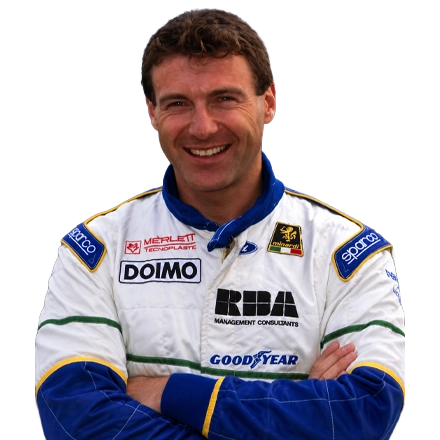
Giovanni Lavaggi (born 18 February 1958) is an Italian former racing driver, engineer, team owner and racing-car constructor. His varied career carried him from a late start in Formula Panda to Formula One, victory at the 24 Hours of Daytona and, eventually, the cockpit of a Le Mans prototype bearing his own name.
Driver Bio
| Nationality | Italian |
| Birthplace | Augusta, Italy |
| Born | 18 February 1958 |
| First Grand Prix | 1995 German Grand Prix |
| Last Grand Prix | 1996 Japanese Grand Prix |
| Years Active | 1995–1996 |
| Current/Last Team | Minardi |
Although born into an aristocratic family, Lavaggi did not have a personal fortune available to bankroll his ambitions. Consequently, he was already 26 when he entered motor racing—unusually late for a future Formula One driver. He nevertheless reached the World Championship with Pacific in 1995 and Minardi in 1996. Away from Grand Prix racing, he built a far more substantial record in sports cars, highlighted by the 1993 Interserie title and overall victory at Daytona in 1995.
Lavaggi later established Scuderia Lavaggi and designed the Lavaggi LS1 prototype, making him one of the comparatively few modern drivers to have raced in Formula One before competing internationally in a car of his own construction. He lives in Monte Carlo.
Early life
Lavaggi was born in Augusta, Sicily, on 18 February 1958 and comes from a family of noble ancestry. Before turning his attention fully to the racetrack, he studied mechanical engineering at Milan Polytechnic—a background that would prove particularly useful when his career progressed from simply driving racing cars to creating one.
Racing career
Lavaggi began competing in 1984 after attending Henry Morrogh’s racing school, where Morrogh reportedly regarded him as the finest student he had taught. His first season was spent as an official Ermolli driver in the Italian Formula Panda Championship. Despite his inexperience, Lavaggi finished runner-up and won more races than any other competitor.
Formula Three was the logical next rung on the ladder, but assembling the sponsorship required for a complete campaign proved impossible. Lavaggi made several appearances in the Italian Formula Three Championship before choosing a different route, moving into Group C sports cars to gain experience on the international stage.
That decision transformed his career. Lavaggi became a regular with Kremer Racing, the celebrated Porsche privateer operation, and produced his strongest championship season in 1993. He won six of the Interserie’s 12 races, added four more podium finishes and secured the title in emphatic fashion.
An even larger prize followed in 1995 when Lavaggi shared the winning car at the 24 Hours of Daytona. In an endurance event built around teamwork, he shouldered an especially heavy workload, spending nine hours behind the wheel as part of the four-driver crew. He later claimed two victories in the FIA Sportscar Championship, including the 1000 Kilometres of Monza. At Monza, he drove for five of the six hours himself. His record in the championship also included five further podiums and two pole positions.
Formula One
Lavaggi’s first direct connection with Formula One came in 1992, when his engineering knowledge and driving experience earned him the position of official test driver for March. His opportunity to race arrived three years later with Pacific, following test outings in the PR02 at Silverstone and Snetterton.
He made his World Championship debut at the 1995 German Grand Prix. At 37, Lavaggi was both an F1 newcomer and the oldest driver on the grid, an unusual combination that attracted plenty of scepticism from the press. The Pacific was desperately unreliable, however, and gearbox trouble contributed to his retirement from each of his four appearances. The statistics looked unforgiving, but they hardly told the story of machinery that rarely gave him the chance to reach the chequered flag.
Lavaggi returned during the second half of 1996, joining Minardi for six Grands Prix. His best performance came at the Hungaroring, where he finished tenth—a modest position on paper, but Minardi’s second-best result of the entire season.
His final Formula One appearance came not in a conventional Grand Prix but at the 1996 Bologna Motor Show’s indoor competition. Driving a Minardi against cars entered by Benetton and Ligier, as well as the sister Minardi, Lavaggi progressed all the way to the final. There he faced Giancarlo Fisichella and lost by the smallest of margins, finishing an impressive second ahead of a field that also included Jarno Trulli, Olivier Panis, Shinji Nakano and Tarso Marques.
Endurance racing and Scuderia Lavaggi
Once his Formula One chapter had closed, Lavaggi returned to the discipline in which he had enjoyed his greatest success. He continued racing in a variety of endurance championships and won the 2001 FIA Sportscar Championship round at Monza after the leading machinery was hit by reliability problems. He returned to the series in 2003 before contesting selected Le Mans Endurance Series events in 2004 and 2005.
For 2006, Lavaggi took on his most ambitious project yet. He founded Scuderia Lavaggi and became a constructor in his own right, using his mechanical-engineering experience to design and build the Lavaggi LS1 Le Mans Prototype. Rather than merely overseeing the operation from the pit wall, he also raced the car himself in the Le Mans Series. The independent programme continued until 2009, completing his journey from late-starting amateur to Formula One driver, endurance winner and creator of his own top-level racing machine.
Around the paddock, Lavaggi acquired the playful nickname “Johnny Carwash”—an approximate English rendering of Giovanni and lavaggi, or “John washes.” American television host David Letterman helped carry the nickname beyond racing circles.
Family
The Lavaggi family moved from Genoa to Palermo in 1420 and settled in Augusta in 1711. Another Giovanni Lavaggi, a cousin of the driver’s grandfather, served as a pilot in the Italian Air Force and became remembered as a war hero. He was killed when his aircraft was sabotaged while transporting Italy’s public works minister, Luigi Razza, to Asmara; Razza also died in the crash.
Streets in both Catania and Augusta were subsequently named Via Giovanni Lavaggi in the pilot’s honour.
Grand Prix Stats
| Race Entries | 10 |
| Race Starts | 7 |
| Did Not Start | 0 |
| Best Race Start | 20th |
| Best Race Finish | 10th |
| Retirements | 6 |
| First-Lap Retirements | 0 |
| Not Classified | 0 |
| Disqualified | 0 |
| Did Not Qualify | 3 |
Qualifying
| Qualifying Sessions | 10 |
| Reached Q3 | 0 |
| Q2 Eliminations | 0 |
| Q1 Eliminations | 0 |
| Did Not Qualify | 3 |
Stats by Season
| Year | Constructor | Entries | Starts | Wins | Podiums | Poles | Fastest Laps | Front Rows | DNF | Best Start | Best Result | Pts Finishes | Points | Championship |
|---|---|---|---|---|---|---|---|---|---|---|---|---|---|---|
| 1995 | Pacific | 4 | 4 | 0 | 0 | 0 | 0 | 0 | 4 | 23 | NC | 0 | 0 | NC |
| 1996 | Minardi | 6 | 3 | 0 | 0 | 0 | 0 | 0 | 2 | 20 | 10 | 0 | 0 | NC |
Stats by Constructor
| Constructor | Years | Entries | Starts | Wins | Podiums | Poles | Fastest Laps | Front Rows | DNF | Best Start | Best Result | Pts Finishes | Points |
|---|---|---|---|---|---|---|---|---|---|---|---|---|---|
| Pacific | 1995 | 4 | 4 | 0 | 0 | 0 | 0 | 0 | 4 | 23 | NC | 0 | 0 |
| Minardi | 1996 | 6 | 3 | 0 | 0 | 0 | 0 | 0 | 2 | 20 | 10 | 0 | 0 |
Teammates & Qualifying Head-to-Head
| Teammate | Years | Races | Qualifying H2H |
|---|---|---|---|
| Andrea Montermini | 1995 | 4 | 0-4 |
| Pedro Lamy | 1996 | 6 | 0-6 |