


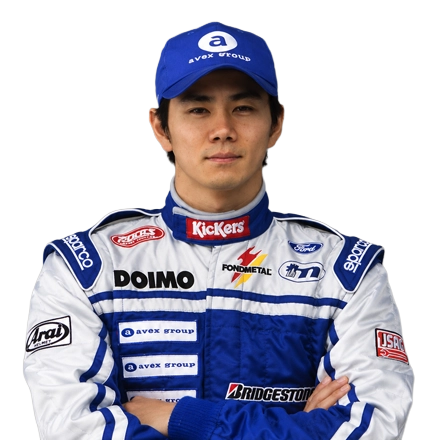
Shinji Nakano (born 1 April 1971) is a Japanese professional racing driver whose career has included Formula One, CART, the Indianapolis 500 and the 24 Hours of Le Mans.
Driver Bio
| Nationality | Japanese |
| Birthplace | Osaka, Japan |
| Born | 1 April 1971 |
| First Grand Prix | 1997 Australian Grand Prix |
| Last Grand Prix | 1998 Japanese Grand Prix |
| Current/Last Team | Minardi |
Motorsport already ran in the family: his father, Tsuneharu Nakano, also raced and competed in the All-Japan Formula Three Championship.
Racing career
Early years
Nakano began competing nationally in karting during the mid-1980s. He placed ninth in the 1986 All Japan Karting Championship before improving to second the following season. In 1987, he also won the International Kart Grand Prix.
A third-place finish in the 1988 national karting championship completed his preparation for single-seaters. Nakano entered Japanese Formula Three in 1989 and finished seventh during his first season.
He travelled to Europe for 1990, placing fifth in Formula Vauxhall Lotus and 17th in Formula Opel Lotus. A second Formula Opel campaign followed in 1991, when he ended the year 12th.
Returning to Japan, Nakano combined Formula Three with occasional Formula 3000 appearances. He was 24th in Japanese F3 in 1992 and went unclassified in that year’s Formula 3000 championship. His results steadily improved: fifth in Formula Three in 1993, then third in 1994, when he also made further Formula 3000 appearances.
Nakano concentrated on Japanese Formula 3000 in 1995 and finished 11th. When the championship became Formula Nippon the following year, he rose to sixth in the standings—enough to earn his opportunity in Formula One.
Formula One
Nakano made his Grand Prix debut in Melbourne at the beginning of the 1997 season, joining Olivier Panis at the newly established Prost team owned by four-time World Champion Alain Prost.
He scored two championship points during his rookie campaign, each coming from a sixth-place finish. His presence at Prost was closely connected to the team’s supply of Mugen-Honda engines, however, and that relationship did not survive a change in powerplants.
When Prost switched to Peugeot engines for 1998, Panis remained and Jarno Trulli was selected for the other seat. Nakano consequently moved to Minardi, partnering Argentine rookie Esteban Tuero.
The small Italian team suffered from limited funding and an underpowered car, leaving Nakano with little chance to reproduce his points-scoring results. He completed the season without adding to his tally and made his final Formula One appearance at his home Grand Prix at Suzuka.
Nakano’s World Championship career ended after 33 Grands Prix and two points. He remained within the Formula One paddock during 1999 as an occasional Jordan test driver, renewing his association with Mugen-Honda engines.
CART and Indianapolis
Nakano moved to North America in 2000 and began a three-year CART career with Walker Racing and Fernandez Racing.
He made 56 starts between 2000 and 2002. His strongest championship position was 17th in his final season, while his best individual result came on the streets of Toronto in 2002, where he finished fourth.
Nakano entered the Indianapolis 500 with Beck Motorsports in 2003. He qualified 15th and completed the race in 14th place.
Endurance racing
Sports cars supplied the next major chapter of his career. Nakano made appearances at the 24 Hours of Le Mans in 2006 and 2008 before returning with OAK Racing in 2011. He contested the French endurance classic again in 2012 as part of the Boutsen Ginion squad.
Helmet design
Nakano’s original helmet featured a predominantly black design. A black circle sat on the crown within a white halo, while red and silver flames wrapped around the visor. A black-and-silver chequered flag completed the pattern towards the rear.
He revised the colours after moving to CART. White replaced the black base, the halo became blue and the circle on top turned red. The chequered flag disappeared, while the flames changed to red with a blue outline.
For his appearances at Le Mans, Nakano expanded the flame pattern into the area previously occupied by the flag.
Broadcasting
Nakano became part of DAZN Japan’s Formula One coverage in 2016, working as a race commentator. In March 2017, he also appeared as a guest on the TV Asahi variety programme Aruaru Gijido.
Grand Prix Stats
| Race Entries | 33 |
| Race Starts | 33 |
| Did Not Start | 0 |
| Best Race Start | 12th |
| Best Race Finish | 6th |
| Retirements | – |
| First-Lap Retirements | 0 |
| Not Classified | 0 |
| Disqualified | 0 |
| Did Not Qualify | 0 |
Qualifying
| Qualifying Sessions | – |
| Reached Q3 | – |
| Q2 Eliminations | 0 |
| Q1 Eliminations | 0 |
| Did Not Qualify | 0 |


