


























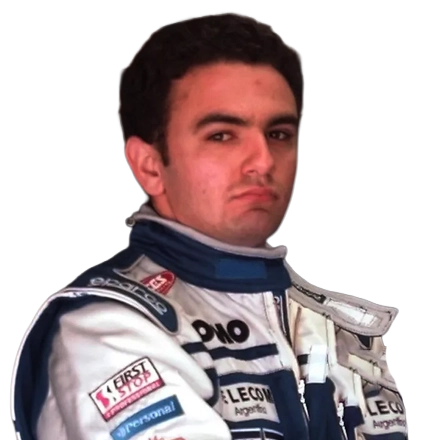
Esteban Eduardo Tuero is an Argentine former racing driver whose rapid rise to Formula One made him one of the sport’s youngest-ever competitors. He raced for Minardi in 1998 and, at just 19 years old, became the third-youngest Formula One driver in history (at the time). Although his F1 career lasted only one season, Tuero remains one of the most fascinating examples of raw talent fast-tracked to motorsport’s highest stage.
Driver Bio
| Nationality | Argentine |
| Birthplace | Buenos Aires, Argentina |
| Born | 22 April 1978 |
| First Grand Prix | 1998 Australian Grand Prix |
| Last Grand Prix | 1998 Japanese Grand Prix |
| Years Active | 1998 |
| Current/Last Team | Minardi |
Born in Argentina during an era when legends such as Nelson Piquet and Alain Prost were beginning to dominate Formula One, Tuero grew up surrounded by a nation deeply passionate about racing. The famous Autódromo Oscar y Juan Gálvez—home of the Argentine Grand Prix—was close to where he was raised, helping fuel his obsession with speed from an early age.
Motorsport was already in the family. His father was a club-level racing driver, and Tuero was introduced to karting at the age of seven. He spent years honing his craft in karts before stepping into single-seaters in his early teens.
Junior career
Tuero moved into car racing in 1993, contesting Formula Renault with the Crespi team. A year later he switched to Formula Honda with Kissling and immediately made headlines by winning the championship.
Still only a teenager, he also sampled South American Formula Three, proving he could adapt quickly to faster machinery and tougher competition. But Argentina was only the beginning.
In 1995, Tuero relocated to Europe—an essential move for any young driver with Formula One ambitions. He dominated the Italian Formula 2000 National Trophy in a Dallara 392 and also gained experience in Italian Formula Three.
By 1996, he joined Coloni Motorsport in Italian F3, driving a Dallara-Alfa Romeo package. His pace attracted attention from several Formula One teams, including Benetton, but it was Minardi who moved first, signing him as a test driver while he was still only 18.
Fast track to Formula One
Tuero’s 1996 Formula Three season was eventful from the start. He finished fourth on debut, then crossed the line first in his second race—only to be disqualified for illegal fuel.
At the prestigious non-championship Monaco F3 race, he started on the front row beside future F1 driver Jarno Trulli. The two battled fiercely until Tuero made contact with Trulli at the hairpin. Tuero later retired with electrical trouble.
Rather than complete the F3 season, he jumped to International Formula 3000 mid-year. Results were modest, but his speed remained obvious. In 1997, instead of stepping backwards, he headed to Japan for Formula Nippon. He scored only one point, yet importantly completed enough mileage to qualify for an FIA Super Licence.
That, combined with strong performances testing for Minardi, earned him a race seat for 1998 alongside Shinji Nakano.
Formula One career
Tuero’s promotion was controversial. Many believed he had reached Formula One too early, and some pundits questioned whether he had enough experience to compete safely.
Eventually granted a Super Licence by the FIA, Tuero lined up in Australia as one of the youngest Formula One drivers ever.
He responded immediately.
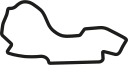
In Melbourne, he qualified an impressive 17th—ahead of teammate Nakano and even ahead of established names such as Olivier Panis. It was a statement performance.
Race day, however, was more chaotic. He jumped the start, received a time penalty, later sped in the pit lane, and then retired with engine failure.
That pattern defined much of his rookie season: flashes of genuine speed mixed with inexperience and unreliable machinery.
Gearbox issues in Brazil and a spin into the gravel at his home Argentine Grand Prix left him pointless after three rounds.
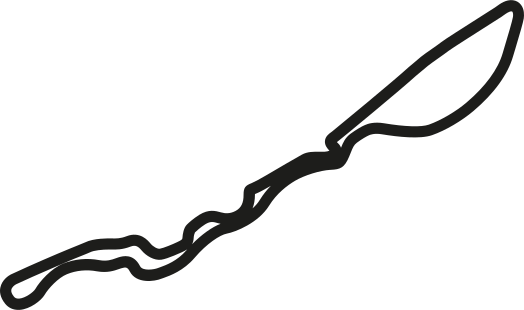
At the San Marino Grand Prix, Tuero delivered a mature drive to finish 8th in a race of attrition—his best result of the season. Further finishes followed in Spain, Germany, and Italy, but retirements were frequent.
He failed to finish in Monaco, Canada, France, Britain, Austria, Hungary, Belgium, and Luxembourg, often through spins or mechanical problems.
Final Formula One race
Tuero’s last Grand Prix came at Suzuka in Japan.
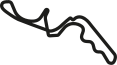
Starting 21st, he collided with Toranosuke Takagi after mistakenly hitting the throttle instead of the brake. His Minardi launched over Takagi’s Tyrrell in a dramatic accident. On landing, Tuero suffered damage to several vertebrae in his neck.
The crash had wider championship consequences. Debris scattered across the track moments before Michael Schumacher suffered a rear tyre failure that ended his title hopes, handing Mika Häkkinen his first World Championship.
For Tuero, it was the end of his only Formula One season. He scored no points and was unclassified in the championship standings.
Sudden exit
Minardi initially planned to retain Tuero for 1999 alongside Marc Gené. He was due to test the new M01 car in January.
Instead, on the eve of testing, Tuero stunned the team by announcing his retirement from Formula One and returning to Argentina.
At just 20 years old, his Grand Prix career was already over.
After Formula One
Back home, Tuero switched to touring cars, joining the popular Argentine TC2000 championship.
Results were mixed at first, but he soon became a race winner, taking two victories in a Volkswagen Polo entered by the factory-backed Volkswagen squad.
He remained a regular in Argentine touring cars for many years, racing for multiple teams and continuing to show strong pace. In 2008, he also competed part-time in the FIA GT Championship in a Ferrari 550-GTS Maranello.
After a long domestic career, Tuero officially retired from racing following the 2016 TC2000 season.
Grand Prix Stats
| Race Entries | 16 |
| Race Starts | 16 |
| Did Not Start | 0 |
| Best Race Start | 17th |
| Best Race Finish | 8th |
| Retirements | 12 |
| First-Lap Retirements | 1 |
| Not Classified | 0 |
| Disqualified | 0 |
| Did Not Qualify | 0 |
Qualifying
| Qualifying Sessions | 16 |
| Reached Q3 | 0 |
| Q2 Eliminations | 0 |
| Q1 Eliminations | 0 |
| Did Not Qualify | 0 |
Stats by Season
| Year | Constructor | Entries | Starts | Wins | Podiums | Poles | Fastest Laps | Front Rows | DNF | Best Start | Best Result | Pts Finishes | Points | Championship |
|---|---|---|---|---|---|---|---|---|---|---|---|---|---|---|
| 1998 | Minardi | 16 | 16 | 0 | 0 | 0 | 0 | 0 | 12 | 17 | 8 | 0 | 0 | NC |
Stats by Constructor
| Constructor | Years | Entries | Starts | Wins | Podiums | Poles | Fastest Laps | Front Rows | DNF | Best Start | Best Result | Pts Finishes | Points |
|---|---|---|---|---|---|---|---|---|---|---|---|---|---|
| Minardi | 1998 | 16 | 16 | 0 | 0 | 0 | 0 | 0 | 12 | 17 | 8 | 0 | 0 |
Teammates & Qualifying Head-to-Head
| Teammate | Years | Races | Qualifying H2H |
|---|---|---|---|
| Shinji Nakano | 1998 | 16 | 5-11 |